




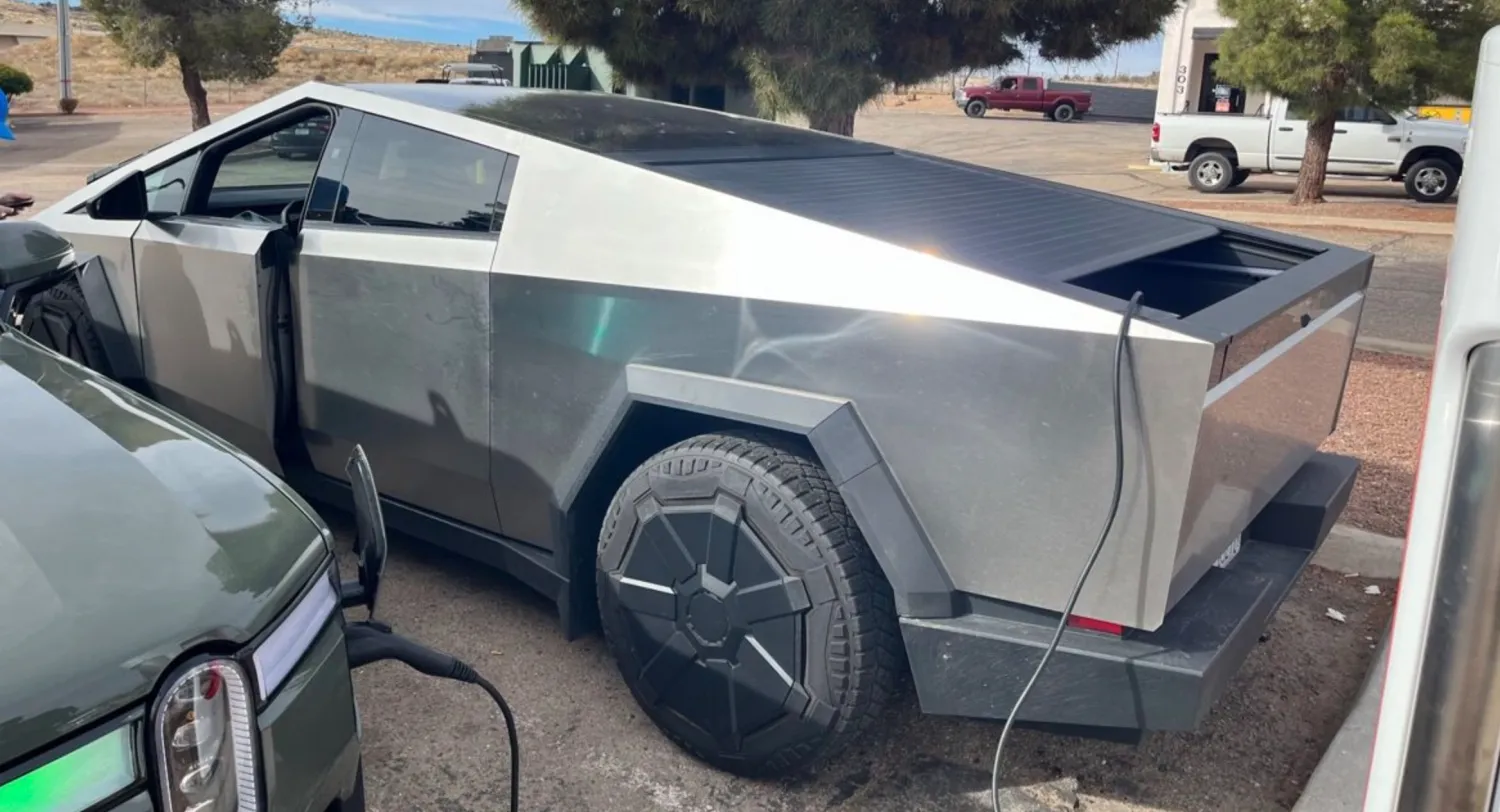
In an unexpected turn of events, a Tesla Cybertruck recently played the role of a charging savior for a Rivian R1T electric pickup. The incident, captured by Kitty Adams Hoksbergen, executive director at Adopt A Charger, Inc., sheds light on the collaborative nature emerging within the electric vehicle (EV) community.
The Rivian R1T owner seemingly encountered a setback when attempting to charge at a CCS charging station, only to find it non-operational. Undeterred, the owner and their stranded R1T found assistance from a nearby Tesla Cybertruck equipped with a 240-volt outlet in the bed. This feature allows the Cybertruck not only to power various tools but also to serve as a charging source for other vehicles utilizing a level 2 mobile charger.
While a level 2 charger may not match the rapidity of a level 3 fast charger, it proved instrumental in providing sufficient charge for the Rivian R1T to reach the next operational fast-charging station. The incident highlights the real challenges faced by EV owners when encountering inoperable DC fast-chargers, a predicament prompting some automakers to adopt the NACS connector standard to gain access to Tesla’s reliable Supercharger network in North America.
Importantly, this occurrence does not reflect a flaw in the Rivian R1T itself but rather underscores challenges associated with charging infrastructure using CCS connectors. Notably, the reverse scenario would not have been possible, as the R1T lacks a 240-volt outlet in the back, featuring only a 110-volt option. This situation has prompted Rivian buyers to express a desire for updates that would enable increased power accessibility in the bed of their electric trucks.


