



European Union tariffs on electric vehicles imported from China have reduced the share of China-built battery-electric vehicles (BEVs) in the bloc’s market, but Chinese automakers continue to expand their presence, according to a new analysis by Transport & Environment (T&E).
The organization said battery-electric vehicles manufactured in China accounted for 17% of the EU market in the first quarter of 2026, down from a peak of 22% in 2024 when the tariffs were introduced.
However, T&E said the decline was driven largely by Western automakers relocating production from China rather than a broad reduction in Chinese vehicle exports.
Western Brands Reduce China Production
According to the report, manufacturers including Tesla, BMW and Volvo have shifted more electric vehicle production from China to Europe, reducing the number of China-built vehicles exported to the EU.
T&E said European manufacturers’ share of battery-electric vehicle imports from China fell from 38% in 2024 to 23% in the first quarter of 2026.
Tesla’s share of those imports also declined over the same period, while Chinese automakers now account for more than half of battery-electric vehicles imported from China into the European market.
Chinese Automakers Respond to Tariffs
The report said the impact of tariffs has varied depending on the duty rates applied to individual manufacturers.
According to T&E, imports of battery-electric vehicles from SAIC, which faces one of the highest additional tariff rates, almost halved between 2023 and 2025.
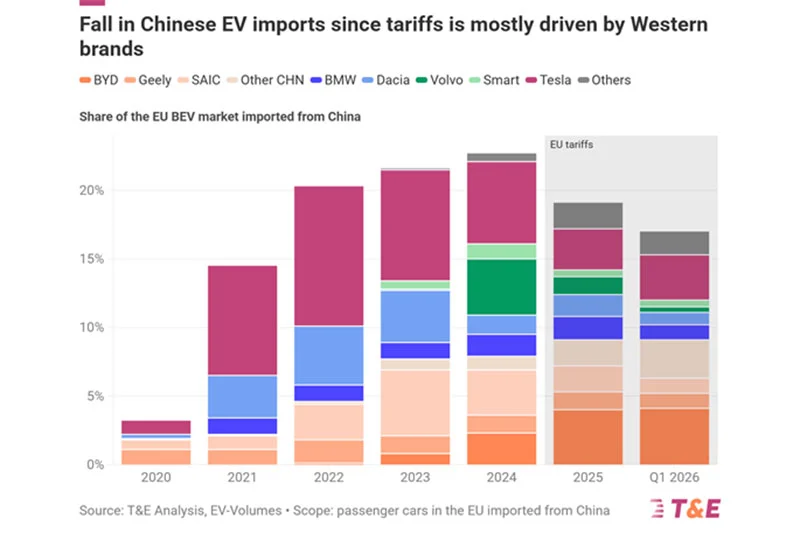

By contrast, imports from BYD more than doubled over the same period under a lower tariff rate.
T&E also found that battery-electric vehicles from Chinese brands remain, on average, 21% less expensive than comparable European models despite the additional import duties.
The organization added that Chinese automakers have announced 10 planned production facilities in Europe since the European Commission launched its anti-subsidy investigation in September 2023.
Plug-In Hybrid and Battery Imports Increase
The report also noted that Chinese manufacturers have expanded exports of plug-in hybrid vehicles to Europe, a segment not covered by the same tariff measures.
According to T&E, Chinese brands increased their share of the EU plug-in hybrid market to 13% from 3% in 2024.
Meanwhile, imports of batteries from China have continued to grow. T&E said battery imports increased sevenfold between 2020 and 2025, while fewer than one-quarter of batteries produced within the European Union are supplied by European manufacturers.
T&E Calls for Stronger Battery Industry Support
Lucien Mathieu, Cars Director at T&E, said the tariff measures had encouraged some production to move closer to the European market but additional action would be needed to strengthen the region’s battery industry.
“The EU tariffs worked up to a point. Western carmakers moved production to Europe and Chinese manufacturers started to onshore. But European companies’ competitiveness in EV and battery technology is still at stake.”
T&E recommends higher tariffs on battery imports from China alongside policies to encourage domestic battery manufacturing.
The organization also urged EU member states to support measures including the Industrial Accelerator Act and the proposed Clean Corporate Vehicles Regulation, arguing that they would help strengthen demand for electric vehicles and batteries produced within Europe.


