
Electrifying large corporate vehicle fleets and restricting financial support to eligible low- and zero-emission vehicles manufactured in Europe could generate up to 344,000 additional jobs and €18 billion in extra investment by 2030, according to a new study from Transport & Environment (T&E).
The analysis examines the potential economic effects of the EU’s proposed Clean Corporate Vehicles Regulation, which would establish targets for electric vehicle adoption among large corporate fleets. T&E argues that combining fleet electrification targets with conditions on national financial support could increase demand for European-made electric vehicles and encourage investment across the automotive supply chain.
Under the regulation, 45% of new-car sales in large corporate fleets would be electric by 2030, establishing a minimum level of electrification.
Stronger Targets Could Increase Economic Gains
T&E’s analysis compares different scenarios for the pace of corporate fleet electrification. In its stronger scenario, combustion-engine vehicles would be phased out of company fleets more quickly, allowing electric cars to account for 69% of new-car sales in large corporate fleets by 2030.
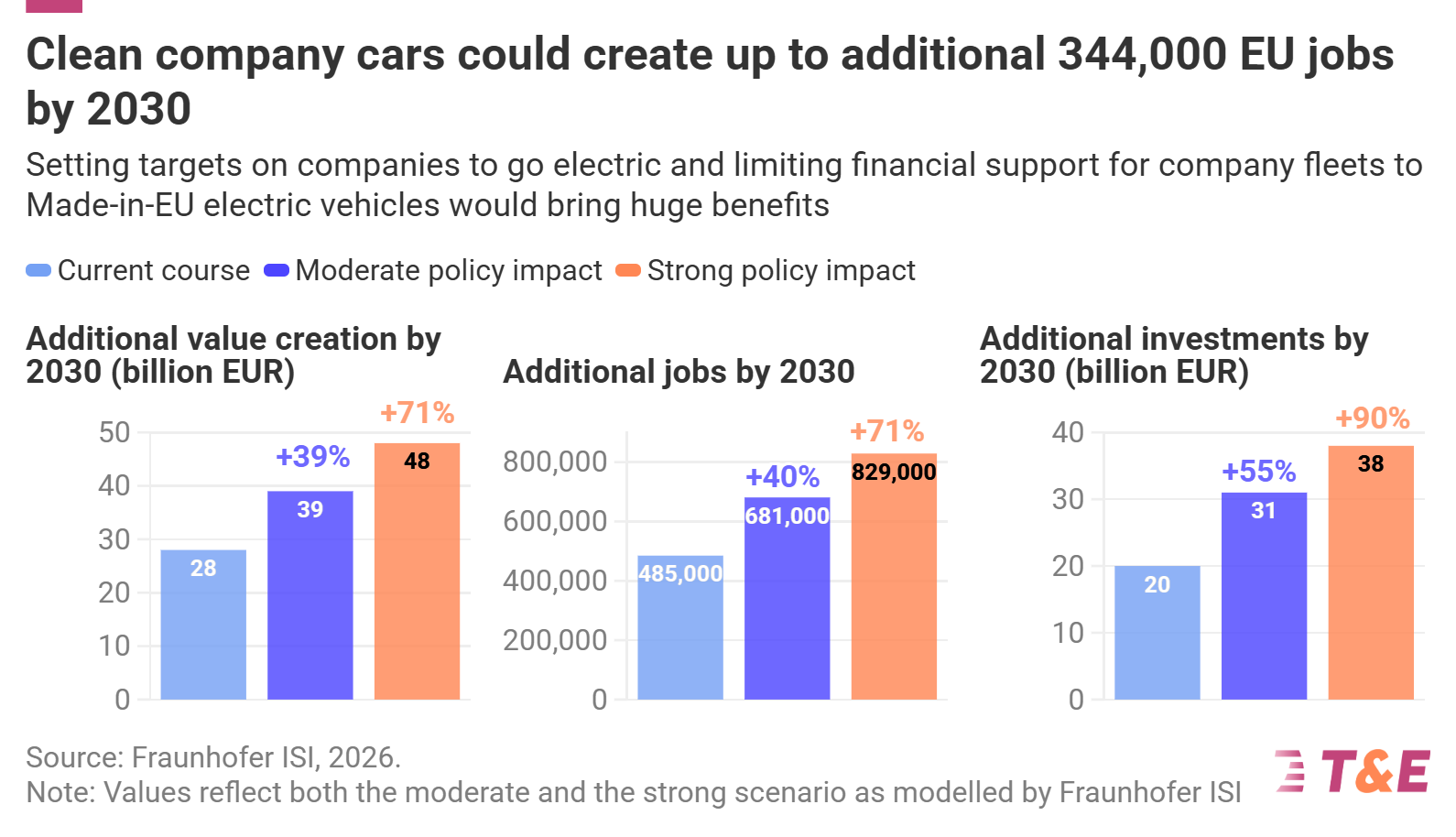
Under this scenario, the study estimates that additional employment could reach 344,000 jobs. Total economic gains could increase from €28 billion to €48 billion, while investment could rise from €20 billion to €38 billion.
Even a more moderate scenario is projected to create 196,000 additional jobs, according to T&E.
The organisation also highlights the proposed restriction of financial support for company cars from January 2028. Under Article 4 of the regulation, limiting national fiscal benefits to eligible low- and zero-emission vehicles made in Europe would, according to the study, produce the largest economic gains.
Sofie Grande y Rodriguez, clean fleets policy manager at T&E, said company cars could help connect electric vehicle adoption with industrial employment.
“Company cars are the quickest way to turn Europe’s EV transition into European jobs. Lawmakers have the opportunity to make the company cars regulation a key driver of Europe’s automotive competitiveness. Watering down its ‘Made-in-EU’ requirements would remove the incentive for carmakers to localise production . Equally important for securing at-risk jobs is keeping 2028 as the entry-into-force date.”
Germany and Poland Could See Major Benefits
Germany and Poland are identified as the countries with the greatest potential employment gains under the stronger scenario.
The study estimates that Germany could gain 134,000 additional jobs, equivalent to 39% of the projected EU-wide total. Poland could add approximately 38,500 jobs, with 82% of those positions linked to the battery sector.
T&E also points to potential growth in Polish battery manufacturing. Under its analysis, battery-cell production capacity could increase from 31 GWh to 81 GWh by 2030 if demand and investment develop in line with the scenario.
The findings suggest that corporate fleet policy could influence not only vehicle assembly but also investment in battery production and other parts of Europe’s electric vehicle supply chain.
Volkswagen Illustrates the Employment Potential
T&E argues that stronger demand for European-made electric vehicles could support manufacturers as they restructure their operations.
The organisation cites Volkswagen as an example. While the automaker plans to cut 35,000 jobs by 2030, T&E estimates that the regulation could generate up to 56,300 additional direct jobs at the group over the same period.
These figures represent the study’s projected employment effects rather than confirmed job creation. The outcome would depend on the final regulation, manufacturers’ production decisions and the extent to which additional vehicle demand translates into investment in European facilities.
T&E Calls for Guaranteed Demand for European EVs
T&E argues that fleet electrification could provide a more predictable market for European-made electric vehicles, helping manufacturers justify investment in production capacity and battery facilities.
Sofie Grande y Rodriguez said:
“Electrifying the fleets of large companies is key to securing Europe’s EV value chain and reducing our dependence on dominant global suppliers. Europe already assembles most of its electric company cars. What it needs now is guaranteed demand, so the battery plants announced here actually get built. To stop losing ground to China on EVs, Europe must bet on Made-in-EU electric company cars”
The organisation warns that weakening the proposed European-content requirements could reduce the incentive for automakers to localise production. The regulation’s final design will therefore be important in determining how much additional demand benefits European manufacturing rather than overseas suppliers.
The projected employment and investment gains remain dependent on policy choices and market responses. However, T&E’s analysis presents corporate fleets as a potential mechanism for linking the EU’s electrification objectives with industrial investment and employment growth.