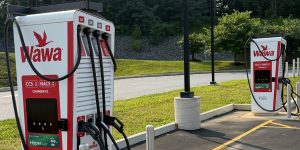





Spain has announced more than 100 million euros ($109 million) in new funding for electromobility projects, with most of the investment directed toward expanding electric vehicle charging infrastructure along key transport corridors.
The funding forms part of the country’s broader “España Auto 2030” strategy to accelerate electric mobility and domestic EV production.
See also: Stellantis in Talks With Leapmotor to Develop Opel Electric SUV in Spain
According to the Spanish government, around 105 million euros from the national Recovery, Transformation and Resilience Plan will support electromobility projects.
Of that amount, approximately 97 million euros will be allocated through the “Moves Corredores” programme to finance 337 charging infrastructure projects expected to deliver about 2,880 charging points across major traffic corridors.
An additional 8 million euros will support the “Moves Flotas Plus” programme, aimed at helping 20 companies purchase around 3,700 electric vehicles and deploy nearly 300 charging stations.
See also: Spain’s Public EV Charging Network Reaches 50,000 Points as Fast Chargers Multiply
The Recovery, Transformation and Resilience Plan is funded through the European Union’s post-pandemic recovery programme and administered in Spain by the Institute for Diversification and Energy Saving under the Ministry for Ecological Transition and Demographic Challenge.
The government said remaining funding from the latest allocation round will also support projects including offshore energy systems at six ports and the development of seven pumped-storage hydroelectric plants.
Spain is currently restructuring its national EV support programmes under the España Auto 2030 framework, which will be built around three main pillars: consumer incentives for EV purchases, industrial subsidies for battery and vehicle manufacturing, and charging infrastructure development.
See also: France and Spain Reaffirm Support for EU’s 2035 Zero-Emission Car Target
The government plans to introduce a new consumer subsidy programme called “Plan Auto+,” which will allocate 400 million euros in direct support for electric vehicle purchases through 2026.
Plan Auto+ is expected to replace the existing Moves III programme, with administration shifting from Spain’s regional governments to the central government beginning in 2026.
However, final eligibility rules and the list of qualifying vehicles for Plan Auto+ have not yet been published.
Spanish media reports have suggested the delay is linked to discussions about incorporating carbon footprint calculations into the subsidy system, similar to policies adopted in France.
See also: France and Spain Reaffirm Support for EU’s 2035 Zero-Emission Car Target
Questions also remain over the full budget for the Moves Corredores programme. Spain had previously announced a 300 million euro funding plan for the charging initiative in December, but the latest allocation amounts to only 97 million euros.
The government has not clarified whether additional financing will be provided later.
Spain is also expected to direct another 580 million euros in 2026 toward the PERTE industrial support programme for electric vehicle and battery production projects, although no new details have yet been released.
“This government’s commitment to the energy transition has always been unwavering,” Sara Aagesen, Spain’s vice-president and minister for ecological transition and demographic challenge, said in a statement.
See also: Ionity Seeks Over €6 Million in State Aid for 20+ New Ultra-Rapid EV Charging Stations in Spain
“A commitment that positions Spain as an engine for growth, employment, and prosperity,” Aagesen added. “Spain has not only seized this great opportunity in time but also finds itself in a privileged position, which we will continue to leverage.”