
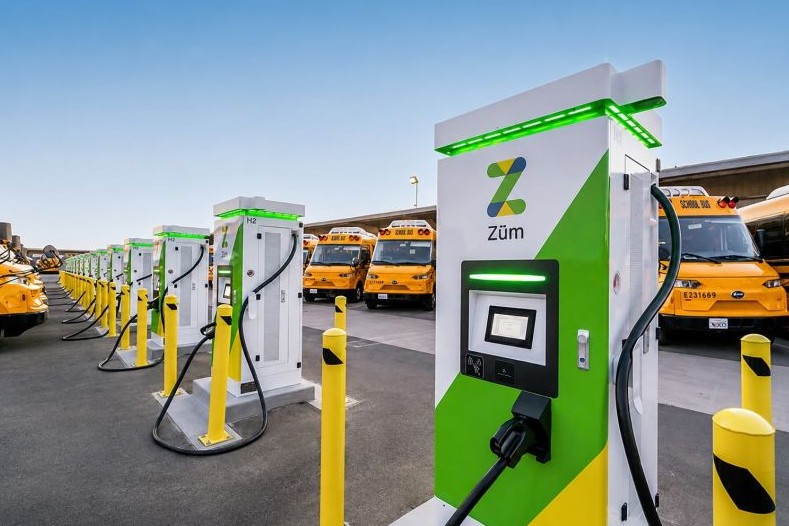
Zum and the San Francisco Unified School District (SFUSD) have announced the deployment of what they describe as the largest electric school bus fleet in the United States, combining battery-electric transportation with vehicle-to-grid (V2G) technology.
The initiative will ultimately include 238 electric school buses equipped with bidirectional charging capability, allowing the vehicles not only to transport students but also to supply electricity back to the grid during periods of peak demand.
The first phase of the rollout is scheduled to begin in August 2026, when 104 electric school buses enter service across the district.
Zum and SFUSD plan to expand the fleet to its full complement of 238 vehicles by the 2027-2028 academic year.
The project integrates the buses into Zum’s Connected Mobility Experience (CMX) platform, which combines fleet operations, charging management, route planning, dispatch functions and real-time communication tools for schools and families within a single system.
According to Zum, the fleet’s bidirectional charging capability will enable school buses to serve as distributed energy resources when they are not transporting students.
The company estimates the fleet will be capable of supplying approximately 3 gigawatt-hours of electricity annually to California’s electricity grid during peak demand periods.
Zum said this volume of energy would be sufficient to power roughly 1.2 million homes for three to four hours.
The company added that the vehicle-to-grid functionality will help strengthen grid reliability and resilience while supporting broader renewable energy integration efforts.
The project has received support through grants and incentive programs involving the U.S. Environmental Protection Agency Region 9, California Energy Commission, Bay Area Air Quality Management District and Pacific Gas and Electric Company.
Ritu Narayan, Chief Executive Officer of Zum, said the deployment represents a significant milestone in the company’s broader electrification strategy.
“Today marks a major achievement in Zum’s national electrification efforts as well as an exciting evolution of our successful partnership with San Francisco Unified School District,” said Ritu Narayan, Chief Executive Officer of Zum.
“This state-of-the-art electric fleet, combined with Zum’s CMX technology, will improve the mobility experience for students, families, and drivers while strengthening grid reliability and resiliency for the entire community,” Narayan added.
SFUSD Superintendent Dr. Maria Su said the investment aligns with the district’s transportation modernization and sustainability objectives.
“This investment reflects our commitment to improving the daily experience for students and families by providing safer, quieter, cleaner, and more reliable transportation to and from school, while also advancing the district’s long-term operational and sustainability goals,” said Dr. Maria Su, Superintendent of San Francisco Unified School District.
California State Senator Scott Wiener highlighted the project’s environmental and energy system benefits.
“This milestone represents a historic moment for San Francisco Unified and the city’s broader sustainability goals,” said Scott Wiener, California State Senator.
“These electric school buses will deliver cleaner air and a quieter ride for students. During peak demand hours, the buses will return energy to the local grid, improving affordability and resiliency for the city,” Wiener added.
The deployment builds on Zum’s previous electrification initiatives. The company launched an all-electric school bus fleet in Oakland in 2024 and recently announced a fully electric school transportation project for Branford Public Schools in Connecticut.
According to Zum, its mobility platform currently supports more than 4,500 schools across 17 U.S. states.
The San Francisco project reflects a growing trend among school districts and transportation providers to use electric school buses not only as zero-emission vehicles but also as energy storage assets capable of supporting grid operations.
As vehicle-to-grid technology continues to develop, school bus fleets are increasingly being viewed as a potential resource for utilities seeking additional flexibility during periods of high electricity demand.