



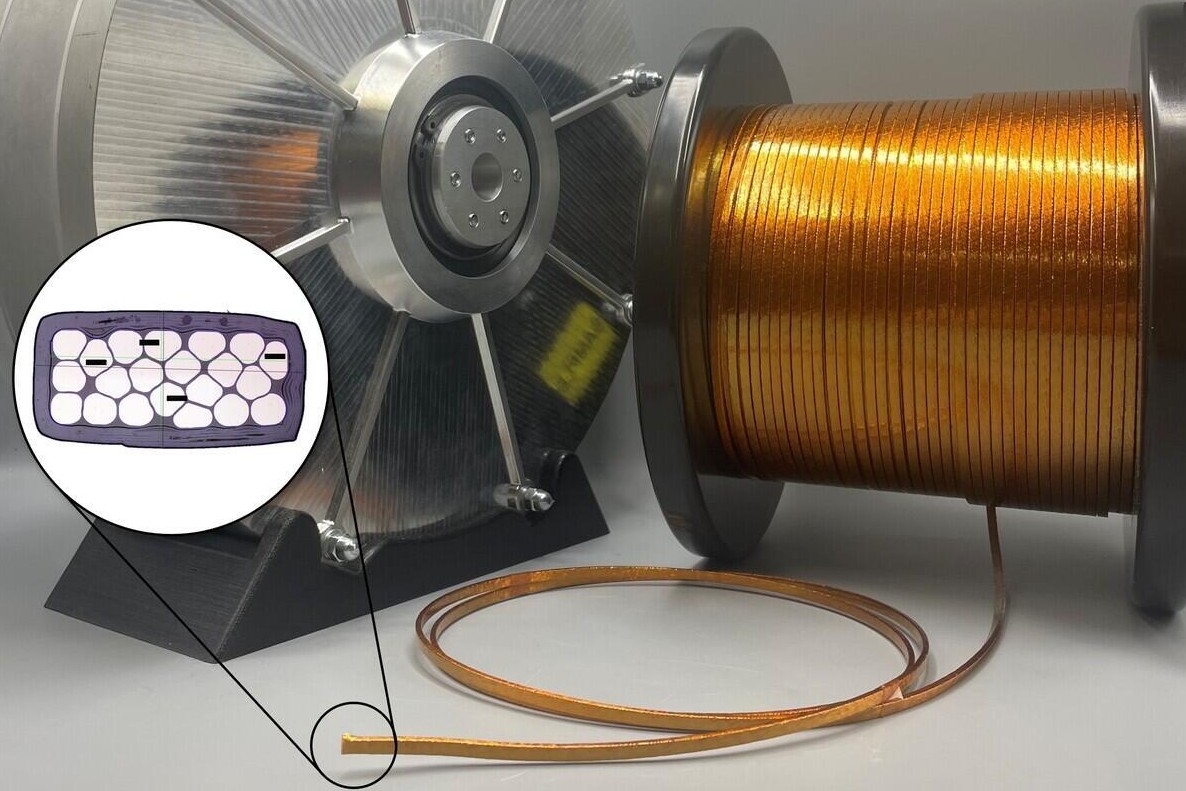
RWTH Aachen University’s Chair of Production Engineering of E-Mobility Components (PEM), in collaboration with industry partner Röscher, has launched a new research project aimed at improving the manufacturing process of axial flux motors, a compact and efficient electric motor technology that has so far been costly to produce.
The project, named REFORMAT and funded by Germany’s Federal Ministry for Economic Affairs and Energy for a period of two and a half years, will focus on developing a new winding process for producing motor coils directly on stator cores using profiled litz wires.
See also: RWTH Aachen Launches DigHy Project to Develop Hydrogen Infrastructure for Mining
“Its compact design, modular construction, and high efficiency make the axial flux motor an attractive alternative to the established radial flux motor topology,” said Prof. Achim Kampker, Director of PEM at RWTH Aachen University. “However, especially in applications with higher corner and maximum rotor speeds, the motor’s efficiency is still low due to eddy current losses.”
Axial flux motors differ from conventional radial flux designs in that their magnetic field runs parallel to the axis of rotation, enabling higher power density and a more compact, disc-like structure. This makes them particularly attractive for applications where space and weight are critical.
See also: RWTH Aachen Researchers Develop Real-Time Method to Monitor Battery Electrode Slurries
Despite these advantages, their adoption has been limited due to manufacturing complexity and cost. “Due to its currently very limited application, the axial flux motor’s product maturity and degree of industrialization is still low, and the process is therefore quite expensive,” said David Drexler, project manager at PEM.
“There is a need to fundamentally investigate the production process of the axial flux motor, increase its technological maturity, and reduce the associated costs,” he added.
As part of the project, PEM and Röscher plan to develop, build, and validate a process station capable of handling different coil geometries and insulation systems. The system will also be designed for integration into existing production lines by considering interfaces with upstream and downstream manufacturing steps.
See also: RWTH Aachen-Led Project Tests Delamination Methods for Direct Battery Recycling
Axial flux motors have so far been used mainly in high-performance applications, including sports cars such as the Ferrari SF90 Stradale and Lamborghini Revuelto, where they function as auxiliary drives. The motors in these vehicles are supplied by UK-based Yasa, which was acquired by Mercedes-Benz in 2021.
The research initiative aims to expand the applicability of axial flux motors beyond niche segments by improving production efficiency and reducing costs, potentially enabling broader use in electric vehicles and other industries.


