





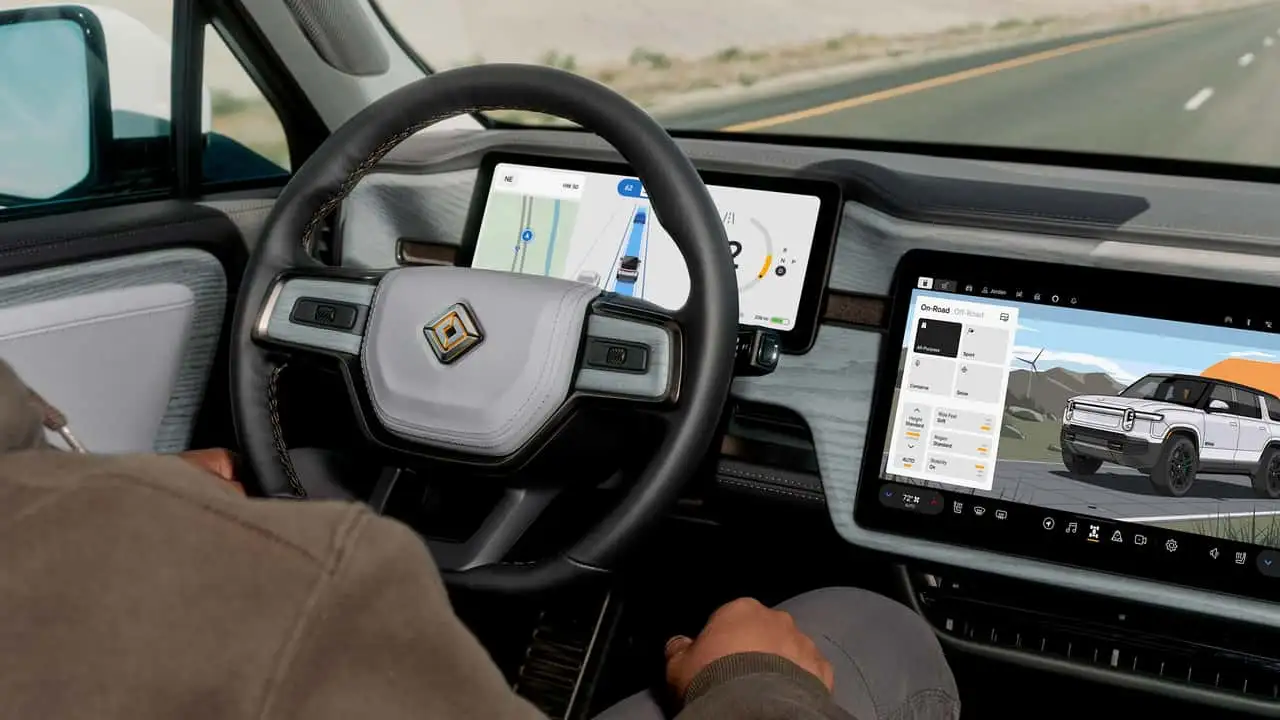
Rivian on Thursday detailed a broad strategy to advance assisted and autonomous driving across its vehicle lineup, unveiling new custom hardware, AI models, and a multi-year software plan during its inaugural Autonomy & AI Day.
The company said the upgrades are designed to support hands-free driving capabilities on most marked roads in North America and eventually enable higher levels of automated operation.
See also: Rivian CEO Says Fully Driverless Consumer Cars Could Arrive Before 2030
At the core of the roadmap is Rivian’s first in-house autonomy processor — developed with Arm and TSMC — which is slated to replace Nvidia hardware beginning in late 2026. The chip uses multi-chip module packaging, provides 205 GB/s of memory bandwidth, and includes a neural engine capable of 800 trillion operations per second.
Rivian founder and CEO RJ Scaringe said the performance gains are critical to supporting the company’s next-generation features. “This level of compute is essential for the camera-centric AI models that will power our future autonomy capabilities,” he said.
See also: Rivian to Add Digital Key Support to Gen 2 Vehicles in Upcoming Software Update
Rivian also introduced Universal Hands-Free, an assisted driving system that extends its current highway-limited hands-free function to nearly any road in the United States and Canada with clearly painted lane lines — an estimated 3.5 million miles of roadway.
The feature will be offered through the company’s new Autonomy+ subscription, launching early next year at US$2,500 upfront or US$49.99 per month. A later software update will activate the system for eligible vehicles, Rivian said, while noting that the capability will provide lane keeping and distance control but not full navigation or traffic-signal recognition.
See also: Rivian R1T Quad-Motor Matches Supercar Acceleration in Independent Performance Test
During the event, Rivian reiterated that its long-term autonomy strategy incorporates lidar and radar sensors, in contrast to Tesla’s camera-only approach. The company said its sensor suite and compute platform are being developed to support eventual Level 4 autonomous operation. Scaringe added that these capabilities could position Rivian to explore robotaxi services in the future.
Beyond driving features, Rivian confirmed that its in-house conversational AI assistant — developed over the past two years — is scheduled to debut in early 2026. The assistant will be available on both first- and second-generation R1 models, enabling voice-controlled access to climate settings, navigation tools, vehicle functions, and select third-party applications.
See also: Rivian Addresses Range Estimation Issue in Dual Standard LFP Vehicles

Google Calendar will be the first integrated service, allowing users to manage events or direct the vehicle to upcoming appointments. Rivian said the assistant relies on its Rivian Unified Intelligence (RUI) platform, which orchestrates multiple AI models for voice interaction, diagnostics, and, eventually, autonomous driving behaviors.


