


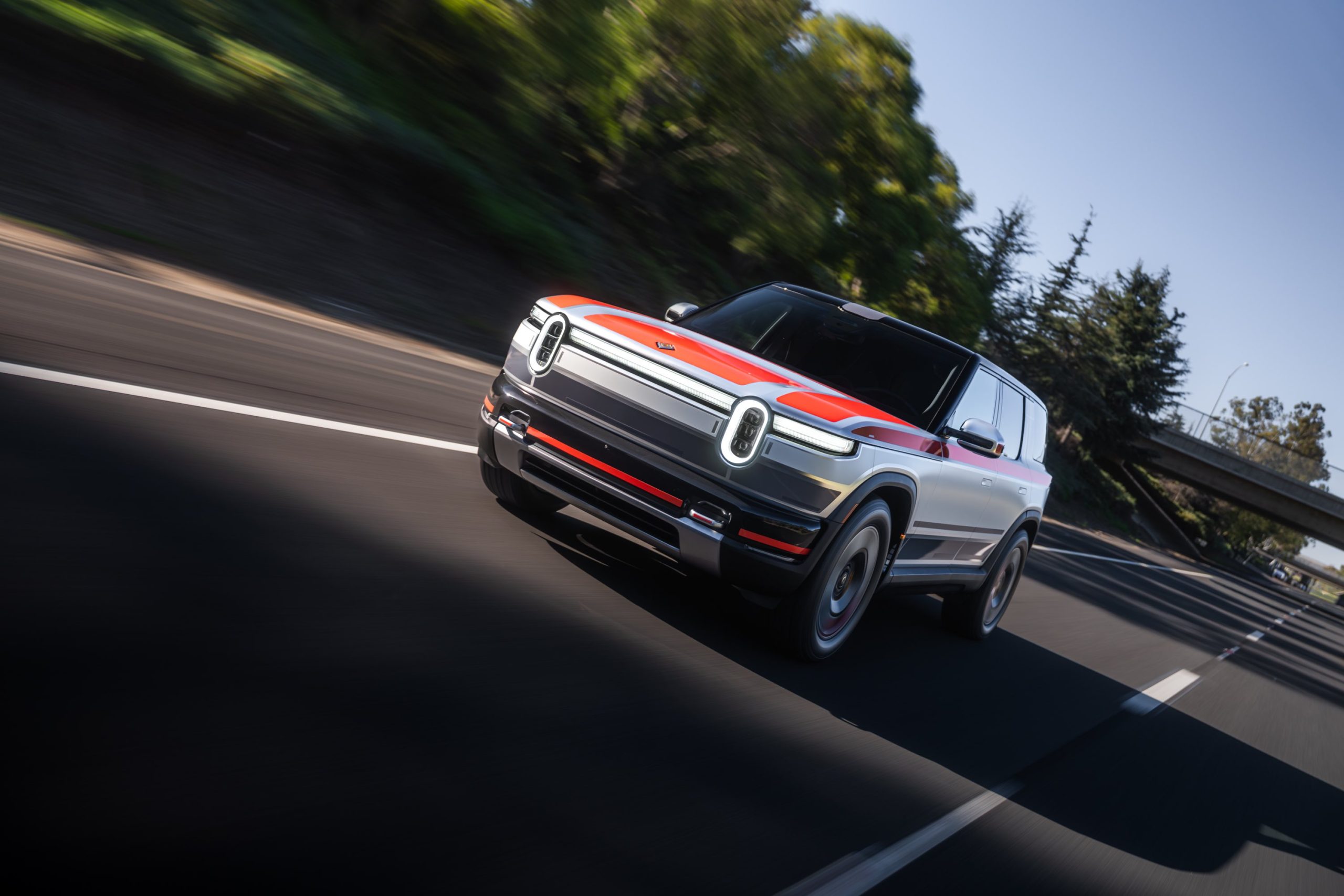
Rivian is planning an accelerated market rollout for its upcoming R2 electric SUV in the United States, positioning the model as a key step toward expanding into the mass-market EV segment.
The company told investors it expects to sell between 20,000 and 25,000 units of the R2 this year, with the first vehicles scheduled to reach customers around June after production begins.
See also: Rivian Plans R2 Production Capacity of Up to 155,000 Vehicles Annually
If Rivian meets even the lower end of that target, the R2 would rank among the fastest-selling electric vehicles in its price category, according to an analysis by TechCrunch. Only the Tesla Model Y has reached similar sales levels faster among EVs priced at or below $60,000.
Rivian founder and chief executive RJ Scaringe described the new model as central to the company’s strategy. The R2 is “maybe the most important thing we’ve launched to date,” he said.

The Model Y, which launched in March 2020, took roughly four months to exceed 20,000 units sold in the United States. Rivian aims to reach the same milestone in about six months, roughly matching the pace of the Honda Prologue when it debuted in 2024.
See also: Rivian Plans Major Service Network Expansion Ahead of R2 Launch
Other electric vehicles have taken longer to reach that level of sales. The Chevrolet Equinox EV required around eight months after its launch in 2024, while Ford Motor’s Mustang Mach-E reached the milestone in a similar timeframe after debuting in 2021. Hyundai’s Ioniq 5 and Kia’s EV6 took approximately 10 and 11 months, respectively.
The R2 will enter a market that has changed significantly compared with earlier EV launches. The U.S. federal tax credit of up to $7,500 for electric vehicles was eliminated in September last year, while some automakers have scaled back EV plans amid evolving emissions regulations and rising costs tied to tariffs.
See also: Rivian’s R2 SUV Enters Final Validation Testing Ahead of Planned Deliveries
Scaringe has suggested that the shifting market environment could benefit Rivian by leaving fewer options in the lower-priced EV segment. The company has said the R2 will start at around $45,000, a price point aimed at broadening Rivian’s appeal beyond its higher-end models.
However, the company has not confirmed when a base $45,000 version will become available. Rivian is expected to launch the R2 initially with a higher-trim dual-motor variant that will likely carry a higher price.
Further pricing details and specifications are expected to be revealed at a company event scheduled for March 12.
Despite current headwinds in the U.S. EV market, some analysts see strong demand for electric SUVs in the segment Rivian is targeting. Competing models such as Volvo’s EX60, BMW’s iX3 and the Mercedes-Benz GLC EV are not expected to arrive in the United States until later this year, potentially giving the R2 an early market opportunity.
See also: Rivian Extends Free Autonomy+ Trial for Third Time Ahead of Paid Launch
“[Scaringe is] right that, that kind of compact-ish, mid-size-ish segment is really kind of missing” in the EV market, said Joseph Yoon, a consumer insights analyst at Edmunds.
Still, some analysts remain cautious about Rivian’s production and pricing expectations. D.A. Davidson analyst Michael Shlisky recently lowered his price target for Rivian, citing what he described as the company’s “aggressive” expectations for the R2 launch.
Barclays analyst Dan Levy also suggested the average transaction price of the R2 could remain closer to $60,000 in the near term while production takes place at Rivian’s Illinois factory, until its planned Georgia facility becomes operational.


