

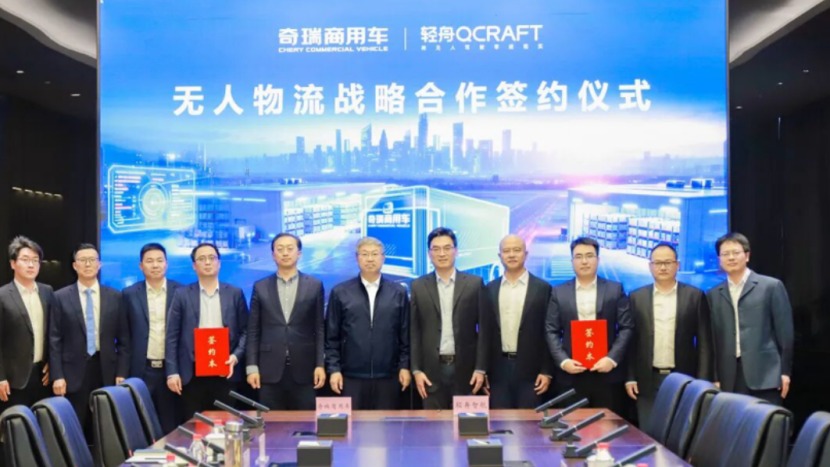
QCraft has entered a strategic partnership with Chery Commercial Vehicles to jointly develop mass-production Level-4 autonomous logistics vehicles, the companies said on Friday. The collaboration aims to combine QCraft’s software and self-driving capabilities with Chery’s large-scale manufacturing and international market reach to accelerate deployment of driverless delivery fleets in urban logistics networks.
Under the agreement, the partners will build an automotive-grade commercial autonomous-driving platform positioned to enhance brand development, product performance and service expansion. Their first jointly developed model is already undergoing pilot operations in several Chinese cities, including Suzhou, Jinhua and Wuhu, with nationwide and overseas rollouts planned.
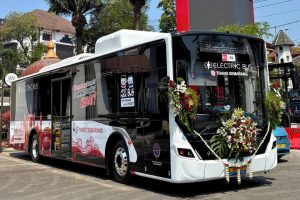
For QCraft, the partnership builds on its years of L4 development and its experience mass-producing L2++ systems. The company says its “QPilot” mid- to high-level driver-assistance suite has now been factory-installed on more than 600,000 vehicles. QCraft has also introduced an end-to-end urban NOA system based on a single Journey 6M chip with expanded safety functions. In L4 autonomy, its Robobus platform has been deployed in 26 major cities worldwide and has delivered more than 650,000 passenger trips.
Chery has been increasing the rollout of intelligent-driving features across its passenger-car portfolio. At the Chery Global Innovation Conference in October, the company’s executive vice president and CTO Xinhua Gao said Chery plans to launch 20 new models next year equipped with automated and remote parking, and will introduce valet-parking functions first in Saudi Arabia and Thailand. Gao said Chery is developing its first-generation Robocar built on an end-to-end architecture that can support both L2 and L4 systems in a unified stack.
At the same event, QCraft co-founder and CEO Qian Yu said the companies had already developed deep cooperation across multiple layers of vehicle intelligence, spanning mass-production L2+ programmes to joint development and commercialisation of L4 autonomous products. Their work now covers passenger vehicles, autonomous buses and driverless logistics fleets, and includes the jointly developed Chery iBar system, which made its public debut at the conference.