
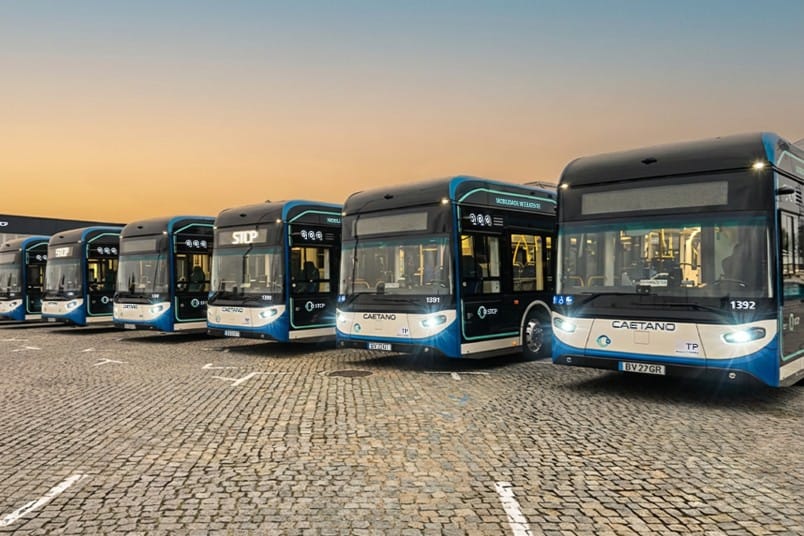
Sociedade de Transportes Colectivos do Porto (STCP) has ρ20 new battery-electric buses into service in the Greater Porto area, marking a further step in the operator’s transition toward zero-emission public transport.
The vehicles were supplied by CaetanoBus, with which STCP has maintained a long-standing partnership spanning several decades. The latest delivery follows the introduction of 15 first-generation electric buses that have already been operating in the city for several years.
See also: Maui Launches First Battery-Electric Buses on Core Transit Routes
The newly deployed buses are the latest-generation e.City Gold model in the 12-metre configuration, offering capacity for up to 88 passengers. Each vehicle is equipped with a 422 kWh battery pack, which CaetanoBus said is expected to deliver a range of more than 400 kilometres under urban operating conditions. The buses will be based at STCP’s Via Norte depot, where they replace an equivalent number of older vehicles being withdrawn from service.
STCP said the investment for the 20 electric buses amounted to €8.6 million and represents the first major procurement since the operator’s intermunicipal merger in 2021. The acquisition was fully funded by the six participating municipalities — Porto, Vila Nova de Gaia, Maia, Matosinhos, Valongo and Gondomar — underscoring a joint commitment to modernising and decarbonising public transport.
See also: Leicester Targets 240 Electric Buses by 2027 With Public and Private Funding Boost
“The Municipal Executive is focused on the challenge of continuously improving the reliability of service and punctuality in public transport, and the arrival of 20 more electric buses to STCP represents a significant step in improving the comfort and experience of users,” said Hugo Beirão Rodrigues, city councillor of Porto.
Cristina Pimentel, chairwoman of the STCP board, said the delivery marked “another firm step in STCP’s transformation journey,” adding that the operator was consolidating a more efficient and environmentally responsible fleet while preparing for future urban mobility challenges.
See also: Bristol Airport to Electrify Two Airport Flyer Bus Routes by 2026
With the addition of the 20 new vehicles, STCP now operates 88 zero-emission buses, accounting for nearly 20% of its total fleet. The remainder consists mainly of compressed natural gas buses, representing about 70%, with diesel vehicles making up the balance.
Electrification is set to continue. STCP said it plans to introduce a further 38 electric buses by the end of 2026, including 30 additional 12-metre e.City Gold units to be supplied by CaetanoBus, following a tender awarded last summer. Eight midi-sized electric buses from an undisclosed manufacturer are also planned. Once delivered, electric vehicles are expected to account for around 30% of the operator’s fleet.