



British energy supplier Octopus Energy and Chinese battery manufacturer CATL have formed a joint venture called Swaptopus to develop a battery-swapping network for electric heavy goods vehicles (HGVs) across Europe.
The initiative was announced at the Energy Tech Summit in London and is intended to address one of the key challenges facing freight electrification: the time required to recharge large commercial vehicle batteries.
Focus on Battery-Swapping Infrastructure
The partnership plans to deploy a network of large-scale battery-swapping hubs where electric trucks can exchange depleted battery packs for fully charged units within minutes.
Rather than building standalone swapping stations, Swaptopus intends to establish “mega-hubs” equipped with multiple battery exchange systems capable of serving large volumes of commercial vehicles.
The first hub is expected to open in the United Kingdom in 2027, with more than 30 sites planned across Europe by 2035.
According to the companies, the network could eventually support more than 300,000 electric trucks.
Reducing Downtime for Freight Operators
Battery swapping is being promoted as an alternative to conventional charging for long-haul freight transport, where vehicle utilization and operational uptime are critical.
Greg Jackson, Founder and Chief Executive Officer of Octopus Energy Group, said the model could help overcome operational barriers to electric truck adoption.
“Electric trucks already beat diesel on running costs, the challenge is keeping them moving. Battery swapping changes that. Instead of waiting for hours, trucks can be back on the road in minutes.”
“By combining Octopus’s software and energy expertise with CATL’s world-class battery technology, we’re making clean freight practical at scale across Europe.”
Building on Experience in China
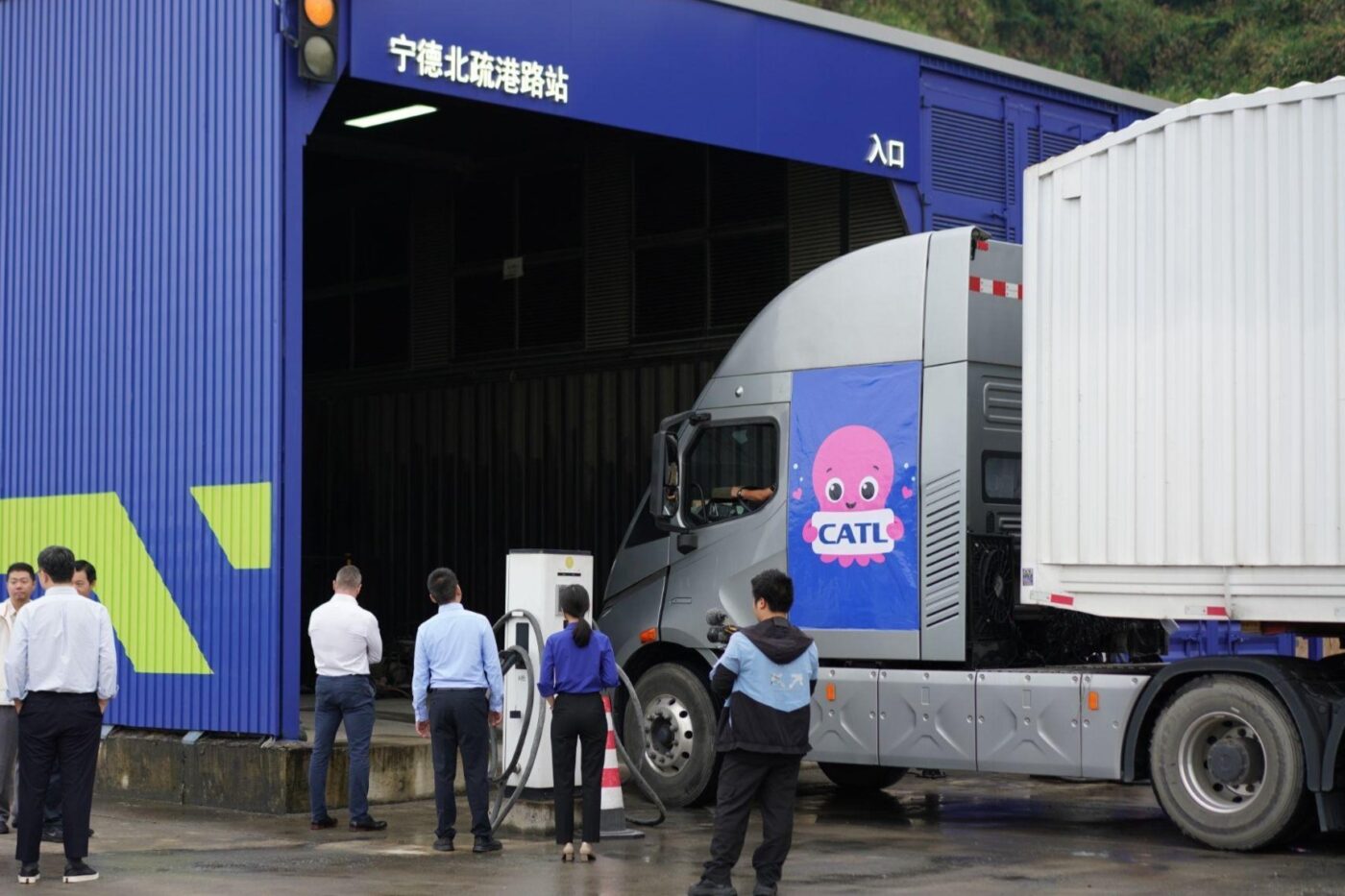
CATL has already deployed battery-swapping technology for commercial vehicles in China through its subsidiary Qiji Energy.
The company reported operating more than 300 battery-swapping stations for electric trucks by the end of 2025 and plans to significantly expand the network in the coming years.
CATL Chairman and Chief Executive Officer Robin Zeng said the company sees battery swapping as an important component of future commercial transportation.
“Battery swapping will be a significant part of the future of commercial transport.”
“We have field-proven this technology in China, and we are delighted to bring it to the UK and Europe as part of our joint venture with Octopus.”
Alternative to High-Power Charging
According to CATL executives, battery-swapping systems may offer operational advantages over ultra-fast charging for heavy-duty vehicles.
Oscar Luo, Head of Overseas Investment at CATL, said the company’s system can replace battery packs exceeding 500 kWh in approximately five minutes.
The approach also allows fleet operators to select different battery configurations depending on route length and payload requirements.
Supporting Freight Electrification
The transport sector remains one of the most challenging areas to decarbonize, particularly for long-distance freight operations that require high vehicle utilization and minimal downtime.
Swaptopus aims to combine CATL’s battery technology and swapping systems with Octopus Energy’s software, energy management, and electricity trading capabilities to support wider adoption of electric trucks across Europe.
If deployed at scale, the network could provide an alternative refueling model for commercial fleets while supporting the broader transition from diesel-powered freight transport to electric mobility.
Source: FT


