
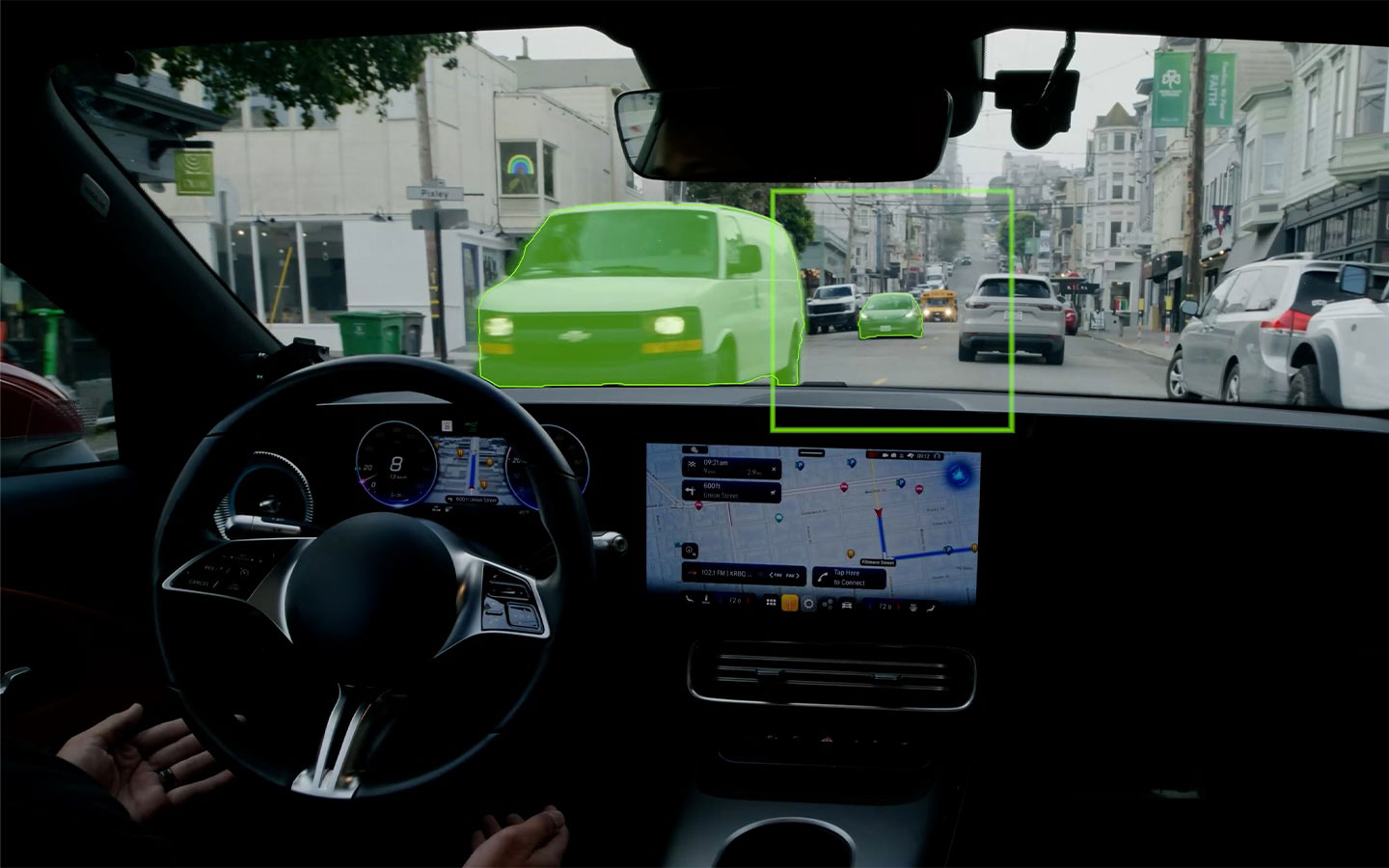
Nvidia has introduced Alpamayo 2 Super, a 32-billion-parameter open reasoning model designed to support the development of Level 4 autonomous driving systems, alongside a suite of complementary tools intended to streamline training, simulation and deployment.
The launch also includes AlpaGym, a closed-loop reinforcement learning framework, and OmniDreams, a scenario generation platform. Together, the technologies are intended to provide a development pipeline that spans real-world data collection, simulation, model training and deployment in autonomous vehicles.
Expanded Reasoning Capabilities
Alpamayo 2 Super expands Nvidia’s existing model family from 10 billion to 32 billion parameters and introduces enhanced capabilities for autonomous driving applications.
According to Nvidia, the model supports full 360-degree surround perception and can generate Meta-Action outputs, allowing it to make higher-level driving decisions across the vehicle’s software stack.
The company said the model’s reasoning-based auto-labelling capabilities can significantly reduce data annotation timelines, compressing processes that previously took months into a matter of days. Nvidia also noted that the model can be distilled into smaller versions suitable for deployment on vehicle hardware.
Closed-Loop Learning Framework
Nvidia also unveiled AlpaGym, an open-source reinforcement learning framework designed to train autonomous driving systems through continuous decision-making cycles in simulated environments.
Unlike traditional open-loop approaches that rely on static recorded datasets, AlpaGym allows models to interact with simulations and learn from the consequences of their actions.
The company said this approach helps expose compounding errors and rare failure cases that may not be detected during conventional training methods, enabling models to improve before deployment on public roads.
Simulation of Rare Driving Scenarios
The third component of the platform, OmniDreams, is designed to generate photorealistic simulations of uncommon and complex driving situations that are difficult to capture through real-world testing alone.
Using Neural Reconstruction technology powered by Omniverse NuRec, the platform can convert real-world fleet data into adaptable three-dimensional environments. These virtual scenes can then be modified for different sensor configurations and testing requirements.
Nvidia said the capability reduces the need for repeated physical data collection while expanding the variety of scenarios available for autonomous driving development.
Focus on Scaling Autonomous Mobility
Nvidia founder and Chief Executive Jensen Huang said the company’s goal is to provide developers with an integrated platform for building advanced autonomous vehicle systems.
“Alpamayo is the moment cars begin to safely reason, not just drive,” Huang said.
“Only Nvidia makes available open models, simulation, real-world data and agent skills so the entire global robotaxi ecosystem can develop level 4 capabilities that understand edge cases, explain decisions, earn trust and scale safely to millions of vehicles.”
The announcement comes as competition intensifies among technology companies and automakers seeking to commercialize Level 4 autonomous driving systems, particularly in robotaxi and autonomous mobility applications.
By combining AI models, simulation technologies and training frameworks into a unified ecosystem, Nvidia is seeking to strengthen its position as a key technology supplier for the next generation of autonomous vehicles.