
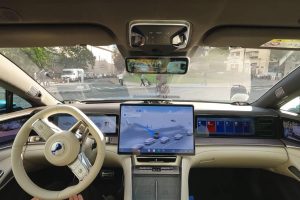





Nissan is working on a new driver assist technology that will help improve collision avoidance features for future autonomous vehicles.
Technologies under development utilize highly accurate real-time information about the vehicle’s surroundings to enhance these collision avoidance features and help reduce traffic accidents. Nissan demonstrated this technology on a test vehicle in Yokohama, Japan.
The “Ground Truth Perception” technology found in this assist driver combines information from LIDAR, radar and high-performance cameras. This technology can detect the shape and distance of objects, as well as the structure of the area around the vehicle, in real time with a high degree of accuracy.
Utilizing this information, the vehicle can instantly analyze the situation, assess it and automatically perform the necessary collision avoidance maneuvers.
Nissan’s latest driver assist technology can also detect slowing traffic and road obstacles in the distance and make appropriate lane changes. The technology can also provide enhanced support to drivers in areas where detailed map information is not available.
Nissan’s Senior Vice President Leading Global Research and Development, Takao Asami, said, “We believe that our technology will make a significant contribution to owner confidence, reducing traffic accidents and autonomous driving in the future.”
Nissan is also partnering with other technology companies to research and develop this technology. The next generation of LIDAR is being integrated into Nissan’s systems in collaboration with Luminar1. For verification technology, Nissan is working with Applied Intuition2, which has the most advanced simulation technology.
With the use of LIDAR technology, Nissan aims to significantly reduce accidents, a goal that is part of Nissan’s 2030 Ambition.
The Japanese manufacturer plans to complete the development of Ground Truth Perception technology in 2025 and will be embedded in some of the newest models launched in 2030.


