
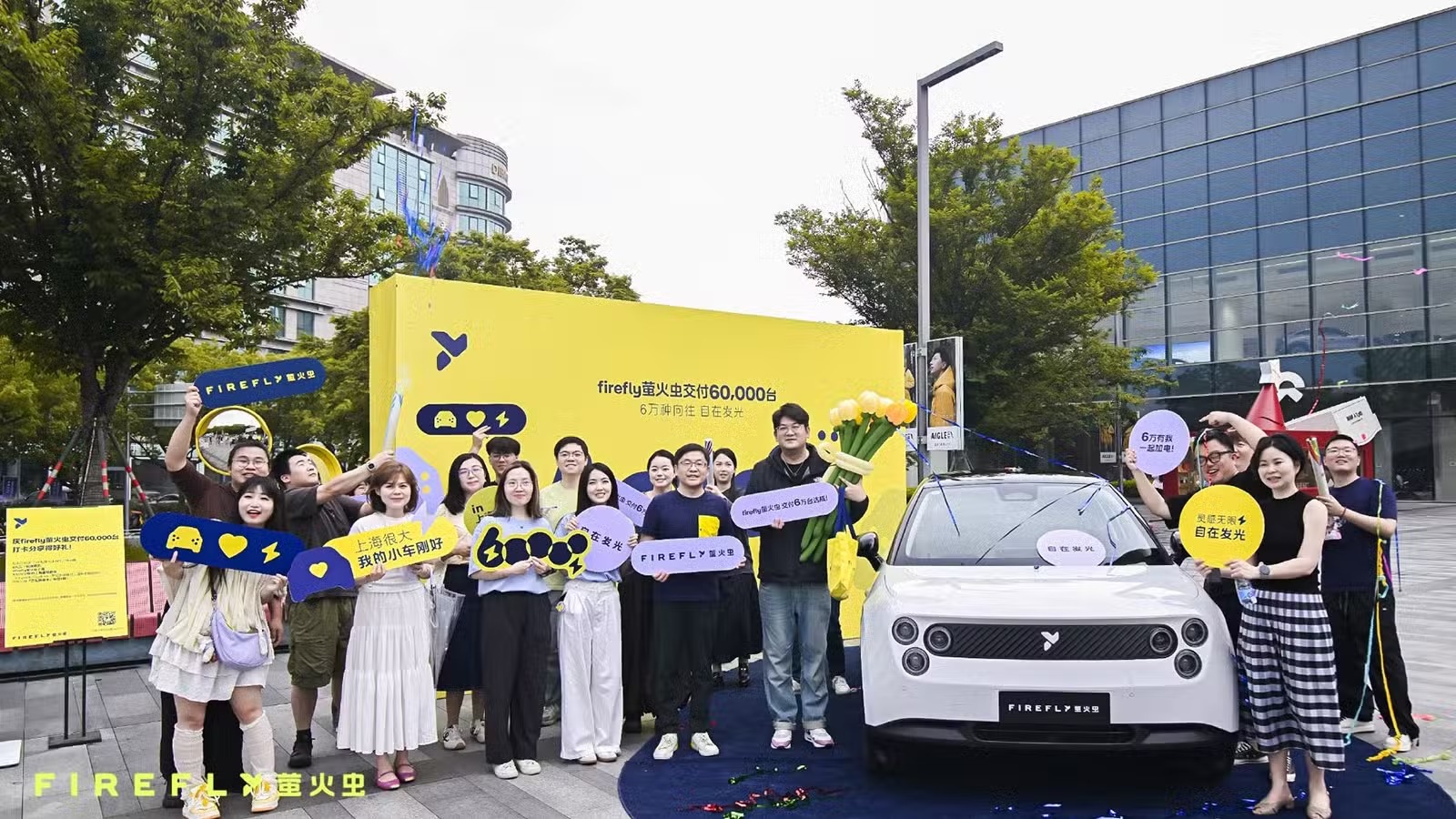
Nio said its boutique compact EV brand Firefly has delivered its 60,000th vehicle, marking a new milestone for the urban-focused electric vehicle brand.
The achievement comes less than two months after Firefly reached the 50,000-delivery milestone on March 29 and about 13 months after the launch of its first and currently only model, the Firefly EV.
Firefly is positioned as a premium compact electric vehicle brand targeting urban commuting consumers in China’s competitive EV market.
The delivery milestone comes shortly after Firefly released a major over-the-air software update, identified as the Aster 1.5.0 system version.
According to the company, the OTA upgrade increases the peak motor output of earlier Firefly EV models from 105 kW to 120 kW, equivalent to about 161 horsepower. The update reduces the vehicle’s zero-to-100 km/h acceleration time to 7.9 seconds.
The performance upgrade aligns older vehicles with the refreshed Firefly EV introduced in April.
The updated model starts at 119,800 yuan ($17,623) for the full vehicle purchase version. Customers using Nio’s Battery-as-a-Service (BaaS) subscription model can purchase the vehicle from 79,800 yuan, with monthly battery rental fees set at 399 yuan.
The software update also introduces a battery swap station parking assist function designed to help vehicles automatically position themselves inside Nio’s upcoming fifth-generation battery swap stations.
Nio said it plans to build between five and 10 fifth-generation pilot swap stations between May and June, with larger-scale deployment scheduled to begin in July and August.
The new stations feature a redesigned architecture intended to support Firefly’s shorter wheelbase models.
Currently, Firefly vehicles are not compatible with Nio’s existing network of 3,857 battery swap stations. The rollout of the fifth-generation stations is expected to enable compatibility for the compact EV lineup.
The Firefly expansion forms part of Nio’s broader strategy to strengthen its position in China’s rapidly evolving electric vehicle market through differentiated brands and battery-swapping infrastructure.