




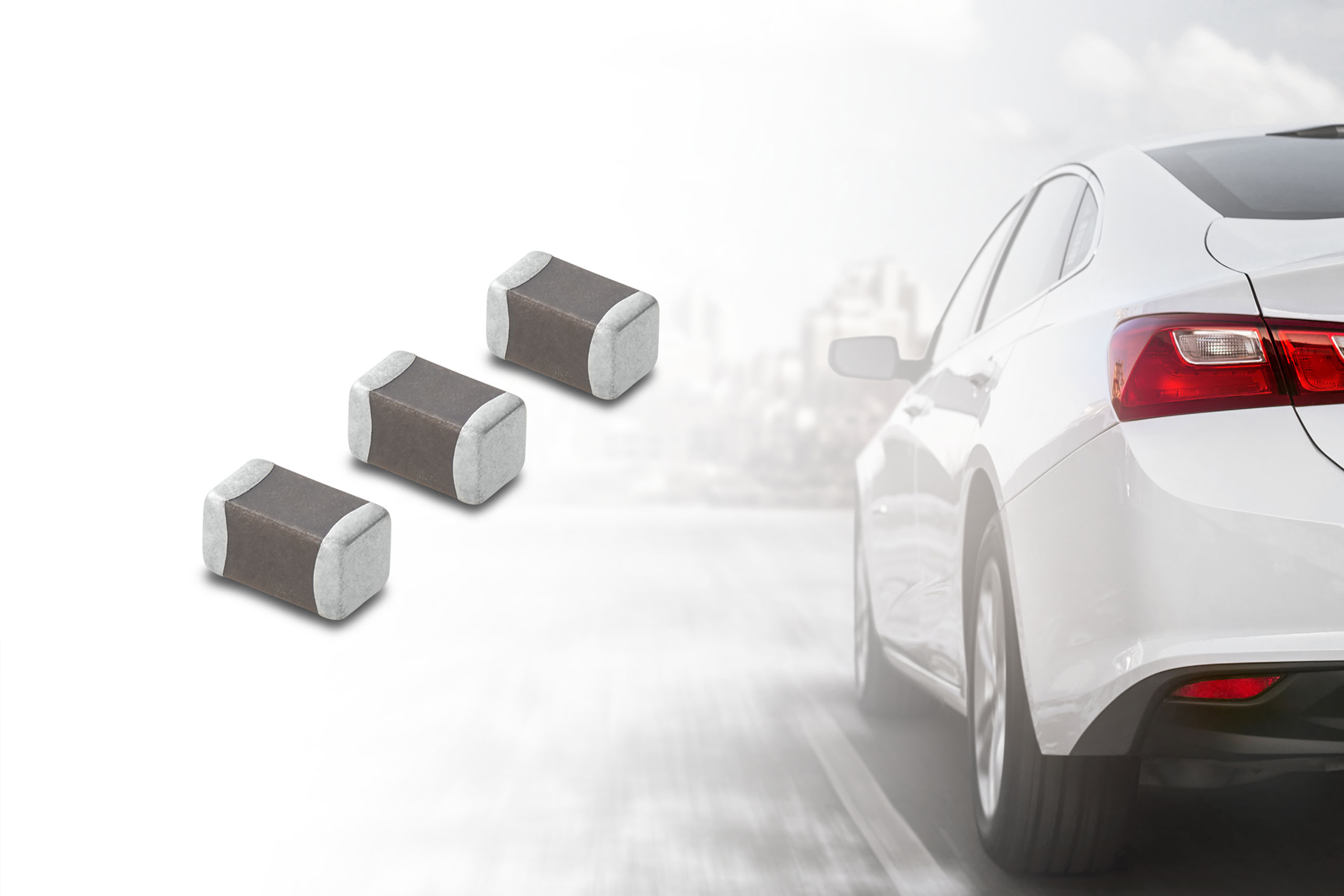
Murata Manufacturing has introduced a new soft-termination chip multilayer ceramic capacitor (MLCC) designed for automotive applications, claiming it is the first product in the industry to achieve a capacitance of 2.2μF at 100Vdc in the compact 0805-inch package size.
The new component, designated GCJ21BD72A225KE02, is aimed at automotive powertrain and safety systems as vehicle manufacturers increasingly adopt 48V electrical architectures and advanced driver-assistance systems (ADAS), creating demand for higher-performance passive components within limited circuit board space.
Automotive Electrification Driving Demand
The shift toward 48V systems is prompting automakers to use components capable of handling higher voltages while maintaining compact dimensions. At the same time, the growing integration of ADAS technologies is increasing the density of electronic systems throughout vehicles, placing additional pressure on engineers to maximize available board space.
Murata said the new capacitor combines high capacitance and voltage ratings in a smaller footprint through proprietary ceramic material technologies, including the control of particle size and material uniformity.
According to the company, these manufacturing techniques enable the component to deliver performance levels previously associated with larger package sizes.
Smaller Footprint, Higher Capacitance Density
Compared with Murata’s previous 2.2μF, 100Vdc MLCC, which required a 1206-inch package, the new capacitor reduces board mounting area by approximately 51%.
The company also said the product provides around 2.2 times the capacitance of its earlier 0805-inch, 100Vdc MLCC, allowing designers to achieve higher capacitance density without increasing component size.
The combination of compact dimensions and increased electrical performance is intended to support the continued miniaturization of automotive electronic control units and power management systems.
Designed for Automotive Reliability
The capacitor incorporates Murata’s soft-termination technology, which is designed to improve reliability in demanding automotive environments.
Flexible termination layers help absorb mechanical stresses caused by circuit board flexing, vibration, and repeated thermal cycling, reducing the likelihood of cracks developing after the component is mounted.
“Soft termination is a reliability feature suited to automotive environments: the flexible termination layers absorb mechanical stress caused by board flexure during vibration and thermal cycling, reducing the risk of post-mount cracking,” the company said.
Murata said the component operates across a temperature range of -55°C to +125°C and complies with X7T temperature characteristics, making it suitable for use in automotive powertrain, safety, and other high-reliability applications.
The launch reflects a broader industry trend toward higher-voltage, space-efficient passive components as vehicle electrification and advanced electronic systems continue to expand across automotive platforms.