



Mercedes-Benz has begun series production of its new axial-flux electric motor at its Berlin-Marienfelde plant, marking a major milestone in the company’s efforts to advance high-performance electric vehicle technology.
The start of production follows Mercedes-Benz’s acquisition of British electric motor specialist Yasa in 2021. Since then, the automaker has further developed the company’s axial-flux motor technology and prepared it for large-scale industrial production.
Production is taking place at the Berlin-Marienfelde facility, where Mercedes-Benz has installed seven production lines across approximately 30,000 square metres and three manufacturing halls. The company described the development as a new chapter for its oldest operating production site, which has been in operation since 1902.
“With the start of large-scale production of the axial flux motor in Berlin-Marienfelde, we are bringing a groundbreaking innovation for electromobility into industrial reality,” said Michael Schiebe, Member of the Board of Management of Mercedes-Benz Group AG responsible for Production, Quality and Supply Chain Management.
“This sends a strong signal for technological leadership, operational excellence, and the transformation of the automotive industry in Germany.”
First Application in AMG Electric Performance Models
The new motors will make their production debut in the upcoming Mercedes-AMG GT 4-Door Coupé, the first vehicle based on Mercedes-AMG’s new AMG.EA electric vehicle platform.
The performance model uses three axial-flux motors that together deliver up to 860 kW of peak power. According to Mercedes-Benz, the vehicle can accelerate from 0 to 100 km/h in 2.1 seconds and reach a top speed of 300 km/h when equipped with the Driver’s Package.
The technology was previously showcased in several concept and prototype vehicles, including the Vision One-Eleven concept and the AMG GT XX demonstrator.
Compact Design Delivers Higher Power Density
The motor technology originates from Yasa, a company known for developing compact axial-flux electric motors.
Unlike conventional radial-flux motors, where the magnetic field flows outward from the centre of the motor, axial-flux motors generate magnetic fields parallel to the axis of rotation. This configuration enables significantly higher power density while reducing overall size and weight.
Mercedes-Benz said the front motor in the AMG GT 4-Door Coupé measures less than nine centimetres in width, while each rear motor is approximately eight centimetres wide.
The motors are integrated into High Performance Electric Drive Units (HP.EDU), which combine the motor and a compact planetary gearbox within a single housing.
Advanced Manufacturing Processes
Mercedes-Benz highlighted the complexity of producing axial-flux motors at scale, noting that the manufacturing process includes 98 individual steps.
According to the company, 65 of these processes are being used for the first time within Mercedes-Benz production facilities, while 35 are entirely new to the automotive industry.
The development work has resulted in more than 30 patent applications.
Precision Engineering and Automation
The production process relies heavily on automation, laser technology, intelligent control systems and AI-supported quality control.
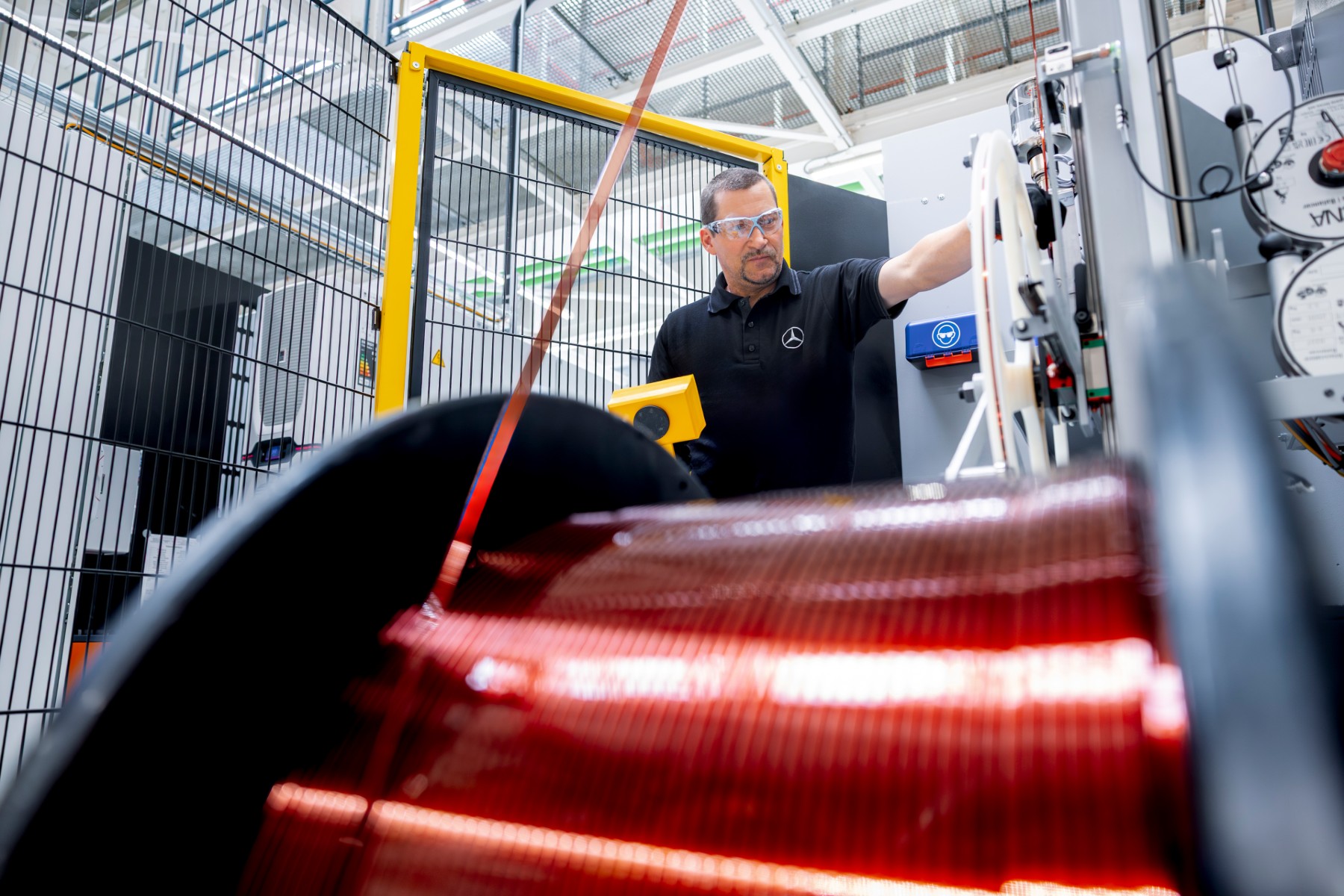
One of the key innovations involves the production of rectangular copper-wire coils used in the stator. Mercedes-Benz said the design allows more copper to be packed into the available space compared with traditional round-wire configurations, increasing motor performance.
The company also developed specialised laser welding techniques to connect the stator components with high precision while avoiding thermal damage to nearby structures.
During final assembly, the stator is positioned between two magnet-equipped rotor discs where magnetic forces of up to 9 kilonewtons act on the components. Mercedes-Benz said an advanced control algorithm continuously adjusts positioning during the final stages of assembly to maintain tolerances of less than 0.1 millimetres.
Strategic Role for Berlin-Marienfelde
The launch of axial-flux motor production further strengthens the role of Berlin-Marienfelde within Mercedes-Benz’s global manufacturing network.
Since 2022, the facility has also served as home to the Mercedes-Benz Digital Factory Campus, where the company develops and tests digital manufacturing technologies based on its MO360 production ecosystem.
By combining advanced electric drivetrain manufacturing with digital production systems, Mercedes-Benz aims to position the site as a centre of excellence for next-generation electric vehicle technologies.


