
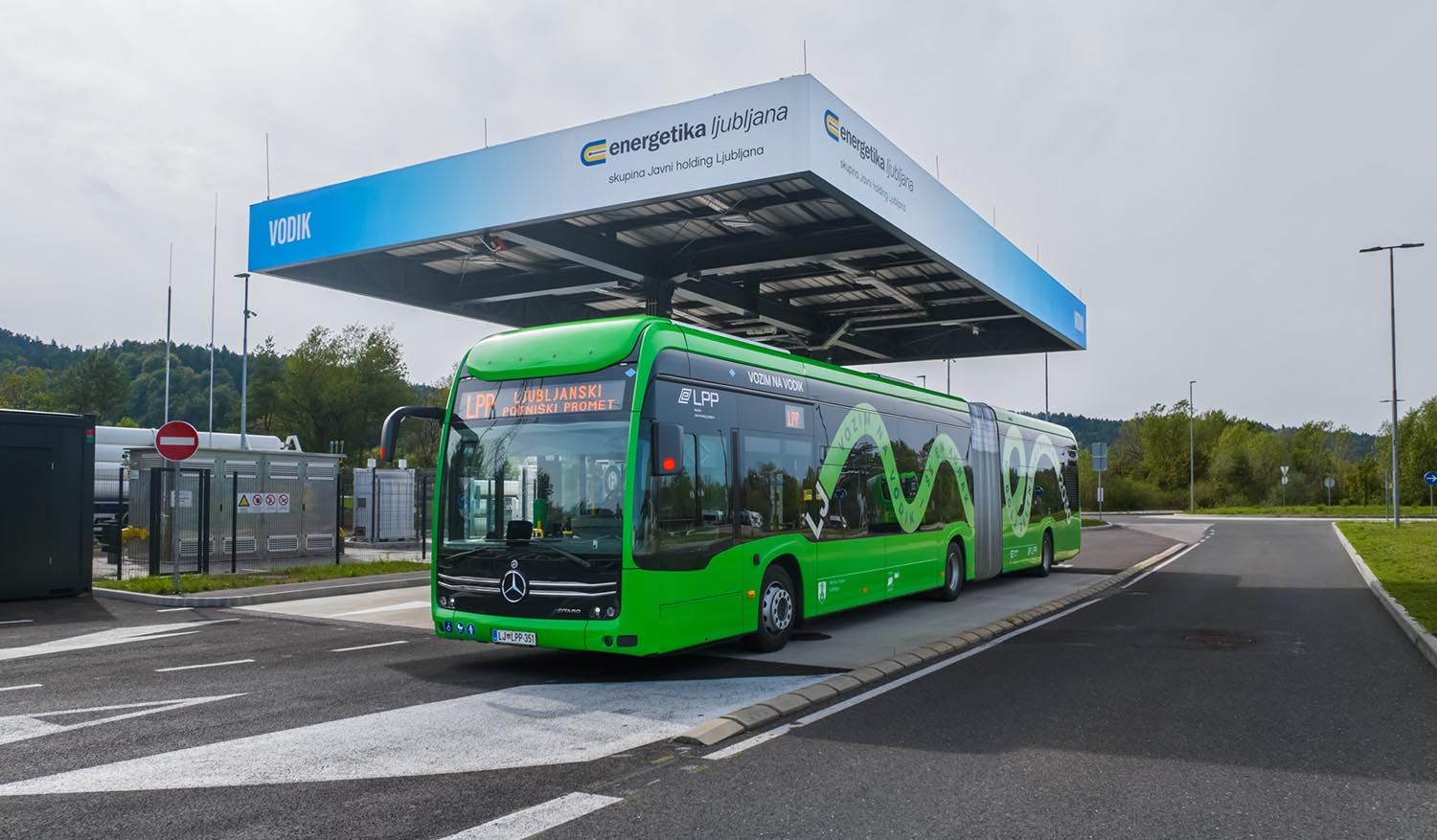
Ljubljana has added 35 battery-electric and hydrogen-powered buses from Mercedes-Benz to its public transport fleet within a year, marking the largest fleet modernisation project in the history of municipal transport operator Ljubljanski Potniški Promet (LPP).
The new vehicles comprise 25 battery-electric eCitaro buses and 10 articulated eCitaro G Fuel Cell buses. The investment value has not been disclosed.
LPP is primarily deploying the battery-electric buses on urban routes with predictable schedules and regular charging opportunities. The hydrogen fuel cell models are intended for routes requiring greater range and operational flexibility.
The fleet expansion combines two drivetrain technologies to support the city’s transition to locally emission-free public transport.
“Over the past year, we have built a locally CO₂-free fleet based on both battery-electric and hydrogen technology. Together, they create the foundation for reliable and future-ready public transport,” said Dr. Rok Vihar, CEO of LPP.
Battery and hydrogen technologies serve different routes
The Mercedes-Benz eCitaro battery-electric bus is designed for operations where vehicles can recharge regularly during scheduled service. In its standard solo-bus configuration, the model can theoretically accommodate up to 666 kWh of battery capacity.
The eCitaro G Fuel Cell combines a smaller battery with a hydrogen fuel cell that acts as a range extender. In the articulated version, the bus can be equipped with up to 392 kWh of battery capacity, while its fuel cell delivers 60 kW.
LPP has not disclosed the exact technical configurations of its new buses. As a result, the precise battery capacities and operating ranges of the vehicles deployed in Ljubljana cannot be confirmed from the available information.
The two technologies allow the operator to match vehicles to different route requirements, taking into account charging opportunities, operating schedules and range demands.
Charging and hydrogen infrastructure supports fleet deployment
Alongside the vehicle procurement, LPP has developed the charging and hydrogen infrastructure required to support the new fleet and adapted its operational processes to accommodate the different powertrain technologies.
The infrastructure investment is an important part of the transition, as battery-electric buses depend on access to suitable charging facilities, while hydrogen fuel cell vehicles require dedicated hydrogen refuelling arrangements.
Rasto Oderlap, CEO of Autocommerce, the general distributor partner for Mercedes-Benz buses in Slovenia, said successful fleet electrification requires coordination between vehicles, infrastructure and operational capabilities.
“The transition to locally CO₂-free mobility today is far more than simply a vehicle issue. What matters is the interaction between vehicle technology, infrastructure, and operational expertise,” Oderlap said.
He added that LPP demonstrates how these elements can work together to support efficient public transport operations.
Contribution to Ljubljana’s climate targets
The fleet modernisation also supports Ljubljana’s participation in the European Union’s 100 Climate-Neutral and Smart Cities initiative, which helps participating cities advance their transition towards climate neutrality.
By introducing battery-electric and hydrogen-powered buses, the Slovenian capital is reducing tailpipe emissions from its public transport operations while investing in the infrastructure needed to support alternative drivetrains.