
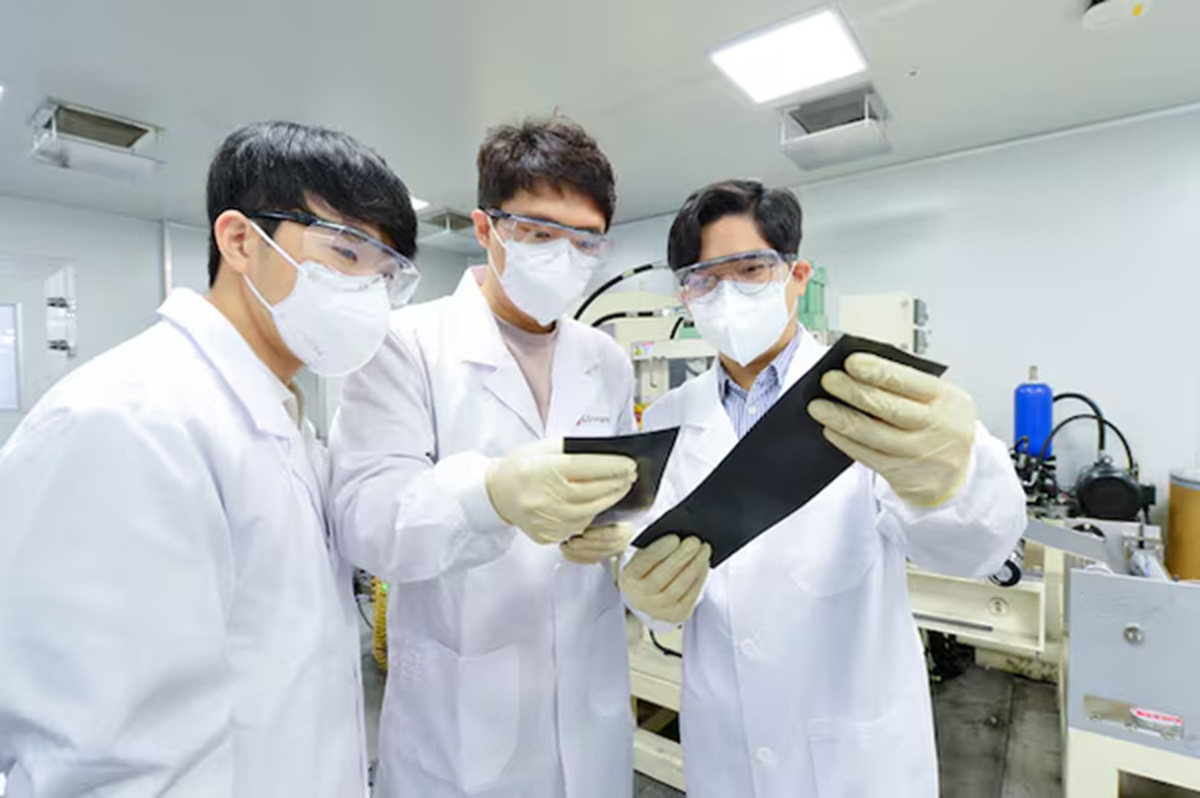
LG Energy Solution is advancing its dry electrode process, a next-generation battery manufacturing technology expected to reshape production efficiency and cost structures across the electric vehicle industry. The company plans to begin commercial production by 2028, positioning itself at the forefront of the global race to modernize battery manufacturing.
The dry electrode process eliminates the need for solvents, which are central to the traditional wet electrode method. By mixing only solid powders, the process removes the drying and solvent recovery steps, leading to lower facility investment, reduced energy consumption, and more compact manufacturing layouts. This streamlined approach allows for faster and more cost-effective production, making it a significant leap forward in the evolution of battery technology.
See also: LG Energy Solution Forecasts 34% Rise in Q3 Operating Profit on U.S. EV Demand Surge
Industry analysts see the dry electrode process as a potential breakthrough that could boost the price competitiveness of electric vehicles once commercialized. Global automakers and battery producers in South Korea, China, and Japan are all accelerating their research into this technology as they seek new ways to meet demand for affordable and efficient EVs.
LG Energy Solution’s development stands out due to its flexibility. The company’s process can be applied to both anodes and cathodes, regardless of particle size, giving it a technical edge for large-scale adoption. Pilot production lines are currently being set up at the company’s Ochang Energy Plant in South Korea, with the goal of securing mass production capabilities ahead of the 2028 timeline.
See also: KAIST, LG Energy Claim Breakthrough in Lithium-Metal Batteries That Could Transform EV Charging
In addition to advancing dry electrode technology, LG Energy Solution continues to strengthen its position across multiple battery segments. The company is enhancing its high-nickel NCMA products, accelerating the development of mid-nickel NCM and lithium iron phosphate (LFP) batteries, and preparing to launch its 46-Series cells. It also plans to expand its LFP offerings for energy storage systems, reinforcing its broader strategy to meet diverse market needs across the mobility and energy sectors.
LG Energy Solution Signs $4.3 Billion Global LFP Battery Supply Deal for 2027–2030