



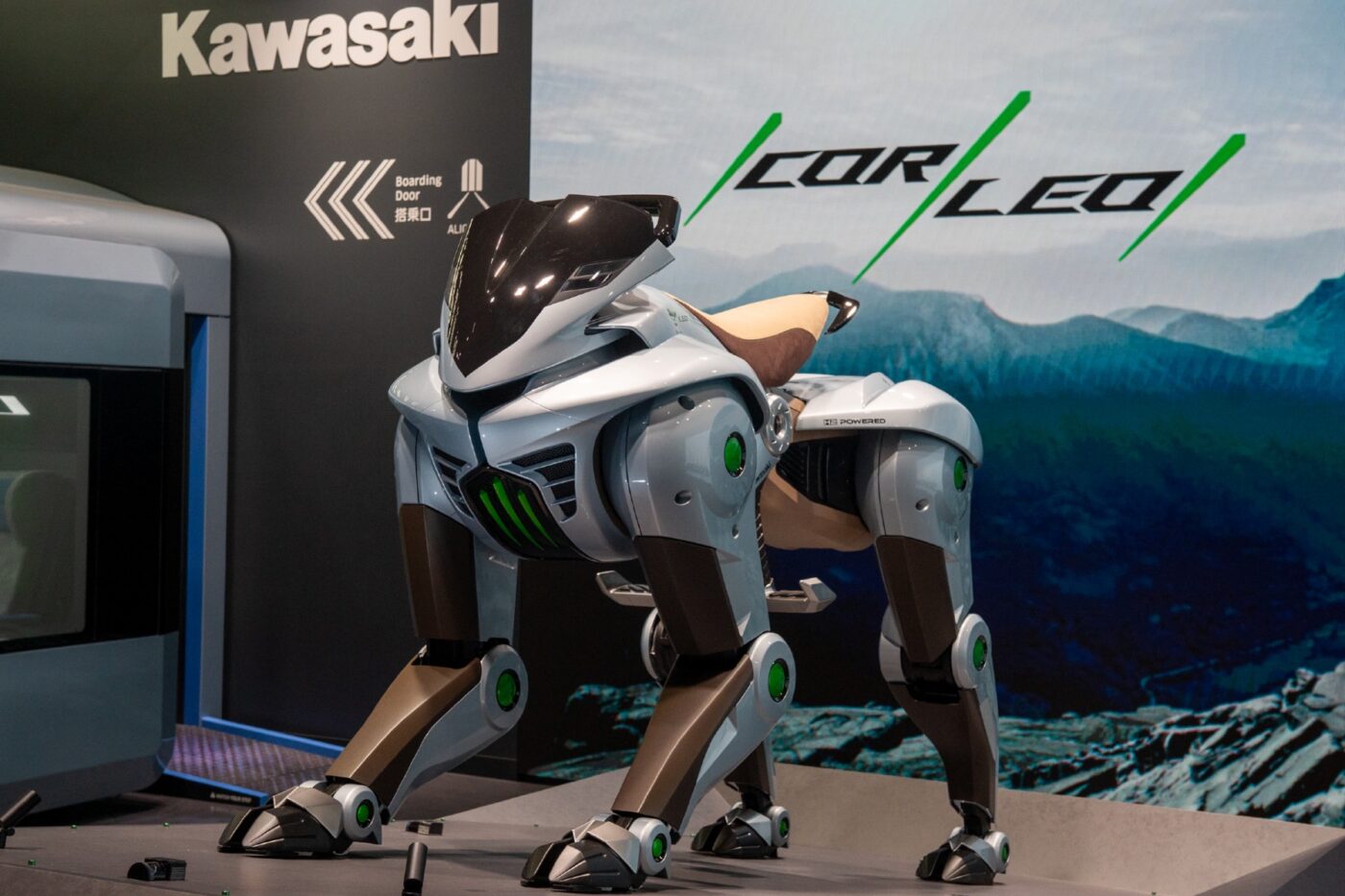
Kawasaki Heavy Industries is developing a hydrogen-powered quadruped robot designed for off-road mobility in mountainous terrain. The concept, named Corleo, was presented at Expo 2025 Osaka and is intended as a robotic alternative to motorcycles in environments where conventional vehicles struggle.
The company describes Corleo as a four-legged robotic mount capable of traversing difficult landscapes. To advance the project, Kawasaki has established a dedicated business development team called Safe Adventure, which reports directly to the company’s CEO and is tasked with turning the concept into a commercial product.
According to Kawasaki, the robotic horse will be powered by a small hydrogen combustion engine with a displacement of around 150 cc. Hydrogen is expected to be stored in cartridges located at the rear of the vehicle. While full technical specifications have not yet been disclosed, the system is designed to combine robotics with technologies derived from motorcycles.
One example is the suspension design. Kawasaki notes that Corleo applies a swing-arm mechanism originally developed for motorcycles, allowing the rear legs to move independently and absorb shocks when travelling over uneven terrain.
Instead of traditional handlebars or steering controls, the rider is expected to guide the robot by shifting body weight, similar to riding a real horse. This approach is intended to create a more intuitive riding experience while navigating natural environments such as mountains, forests or rough trails.
The concept is primarily aimed at individual mobility in remote areas where wheeled vehicles reach their limits.
Kawasaki plans to present functional prototypes capable of test rides by the time of Expo 2030 Riyadh. If development proceeds as planned, a commercial launch could follow around 2035.
With expertise in both robotics and motorcycles, Kawasaki believes it has the technological foundation to develop the quadruped mobility platform. However, many details about performance, range and real-world applications remain to be clarified as the project moves from concept to prototype.


