
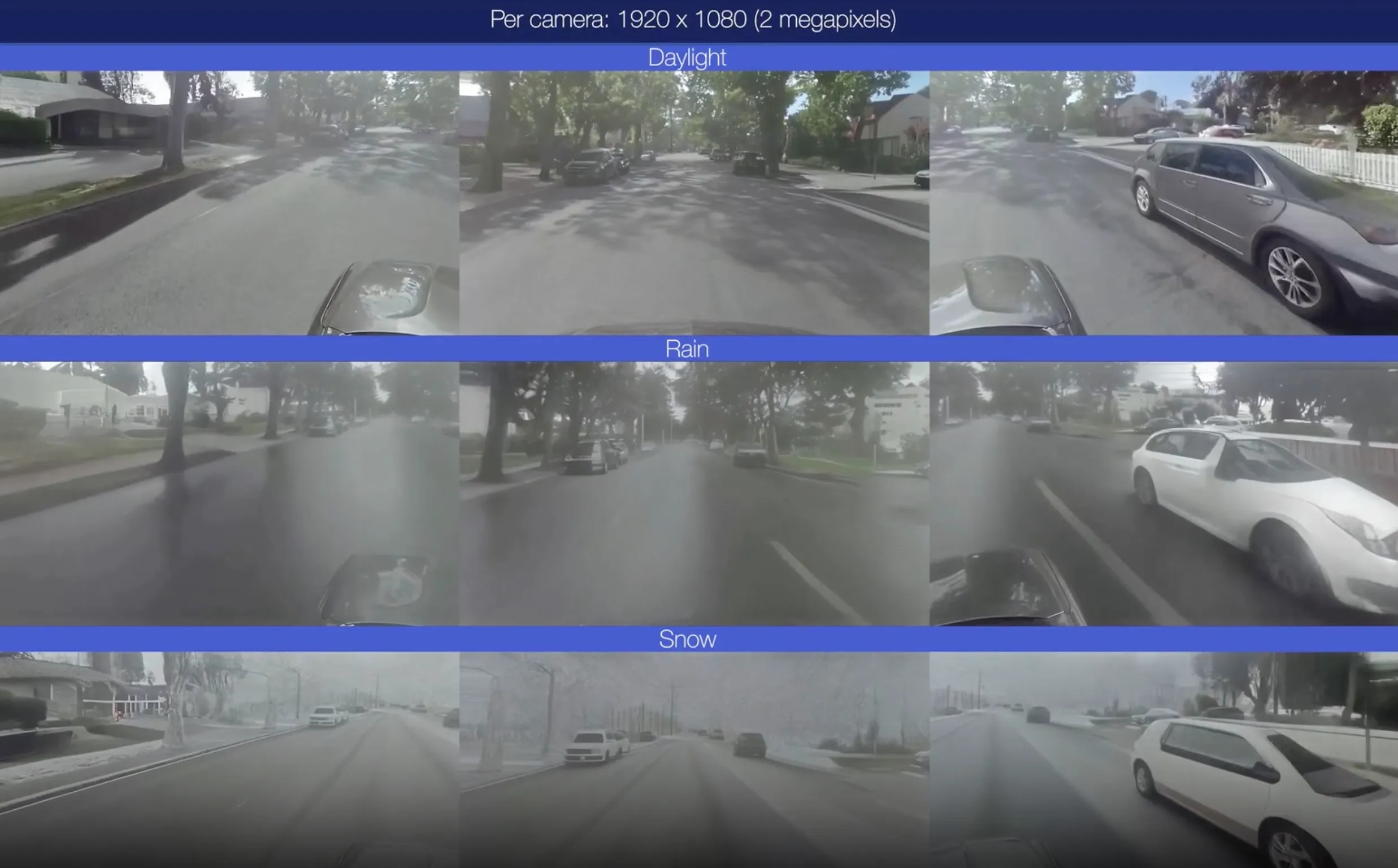
Helm.ai has launched two new generative artificial intelligence models designed to create high-resolution synthetic driving data for autonomous vehicle development, aiming to address growing industry demand for scalable alternatives to real-world data collection.
The software company introduced GenSim-3 and VidGen-3, which generate Full HD camera data across a six-camera, 360-degree surround-view configuration. According to Helm.ai, the system produces a synchronized 12-megapixel scene for each simulation timestep, significantly increasing the level of detail available for training and validating autonomous driving systems.
The company said the models deliver approximately five times the pixel density of many existing generative world models used in the automotive industry, which typically operate at lower resolutions.
Helm.ai develops perception, simulation and autonomous driving software for advanced driver assistance systems (ADAS) and Level 4 autonomous vehicle applications.
The company argues that higher-resolution synthetic data is becoming increasingly important as production vehicles adopt cameras with greater image quality and sensor fidelity.
According to Helm.ai, training perception systems using lower-resolution synthetic images can create a gap between simulation performance and real-world deployment.
The new models are designed to generate data at native Full HD resolution of 1,920 by 1,080 pixels for each camera in a six-camera configuration.
The platform can also be configured for different validation requirements.
For example, engineering teams can use a three-camera setup operating at 30 frames per second for high-speed simulation scenarios, while a full six-camera surround-view mode can provide broader environmental coverage at five frames per second.
Helm.ai said the technology is intended to emulate the behavior of real automotive sensors rather than generating conventional computer-generated imagery.
According to the company, the models reproduce physical sensor characteristics such as image banding, lens flare effects and dynamic exposure changes that can occur in real-world driving environments.
The company believes these features can help improve the robustness of perception systems trained using synthetic data.
The two models serve different purposes within the development process.
GenSim-3 focuses on scene transformation and data augmentation by modifying existing real-world video footage. The system can alter weather conditions, lighting environments and object appearances while maintaining synchronization across all six cameras.
VidGen-3, meanwhile, generates driving scenarios entirely from scratch, creating virtual environments, traffic behavior and road users to support the development of autonomous driving systems in situations where real-world data may be limited.
Helm.ai said the technology can help address geographic, environmental and operational data gaps while reducing the cost of collecting and annotating large-scale driving datasets.
The company also emphasized the efficiency of the underlying computing architecture.
According to Helm.ai, the Full HD models were trained using several hundred advanced graphics processing units (GPUs), compared with the much larger computing resources often associated with large-scale generative AI systems.
Vladislav Voroninski, founder and chief executive officer of Helm.ai, said the company views the technology as a step beyond traditional AI-generated video.
“We are moving the industry from standard ‘AI video’ to authentic, hardware-accurate sensor emulation,” said Vladislav Voroninski, Founder and Chief Executive Officer of Helm.ai.
“By leading with a Full HD (2MP) standard and a 12-megapixel total aggregate capability per timestep, we have solved the resolution bottleneck that has historically limited the utility of generative AI in safety-critical systems,” Voroninski added.
He said the platform is designed to allow developers to validate autonomous driving software using synthetic data that closely matches the output of production vehicle sensors.
Founded in 2016, Helm.ai develops artificial intelligence software for autonomous driving applications and works with global automotive manufacturers on production vehicle programs.
The launch reflects a broader trend across the autonomous vehicle industry, where companies are increasingly turning to generative AI and simulation technologies to accelerate development, reduce testing costs and improve the validation of safety-critical systems.