
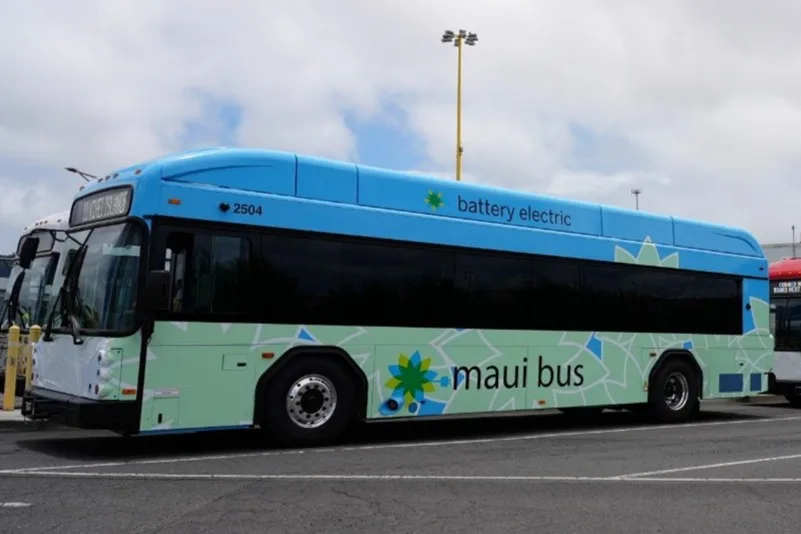
Hawaii’s Department of Transportation (HDOT) will deploy new battery-electric buses in four counties as part of a broader effort to decarbonise public transport across the state by 2035. The new electric buses, manufactured by Gillig, will replace 12 aging diesel buses on routes across Kaua’i, Maui, and Hawaii Island.
The $16.6 million project is being funded primarily through an $11.2 million grant from the Federal Transit Administration, with additional support of $3.53 million from the Hawaii State Energy Office. The remaining costs are being covered by the counties.
“These new electric buses are a significant step toward reducing our emissions and expanding sustainable transportation options for our residents,” said Hawaii Island Mayor Kimo Alameda. “They are a win both for our environment and the people of Hawaiʻi. Mahalo to our federal and state partners for helping us make this forward-thinking investment possible.”
Technical specifications for the new buses have not yet been disclosed, but HDOT estimates that each replacement will reduce greenhouse gas emissions—primarily nitrogen oxides—by approximately 17.34 tonnes annually.
Hawaii has already begun integrating electric buses into its public fleet. Honolulu operates 17 zero-emission buses on O’ahu and has secured funding to add 78 more over the next three years. The city is also constructing new charging hubs at key locations, including the Alapa’i Transit Center and the Pearl City Bus Facility.
The statewide push toward electrification follows a 2021 rule mandating the transition of all government fleet vehicles to electric: passenger cars by 2030 and light commercial vehicles by 2035. The addition of the new electric buses marks a significant early milestone in this long-term strategy.