



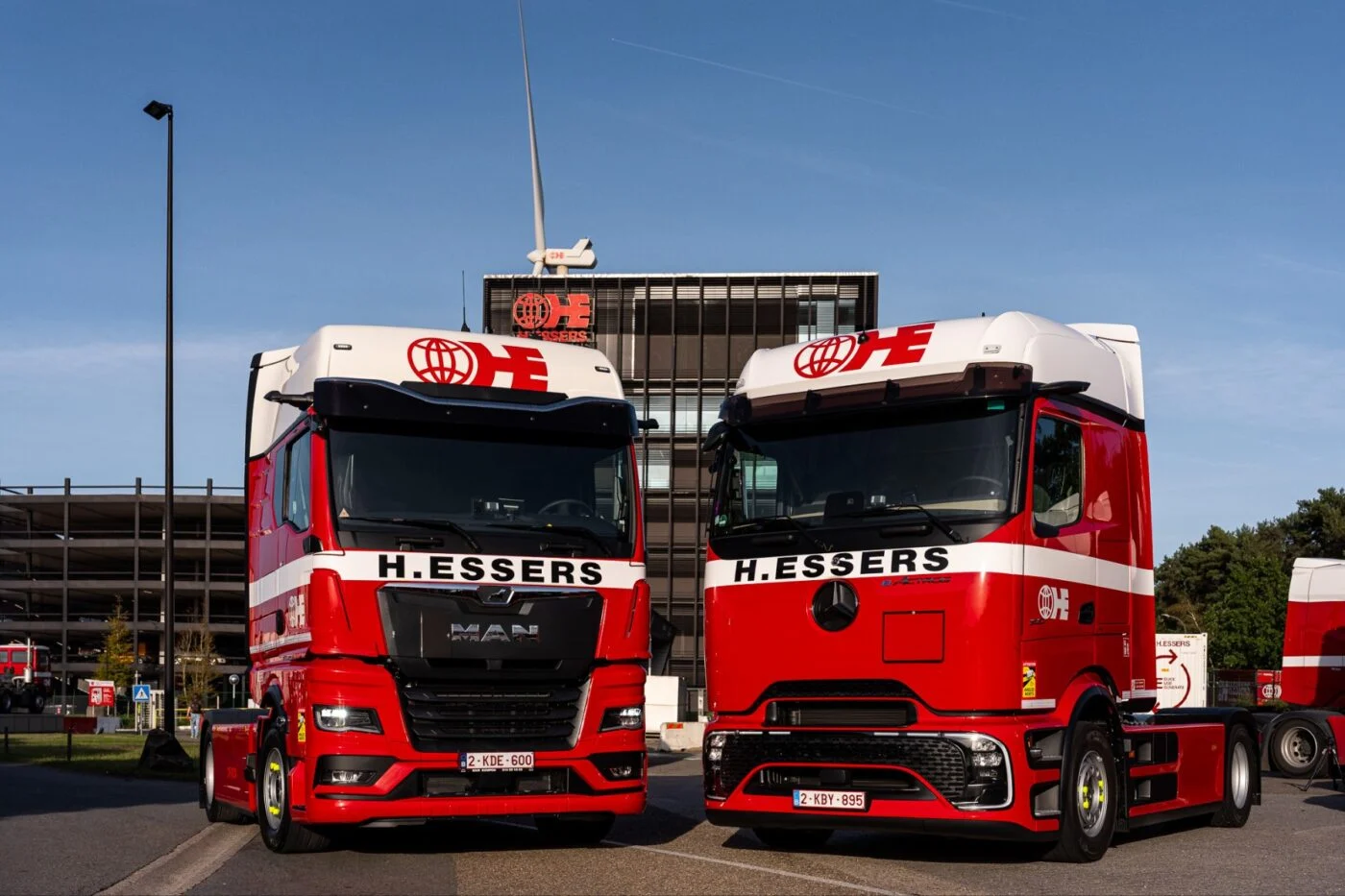
Belgian logistics company H.Essers has expanded its electric truck fleet with 20 new vehicles, comprising ten trucks from MAN and ten from Mercedes-Benz Trucks. The vehicles will primarily operate from the company’s locations in Belgium.
The latest deliveries bring H.Essers’ battery-electric truck fleet to 31 vehicles. The company is expanding its electric transport operations alongside investments in charging infrastructure and energy management as part of its broader emissions-reduction strategy.
H.Essers aims to reduce greenhouse gas emissions from its own transport fleet by 42% by 2030. The company plans to pursue this target through operational efficiency, synchromodal transport, renewable energy, alternative fuels and the electrification of transport activities.
Electric Truck Range and Charging
The newly delivered trucks offer different operating ranges depending on the manufacturer. Mercedes-Benz electric trucks have reported ranges of 525 to 575 kilometres, while the MAN models offer between 400 and 450 kilometres.
Both manufacturers’ vehicles can be recharged in approximately 90 minutes under optimal conditions using DC charging, according to the information provided by H.Essers.
The purchase follows a pilot project conducted in 2025, during which six electric trucks from three manufacturers were used in daily operations. The trial gave the company practical experience with the operational opportunities and challenges of electric freight transport.
H.Essers operates around 1,420 trucks, according to company figures from early 2025. Its longer-term objective is to increase the share of electric trucks to approximately 15% of the fleet by 2030, equivalent to around 200 vehicles based on the reported fleet size.
Electrification Strategy and European Expansion
Christopher Van den Daele, COO Transport at H.Essers, said the company views electrification as one component of a broader approach to reducing emissions from logistics operations.
Making logistics more sustainable requires a combination of solutions. Electric trucks play an important role in this and are becoming a viable option for an increasing number of applications. We believe electrification is an essential part of the logistics of the future.
He said the latest investment would allow H.Essers to deploy electric trucks on a larger scale under real operating conditions while building experience for a wider rollout across its European network.
The company currently operates most of its electric trucks from locations in Belgium and the Netherlands. It is now assessing how the technology could be expanded into other countries and business areas, using operational experience to inform future decisions.
Charging Capacity to Reach 2.7 MW
Alongside the vehicle deliveries, H.Essers is expanding charging infrastructure at its sites in Genk, Belgium, and Bergen op Zoom, the Netherlands. The company plans to increase installed charging capacity at the two locations to a combined 2.7 MW.
Its electrification programme also includes forklift trucks and passenger cars, as well as heating and cooling systems for office and warehouse buildings.
To coordinate the growing energy requirements across its facilities, H.Essers has introduced Synchro Grid, an energy management ecosystem designed to align energy production, consumption and storage.
Van den Daele said the system is intended to help the company develop its sites into flexible energy hubs as electrification progresses.
To manage the growing energy demand across different sites in a smart way, we have also introduced Synchro Grid, a company-wide energy ecosystem that aligns energy production, consumption and storage. Our ambition is to gradually develop our sites into flexible energy hubs and support the further electrification of our operations, while responding to customers’ growing demand for more sustainable transport solutions. In this way, we are working together to build a more sustainable logistics chain.
The expansion of the electric fleet and supporting energy infrastructure forms part of H.Essers’ plan to scale lower-emission transport while assessing the operational requirements of electrification across its European logistics network.


