
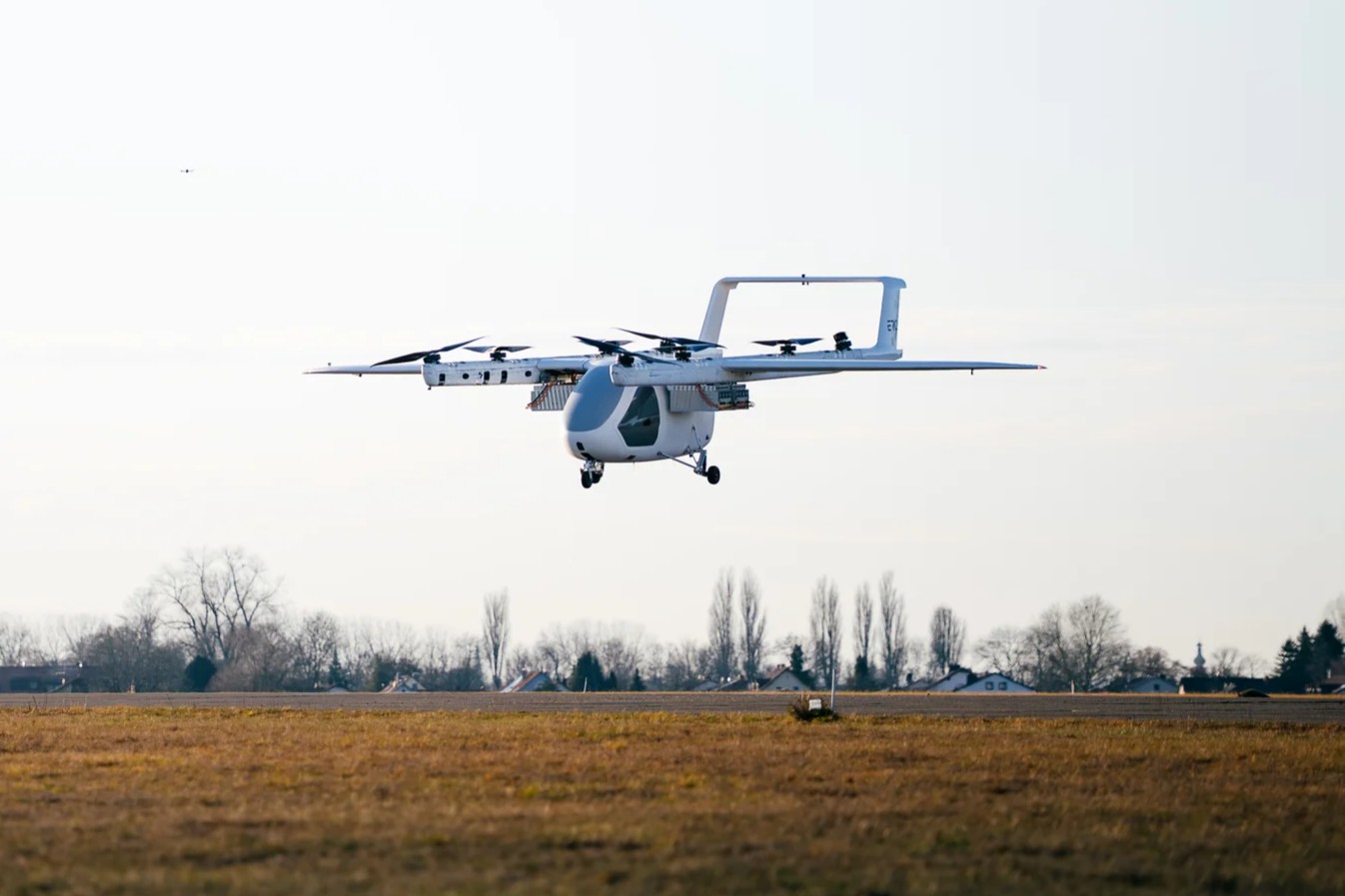
A Bavarian aerospace startup has carried out the first public flight of a new electric vertical take-off and landing aircraft, underscoring continued ambitions in Germany’s struggling air-mobility sector after recent high-profile failures.
The company, ERC System, conducted the demonstration of its prototype aircraft “Romeo” at the former Erding Air Base near Munich, a site now being developed as an innovation centre for the Bundeswehr. The startup, based in Ottobrunn, had previously operated largely out of public view.
Romeo is an eVTOL aircraft designed to take off and land vertically without a runway. Unlike earlier German projects by Lilium and Volocopter, which focused on urban passenger transport before entering insolvency proceedings, ERC System is targeting applications such as medical evacuation, cargo transport, and military missions.
The prototype is larger than many urban air taxi concepts, with a deadweight of about 2.7 tonnes, a wingspan of 16 metres, and eight rotors for vertical lift. The recent test flight was unmanned and remotely controlled, reaching a height of roughly 10 metres and performing limited manoeuvres over several minutes. At present, the aircraft can hover but cannot yet fly forward.
Chief Executive David Löbl said hovering represents the more technically demanding phase, while forward flight may be achieved later using an additional pusher motor. The company emphasises that the aircraft is intended to operate with a pilot onboard in future versions.
ERC System’s choice of roles reflects practical market considerations after setbacks in the urban air taxi sector.
The startup has partnered with DRF Luftrettung, a German air rescue organisation, to explore patient transport uses. Initial deployment would focus on inter-hospital transfers rather than emergency response, allowing patients to be moved between facilities for specialised treatment.
DRF Luftrettung CEO Krystian Pracz said he expects the aircraft to become part of the organisation’s fleet in the 2030s, describing it as a complementary platform to conventional rescue helicopters.
Military use is also under consideration. ERC System noted that collaboration with the Bundeswehr allows rapid testing of large unmanned prototypes in operational scenarios, including evacuation and logistical support missions. The company presented its technology to German Defence Minister Boris Pistorius and Bavarian state premier Markus Söder during the innovation centre’s inauguration.
Following the Romeo prototype, ERC System plans to develop a production aircraft called “Charlie,” featuring ten rotors and a hybrid propulsion system. Unlike the fully electric prototype, the operational model would incorporate a fuel-powered generator to extend range to as much as 800 kilometres.
Certification by the European Union Aviation Safety Agency is targeted for 2031, though approval processes for new aircraft types are complex and costly. The startup said it is receiving technical and financial support from aerospace engineering group IABG.
While the future of urban air taxis remains uncertain, the Romeo test suggests that alternative applications for electric vertical-lift aircraft—particularly in emergency services and defence—may offer a more viable path to commercial deployment.