
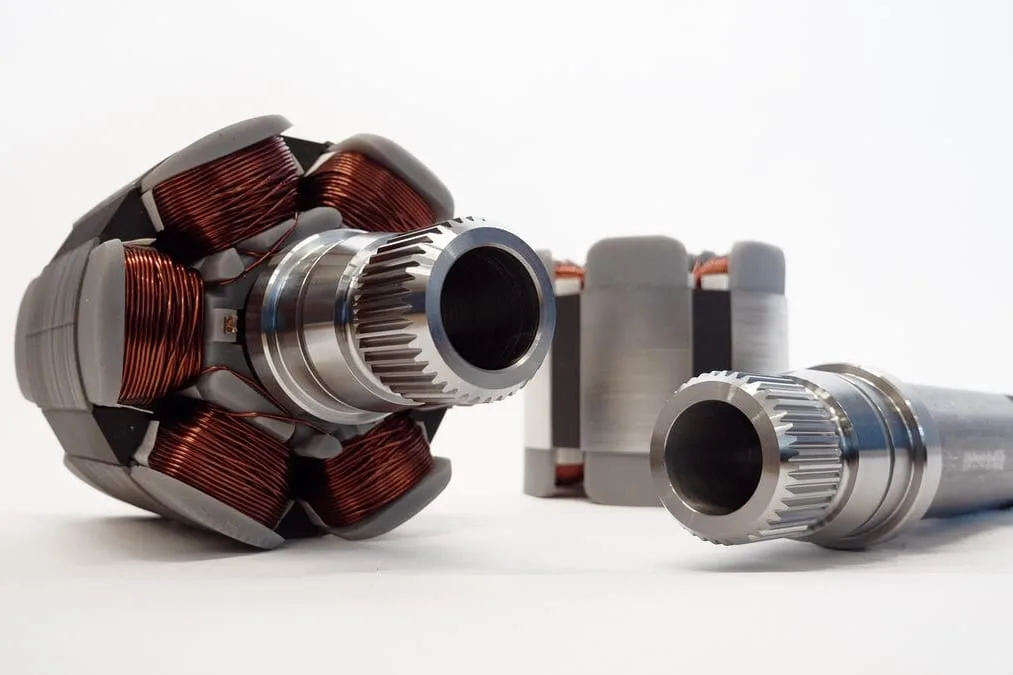
RWTH Aachen University’s Chair of Production Engineering of E-Mobility Components (PEM) has launched a research project aimed at making electric motor rotors easier to recycle, seeking to strengthen supply security for critical raw materials in Europe.
The initiative, called Kreisläufer, focuses on developing production and dismantling processes to ensure valuable elements such as copper and rare earths can be recovered at the end of a motor’s life cycle. The project is supported by Germany’s Federal Ministry for Economic Affairs and Energy and involves industry partners across the supply chain, including Magnet-Physik Dr. Steingroever, Remondis and Wieland eTraction Systems. Daimler Truck and Mubea Motorkomponenten are participating as associated partners.
“Current product topologies and production processes in the field of electric motors are not designed for circular economy and recycling suitability,” said PEM director Prof. Achim Kampker. “As a result, critical materials such as copper and rare-earth elements, which are particularly important for Germany and Europe, are lost in current recycling processes.”
The four-year project, which runs until August 2028, also plans to develop a digital product passport documenting dismantling and recycling information for electric motors. Researchers hope industrial-scale recycling of rotors could become viable within three to five years after the project ends. In the long term, the approach may be extended beyond automotive motors to generators and industrial machinery.
The work highlights a shift in focus from electric vehicle battery recycling, which has drawn the most attention in recent years, to electric motor components such as neodymium magnets. Previous efforts, including the ZIRKEL project led by Fraunhofer IWU, have demonstrated practical methods for recovering and reusing magnets with minimal damage.