




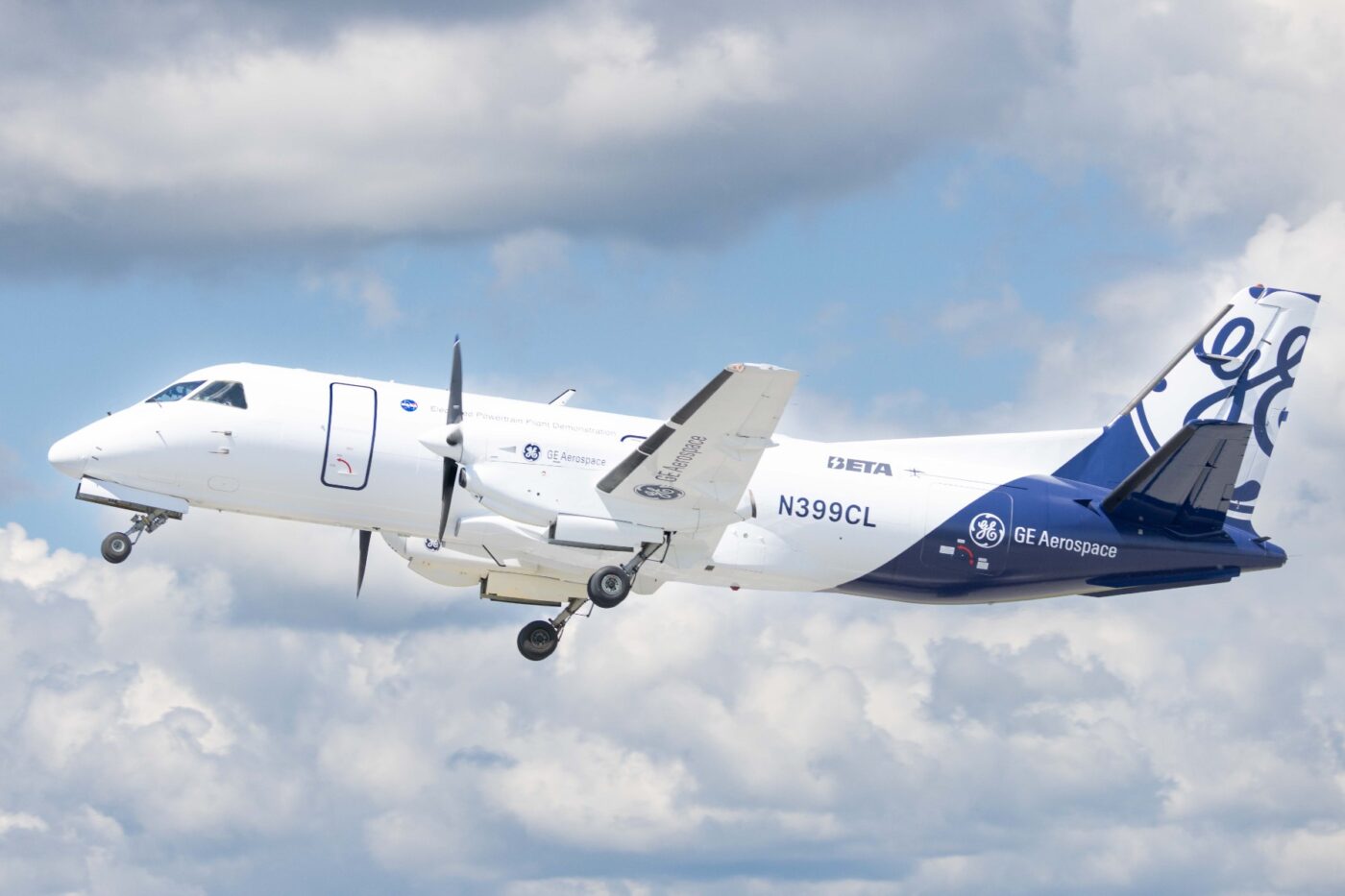
GE Aerospace, in collaboration with NASA, Beta Technologies, and Boeing, has completed what the companies describe as the world’s first hybrid-electric flight at a cruising altitude of 30,000 feet (9,144 meters), demonstrating the technology at an altitude comparable to conventional commercial passenger aircraft.
The flight forms part of ongoing efforts to develop lower-emission propulsion systems for future regional and commercial aviation.
Vertical Aerospace and Honeywell Join EU Air Mobility Integration Project
Hybrid-Electric System Tested at Commercial Cruising Altitude
The demonstration used a modified Saab 340B regional aircraft, which normally accommodates up to 39 passengers. For the test campaign, one side of the aircraft was fitted with a hybrid-electric propulsion system housed within a specially designed engine nacelle.
The propulsion system integrates electric motor-generators, power converters, inverters, and control systems developed by GE Aerospace alongside a CT7 engine. Other project partners contributed key components, including gearboxes from Avio Aero, propellers from Dowty, batteries from BAE Systems, and the engine nacelle developed by Boeing subsidiary Aurora Flight Sciences.
Airbus Advances High-Voltage Aircraft Energy System Through LEIA Project
According to the project team, the successful flight represents the first time a hybrid-electric aircraft has operated at 30,000 feet, a typical cruising altitude for regional passenger aircraft.
H. Lawrence Culp Jr., Chairman and Chief Executive Officer of GE Aerospace, said the demonstration marked an important milestone for hybrid-electric aviation.
“The aviation industry’s first high-altitude hybrid electric flight is one for the history books. GE Aerospace is grateful to NASA, BETA Technologies and Boeing for their collaborative partnership to accelerate hybrid electric technology to meet customer needs for greater efficiency, durability and range.”
Supporting Future Lower-Emission Aviation
Pilots from GE Aerospace and Beta Technologies conducted the flight test campaign in the United States, where the aircraft achieved the 30,000-foot milestone.
Electra to Invest $850 Million in Ohio Factory for EL9 Hybrid-Electric Aircraft
Beta Technologies served as the system integrator for the project and later flew the aircraft across the North Atlantic to the Farnborough International Airshow in the United Kingdom, operating in hybrid-electric mode throughout each flight segment.
Kyle Clark, Chief Executive Officer of Beta Technologies, said the project provided valuable operational data for future aircraft development.
“This hybrid electric system improved the high-altitude performance and climb capability while creating a flying laboratory to inform all future hybrid designs.”
The demonstration is part of broader industry efforts to develop hybrid-electric propulsion technologies that could improve fuel efficiency and reduce emissions for regional aircraft, while complementing fully electric aircraft currently being developed for shorter-range applications.


