



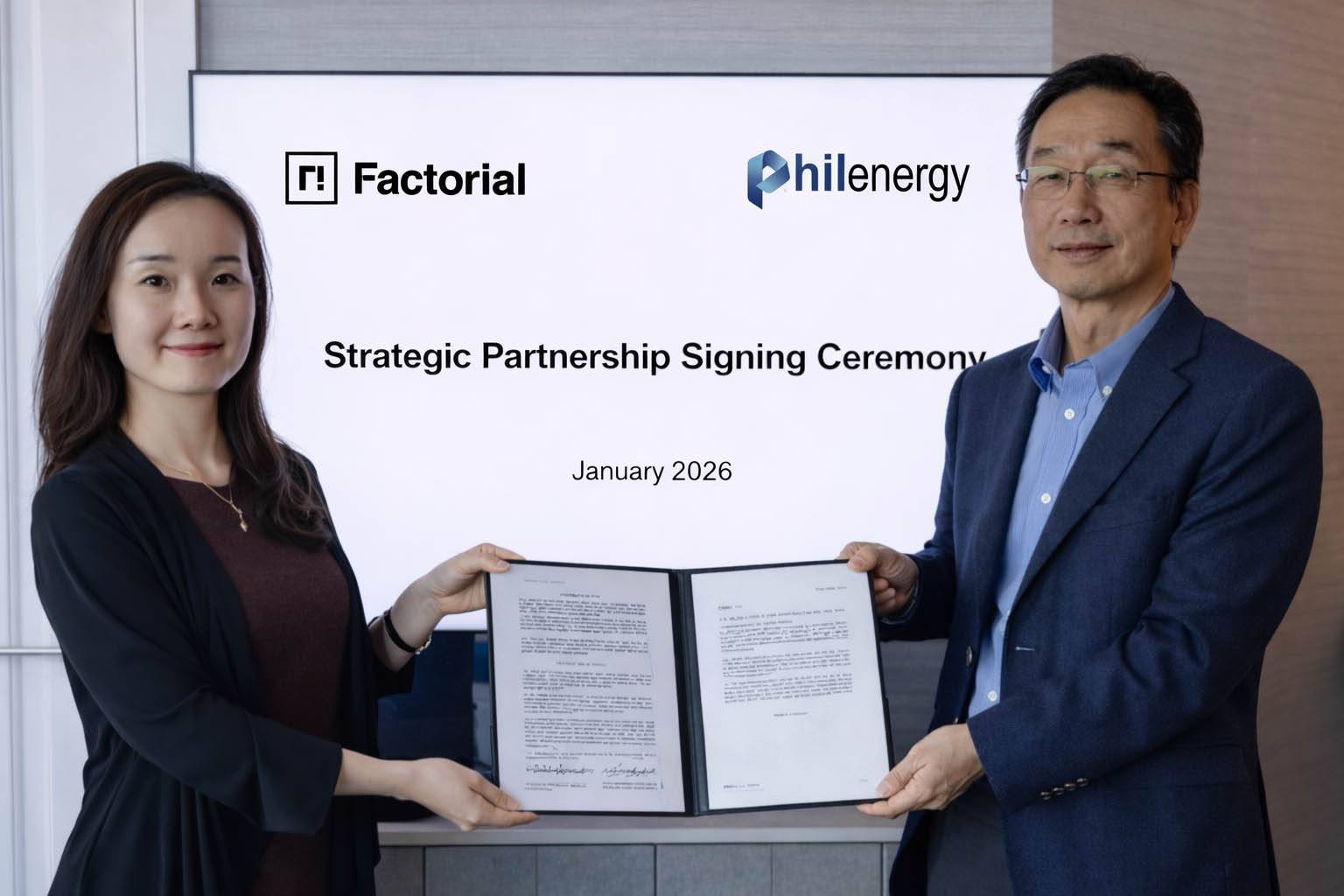
U.S.-based solid-state battery developer Factorial Inc. has signed a memorandum of understanding with South Korea’s Philenergy to explore a strategic manufacturing partnership aimed at scaling production of its Solstice all-solid-state battery technology.
Under the agreement, the companies will assess integrating Philenergy’s manufacturing infrastructure and supply chain capabilities with Factorial’s proprietary battery architecture. The collaboration is intended to support commercialization of next-generation energy systems for applications such as transportation and industrial equipment.
See also: Karma Automotive Partners With Factorial on U.S. Solid-State Battery Production
“The companies that win in next-generation batteries won’t just have breakthrough technology – they’ll have production partners experienced in battery manufacturing and capable of delivering at scale,” said Factorial Chief Executive Siyu Huang. “Philenergy brings proven production expertise and infrastructure that matches the ambition of Solstice.”
Philenergy provides equipment and production systems for battery manufacturing, including automated processing technologies and modular factory designs. Factorial said these capabilities could enable faster transition from prototype development to volume manufacturing while maintaining process control requirements for solid-state batteries.
See also: Factorial Energy Partners With Posco Future M on Solid-State Battery Materials
Philenergy Chief Executive Kim Kwang-il described Factorial as a leading developer in the field. “Factorial has established itself as a true technology leader in the solid-state battery space, with deep materials expertise and a clear path toward scalable commercialization,” he said, adding that the partnership could help bring the technology to global markets.
Factorial said its Solstice platform is designed to deliver significantly higher energy density than conventional lithium-ion batteries while maintaining stable operation at elevated temperatures. The architecture also uses a dry cathode process that reduces reliance on hazardous solvents and energy-intensive manufacturing steps.
See also: Factorial Unveils Gammatron™ AI Platform to Fast-Track Solid-State Battery Innovation
The companies said the collaboration reflects growing demand for energy storage systems capable of operating safely under demanding conditions, with potential applications across transportation, defence and industrial sectors.


