



A new EU-funded study has found that developing just a few low-risk rare earth deposits globally could significantly reduce Europe’s dependency on imports, bolstering the continent’s supply chain resilience for electric vehicles and renewable energy technologies.
The research, part of the EU- and UKRI-backed REEsilience project, assessed 149 global rare earth deposits and evaluated them using environmental, social, and governance (ESG) criteria. The study identified low-risk, high-potential sources in countries such as Norway, Sweden, Finland, Canada, Australia, and Greenland. These findings come amid growing concern over Europe’s dependence on China, which dominates the rare earth market and has recently imposed export restrictions.
“A critical mineral supply chain can only be truly resilient if it is also sustainable, in the broadest sense. That’s why it’s important to consider ESG aspects before exploiting new rare earth deposits,” said Maarten Koese of Leiden University.
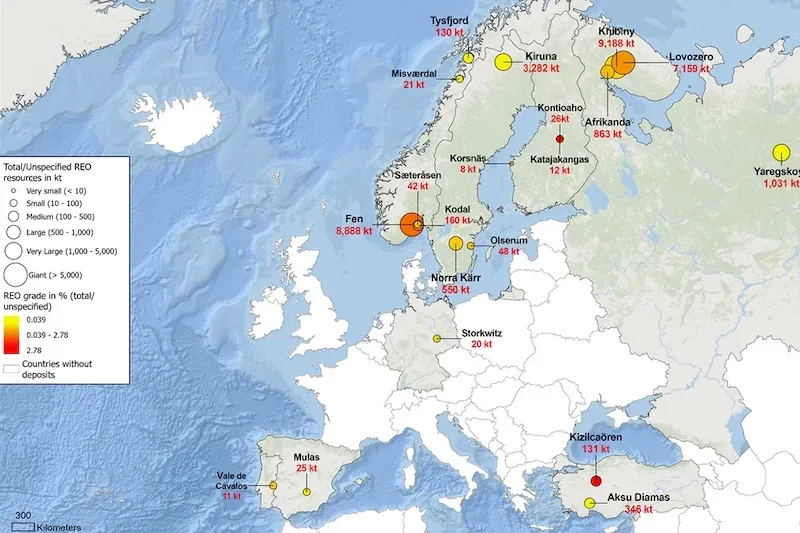
The project highlights the Fen complex in Norway and sites in Greenland as promising examples, due to their high ore quality and low ESG risk profiles. In contrast, regions such as Central Africa, Southeast Asia, and parts of Brazil were found to pose significant environmental and social concerns.
Prof. Dr. Carlo Burkhardt, REEsilience coordinator, emphasized the need to consider the full supply chain: “For a supply chain that is both resilient and sustainable, it is of vital importance not to focus only on the technical part of magnet production but to see the bigger picture. Our REEsilience partners have done a tremendous job here.”
The project also includes a system dynamics model developed to simulate future supply chain scenarios and assess resilience strategies such as increased recycling and product lifetime extension. “Simulation modelling of uncertain systems like global metal supply chains can really help with understanding the future challenges of these systems and how to overcome them,” said Dr.ir. Willem Auping of TU Delft.
As the project continues through June 2026, researchers aim to support the development of a more self-sufficient European rare earth magnet supply chain through advances in recycling, automation, and expert training—paving the way for a cleaner and more secure green energy future.
See also: idw-online.de