




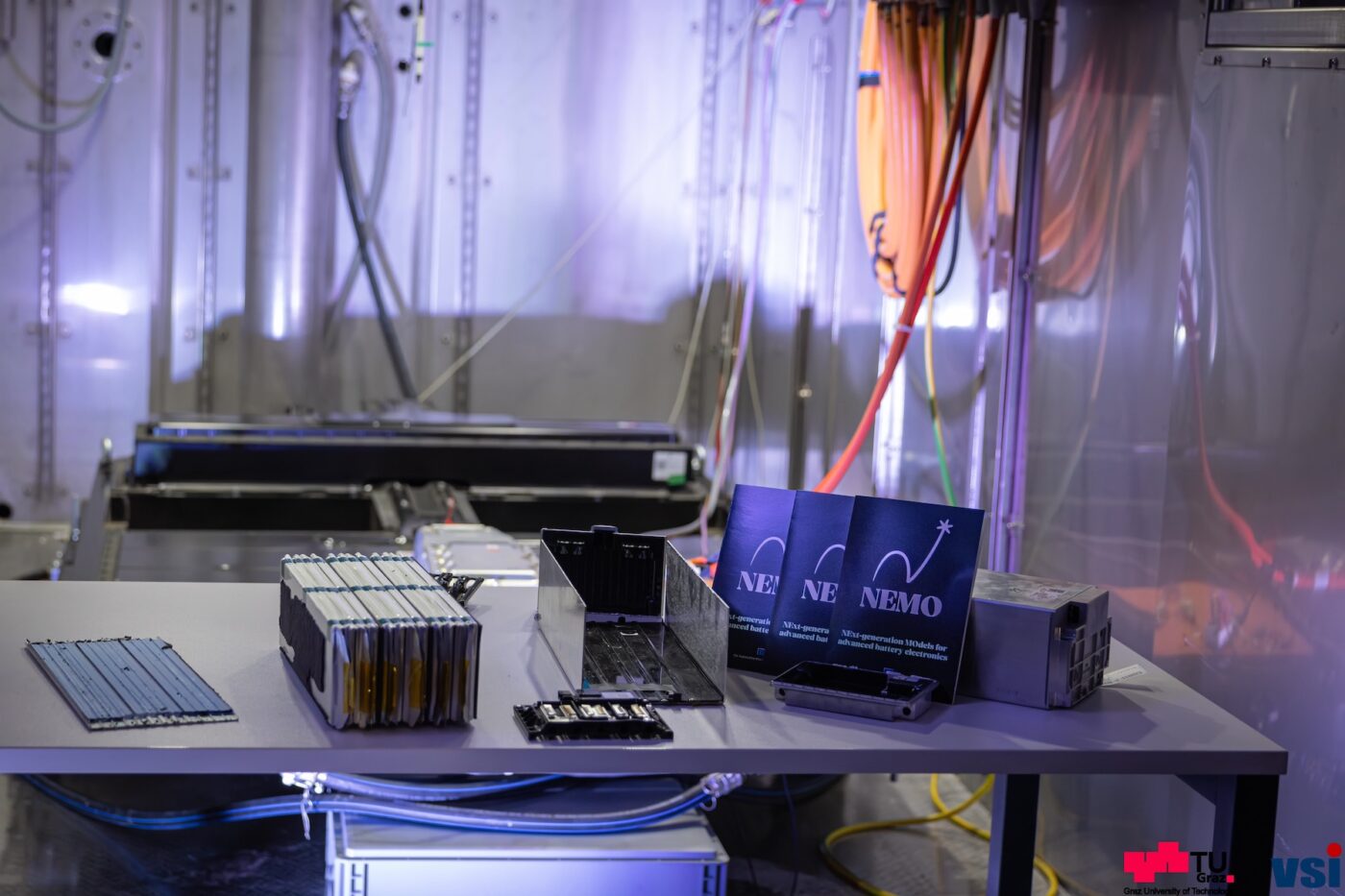
A European research consortium led by academic and industry partners has developed an advanced battery management system (BMS) designed to provide significantly deeper insights into electric vehicle battery health, safety and ageing.
The innovation was created under the EU- and Switzerland-funded Nemo project, which brought together researchers from TU Graz, the University of Brussels, Infineon Technologies Austria, engineering service provider IAV and several other partners.
Moving beyond conventional battery monitoring
Battery management systems play a critical role in monitoring traction batteries in electric vehicles. However, most commercially available systems rely primarily on voltage, current and temperature measurements, limiting their ability to identify internal battery degradation and damage.
The Nemo project sought to address these limitations by developing a next-generation BMS capable of monitoring battery safety, performance and ageing in real time.
According to the researchers, the new system can provide detailed information about individual battery cells while the vehicle is in operation.
Early fault detection and longer battery life
Christoph Drießen of the Vehicle Safety Institute at TU Graz said the technology could improve both vehicle safety and battery durability.
“The battery management system is an important tool for operating electric vehicles more safely and sustainably,” said Drießen.
“If we recognise faults and damage to individual battery cells at an early stage via the BMS, many dangers can be avoided. And thanks to the monitoring of the ageing process of each individual cell, their service life can also be extended substantially through intelligent control.”
Simulating real-world battery damage
Researchers at TU Graz focused on battery safety analysis as part of the project.
At the Graz Battery Safety Centre, the team intentionally deformed battery cells to simulate real-world incidents such as vehicle impacts or parking-related damage.
Data collected from these tests was used to train proprietary algorithms and predictive models capable of identifying battery damage and recommending maintenance actions automatically.
Meanwhile, researchers at the University of Brussels developed algorithms focused on battery ageing and lifespan prediction.
Electrochemical impedance spectroscopy at the core
To gain deeper insight into battery conditions, the project incorporated electrochemical impedance spectroscopy (EIS), an advanced sensing method that measures electrical resistance within battery cells during operation.
The technology enables the system to observe changes occurring inside cells that are not visible through traditional monitoring methods.
According to the research team, this provides a far more detailed picture of battery health than existing BMS solutions.
Improved understanding of battery ageing
The researchers believe the new system offers significant advantages over conventional battery diagnostics.
“Up to now, a test only showed how much the capacity has decreased compared to the original battery condition,” said Drießen.
“But the new models also give us an insight into the changes within the cells as they age. This enables adjustments that are beneficial for performance, service life and safety.”
By identifying internal changes at an earlier stage, the system could help optimize charging strategies, improve battery performance and reduce long-term degradation.
Path toward industrial deployment
Despite its expanded functionality, the consortium believes the advanced BMS can be integrated into electric vehicles without significant increases in size or weight.
The system requires additional sensors and adaptations to existing battery management architectures in order to perform EIS measurements, but researchers say implementation remains practical for future vehicle applications.
The Nemo consortium has already developed a module-level demonstrator and plans to continue refining the technology through follow-up projects focused on industrialization and commercial deployment.
As battery performance, longevity and safety become increasingly important in the rapidly growing electric vehicle market, advanced monitoring technologies such as those developed through the Nemo project could play a key role in the next generation of EV battery systems.