
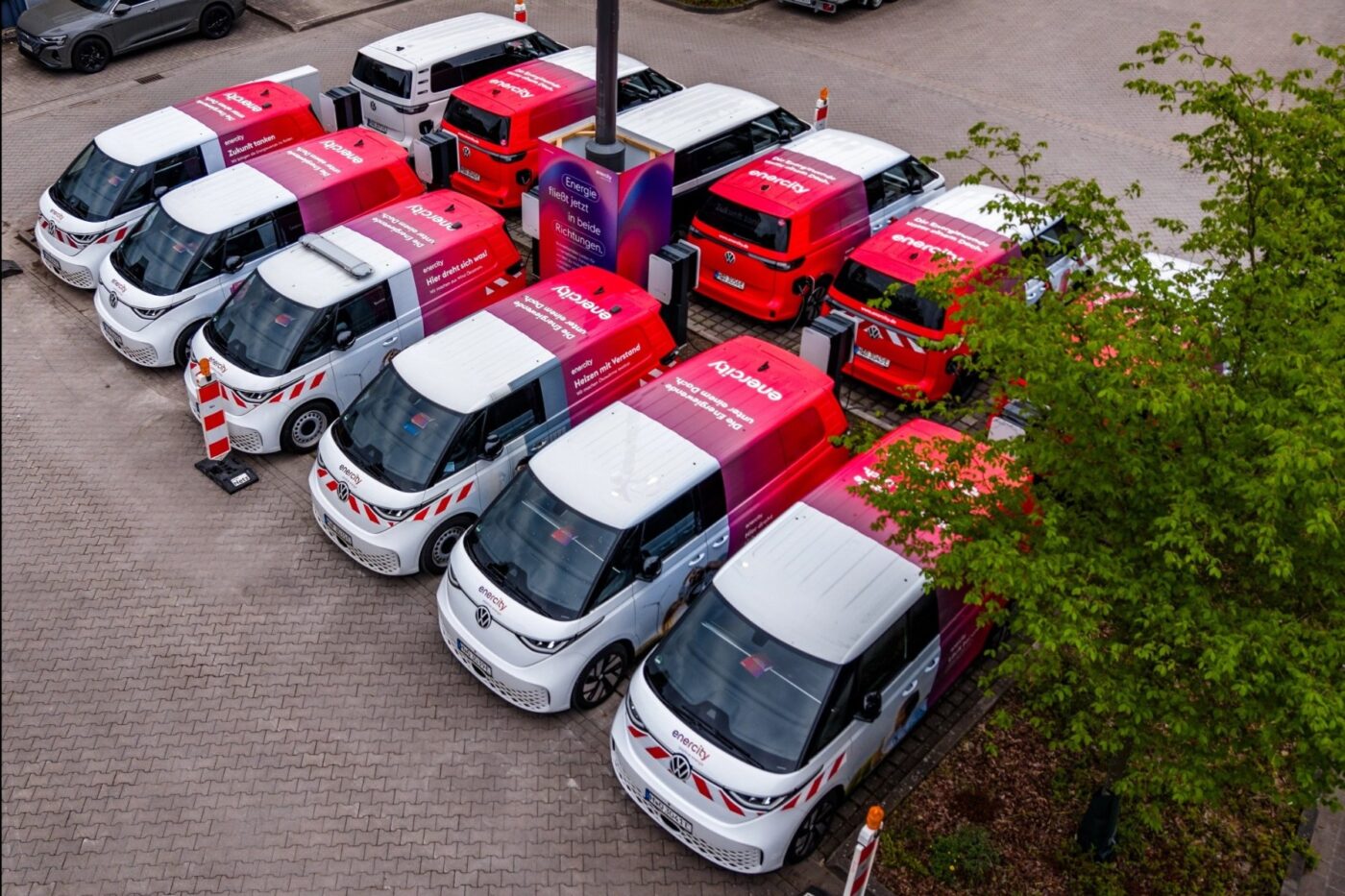
German utility Enercity and Volkswagen Commercial Vehicles have completed a vehicle-to-grid (V2G) pilot project that successfully supplied electricity from electric vehicles back into the public grid and traded it on the electricity exchange, marking a milestone for fleet-based energy flexibility services.
The trial, conducted in Hanover, is believed to be the first instance of a commercial electric vehicle fleet operating as a virtual energy storage system within a real-world business-to-business environment while actively participating in energy market trading.
Using 12 bidirectionally connected Volkswagen ID. Buzz electric vans from Enercity’s company fleet, the project demonstrated how electric vehicles can be aggregated and managed like stationary battery storage systems.
The vehicles were connected through 12 bidirectional charging points, creating a combined technical aggregation capacity of 0.132 MW. Enercity traded 0.1 MW of capacity on the energy market, which the company considers the minimum threshold required for participation.
The test ran for 53 hours between May 8 and May 10. Operations concluded at midnight on Sunday to ensure sufficient battery charge for normal fleet operations on Monday morning.
During the trial period, the system executed 145 transactions on the continuous intraday electricity market.
Although technical limitations affected the exchange connection during part of the test, Enercity said the project generated revenue in the low three-figure euro range through energy trading.
Under the pilot, the electric vehicle fleet was treated as a distributed storage asset. The system automatically charged vehicle batteries when electricity prices were low and discharged energy back to the grid when prices increased.
The vehicles responded dynamically to real-time market signals, demonstrating that electric fleets can be algorithmically controlled using the same principles applied to conventional battery energy storage systems.
For Enercity, the trial represented a transition from simulation-based testing to real-world market participation.
Aurélie Alemany, Chairwoman of the Board of Enercity AG, said the project highlights the growing role of flexibility in future energy systems.
“Flexibility is a key component of the energy transition, and we see that we can increasingly unlock it through bidirectional charging,” said Aurélie Alemany, Chairwoman of the Board of Enercity AG.
“The milestone we have now achieved shows the potential inherent in linking mobility and energy systems. Commercial electric fleets can prospectively provide flexibility precisely when the energy system needs it. This contributes to grid stability and the integration of renewable energies while opening up new economic opportunities for our business customers,” Alemany added.
Enercity believes commercial fleets are particularly well suited for bidirectional charging because vehicle availability can be managed more predictably than privately owned vehicles.
The utility currently operates a fleet of 75 Volkswagen ID. Buzz vans, providing a controlled environment where vehicles are typically parked and connected during evenings and weekends.
The project began in 2025 when Enercity initially connected a single vehicle to a virtual power plant to test communication and control systems.
Following a four-month shadow trading phase that evaluated data flows, software integration and system stability, the company expanded the setup to twelve charging points capable of meeting the minimum capacity requirements for actual energy trading.
According to Enercity, the latest trial demonstrated that the integration of vehicles, charging infrastructure, virtual power plant software and energy market trading platforms can function reliably under real operating conditions.
However, the company said significant regulatory questions remain before vehicle-to-grid services can be deployed at scale.
One of the main unresolved issues concerns how electricity stored temporarily in electric vehicle batteries should be treated under Germany’s energy regulations, particularly regarding grid fees, levies, taxes and the prevention of double charging or double taxation.
Operators must also be able to distinguish between electricity consumed for vehicle operation and electricity stored temporarily before being returned to the grid.
Enercity said ongoing discussions involving Germany’s Federal Network Agency (Bundesnetzagentur) and future grid fee reforms will play a crucial role in determining the commercial viability of large-scale vehicle-to-grid services.
The company expects an interim regulatory framework to emerge by the end of 2028, potentially integrating both stationary and mobile energy storage systems under the planned AgNes grid fee structure.
Looking ahead, Enercity intends to develop commercial flexibility and aggregation services for fleet operators based on the results of the pilot.
The utility sees fleet-based energy management as a future business area where thousands of connected electric vehicles could function as a highly distributed virtual power plant, providing balancing services and supporting renewable energy integration.
According to the company, once regulatory certainty is established, the technology could operate automatically during periods when fleet vehicles are not needed, particularly overnight and during weekends, allowing businesses to generate additional value from their electric vehicle assets while supporting grid stability.
Source: Electrive