
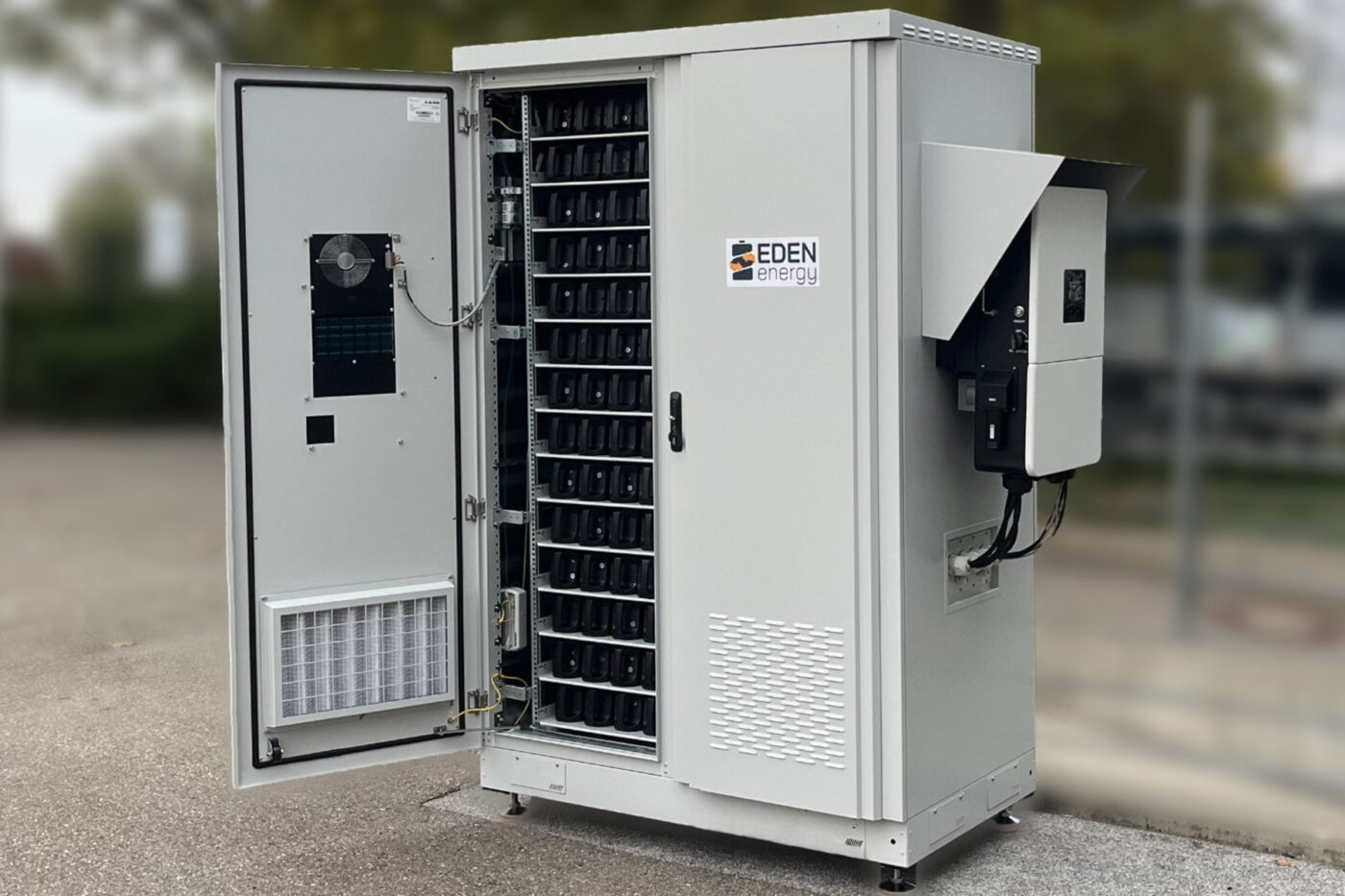
German start-up EDENenergy has delivered its first stationary energy storage system built from used e-scooter batteries, marking an initial deployment of its second-life battery technology for commercial and industrial applications.
The 70 kWh system was delivered to a customer in mid-October. Based in Freiburg, EDENenergy is a spin-off from the Fraunhofer Institute for Solar Energy Systems ISE and is developing modular storage solutions that reuse batteries from electric scooters and bicycles.
The first installation combines 112 used e-scooter batteries connected in series. Before integration, each battery is assessed to determine its technical condition and remaining capacity.
The company said testing results have been better than initially anticipated. Among approximately 350 batteries examined, some retained more than 90% of their original capacity, compared with the 80% State of Health (SoH) level used in EDENenergy’s initial planning assumptions.
Power Electronics Enable Modular Battery Integration
EDENenergy’s technology is based on power electronics developed at Fraunhofer ISE. The system is designed to combine batteries with different physical formats and battery management systems into a single stationary storage installation without dismantling the individual battery units.
However, sourcing remains an operational consideration. The company currently focuses on larger suppliers, including e-scooter and e-bike fleet operators, to secure sufficient quantities of batteries of the same type.
The modular design also allows individual battery units to be replaced when necessary. EDENenergy remotely monitors the modules and can exchange batteries during operation, with the aim of maintaining the system’s overall storage capacity over time.
The company expects the initial 70 kWh capacity to remain available after ten years. Batteries that can no longer be used in the storage system will be sent for recycling.
Commercial Customers and Larger Systems Targeted
EDENenergy is initially targeting small and medium-sized businesses with their own photovoltaic installations. Its storage systems are intended to help customers increase on-site solar electricity consumption and reduce peak electricity demand.
The company also identifies potential applications for municipal utilities and electricity trading. Over the longer term, it plans to expand its modular systems to capacities of up to 300 kWh.
Integrating different battery types remains a technical challenge. Each new battery format can require adjustments to connectors, battery management systems and communication protocols.
EDENenergy sees standardised communication interfaces and clearer regulatory frameworks as important conditions for expanding the stationary reuse of batteries originally designed for mobile applications.
Second-Life Use Before Material Recovery
EDENenergy’s approach differs from battery recycling initiatives that focus primarily on recovering raw materials. In 2025, e-scooter operator Lime and US-based Redwood Materials agreed to cooperate on battery recycling in Germany, the Netherlands and the United States.
While that initiative centres on recovering materials for use in new batteries, EDENenergy aims to extend the useful life of batteries that remain technically functional by deploying them in stationary storage systems before they enter the recycling process.
The start-up is now seeking additional pilot customers among businesses in the region to support further development and deployment.
Projects under Baden-Württemberg’s “Mittelstand trifft Start-ups” funding programme can reportedly receive support covering 50% of eligible project costs. EDENenergy also receives backing from the Sustainability Performance Centre and the BW Pre-Seed programme. Its first investor is JobRad founder Ulrich Prediger.