




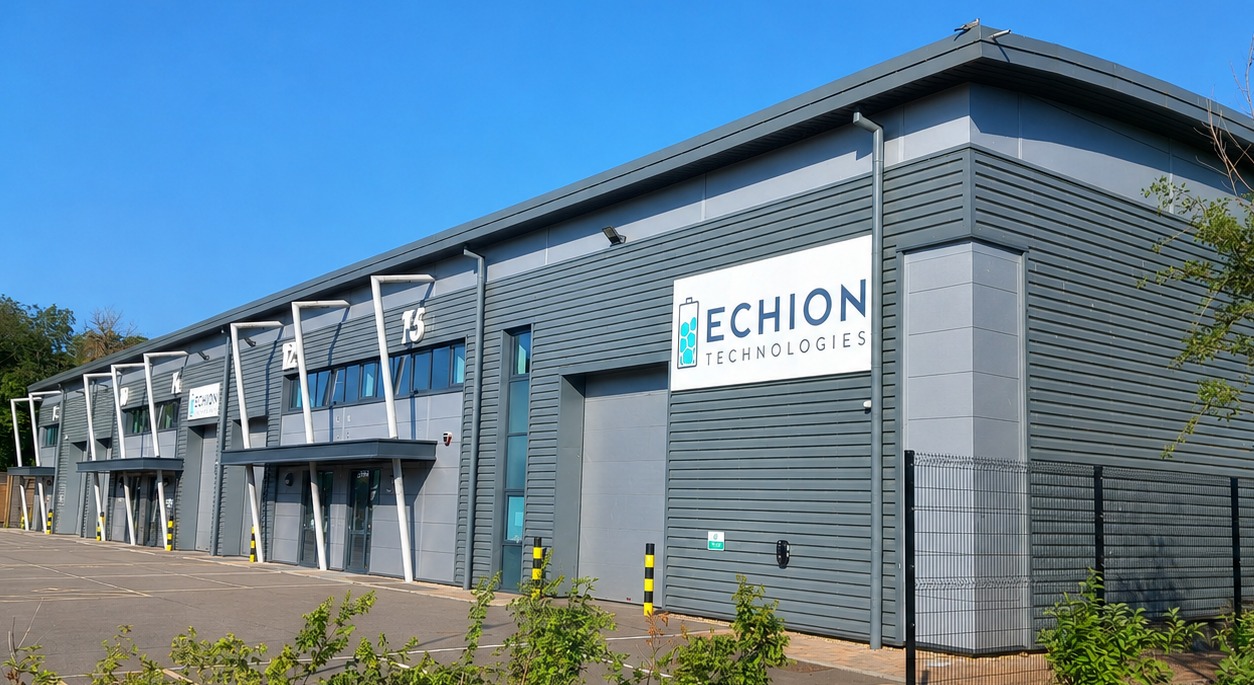
UK battery materials company Echion Technologies has signed a memorandum of understanding with South Korean battery equipment supplier Energy Tech Solution (ETS) to jointly develop battery cells using Echion’s XNO niobium-based anode material.
Under the agreement, ETS will be responsible for cell design, provide manufacturing technology and act as a contract manufacturer for demonstration cells. The partnership is intended to advance XNO from an anode material into complete battery cells for applications requiring fast charging and high cycle stability.
ETS to Produce XNO Cells in Multiple Formats
Echion describes ETS as the first “total battery solution provider” in its partner network. Headquartered in Seoul with an additional site in Chungju, ETS develops battery production equipment for startups and gigafactories and also manufactures cells on a contract basis.
As part of the agreement, ETS will provide capacity at its Chungju facility to produce XNO cells in cylindrical, prismatic and pouch formats.
Y.H. Kim, CEO of ETS, said the company’s testing of Echion’s material has demonstrated its performance potential.
“Echion has demonstrated incredible performance capabilities in our custom-designed cells,” Kim said. “As battery technology saturates every aspect of the global energy system, this long-lasting and high-performance chemistry will find its place serving the most demanding users.”
XNO Replaces Graphite in Lithium-Ion Cells
Echion’s XNO technology focuses on the anode rather than replacing the entire lithium-ion battery chemistry.
The niobium oxide-based XNO material is designed to replace the graphite typically used in lithium-ion battery anodes. According to Echion, existing cathode chemistries such as nickel manganese cobalt (NMC) or lithium iron phosphate (LFP) can remain unchanged.
The company therefore describes XNO as a “drop-in” anode material that can be processed using conventional electrode coating equipment.
The primary targets are fast charging and long service life. Echion specifies continuous charging rates of up to 10C, which theoretically could allow a full charge in approximately six minutes.
Under optimized conditions, the company cites more than 50,000 charge cycles. For industrial applications involving deeper cycling, Echion cites more than 15,000 cycles.
Targeting High-Use Industrial Applications
XNO is being developed primarily for applications in which batteries are repeatedly charged and discharged, rather than for maximizing driving range.
Potential applications include mining vehicles, rail vehicles, ships, forklifts, stationary energy storage and uninterruptible power supplies for data centres.
Echion compares the technology with lithium titanate (LTO), which is also known for rapid charging and high cycle life. The company says XNO offers approximately twice the energy density of LTO while maintaining similarly high cycle stability.
XNO Production Reaches Industrial Scale
Echion said XNO has been produced at industrial scale since 2025.
The company operates a production facility in Araxá, Brazil, with niobium producer CBMM. The facility has annual XNO production capacity of 2,000 tonnes, which Echion estimates is sufficient for approximately 1 GWh of battery cells.
The agreement with ETS adds cell development and manufacturing capabilities to the XNO supply chain, allowing the companies to produce demonstration cells in different form factors.
Demonstration Cells to Test Fast Charging and Cycle Life
The initial phase of the partnership will focus on demonstrating XNO cells with high charging rates and cycle stability.
ETS and Echion are targeting charging rates of up to 10C and cycle life of up to 50,000 cycles. Whether these performance levels can be maintained in mass-produced cells and under real-world operating conditions will require further development and testing.
Echion CEO Jean de La Verpilliere said ETS combines battery manufacturing capabilities with process engineering and research and development expertise.
“Energy Tech Solution offer a comprehensive range of battery solution services and manufacturing expertise, and have shown themselves to be adept at bridging process engineering and scientific R&D,” de La Verpilliere said. “We’re confident that XNO® batteries manufactured by the experts at ETS, on their well-trusted equipment, will give those customers seeking to produce their own XNO® batteries the charging speed and cycle life they need to run their businesses.”


