




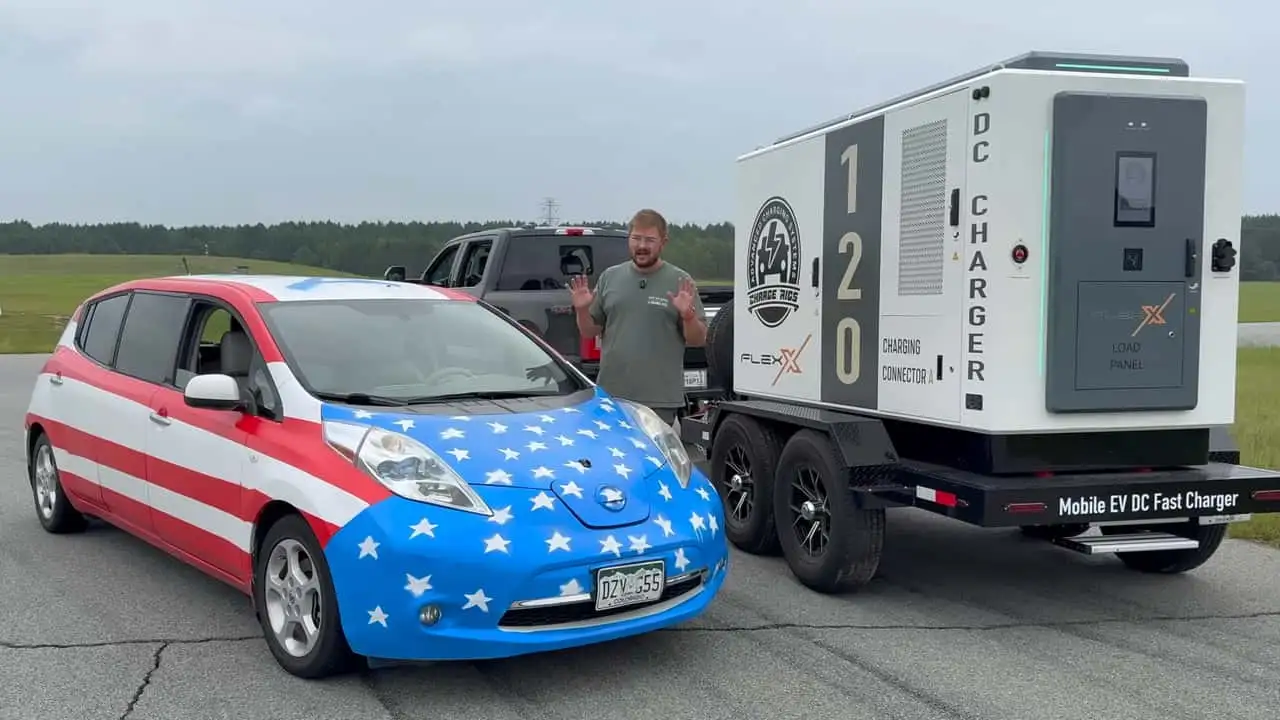
A first-generation Nissan LEAF limousine fitted with dual batteries managed to travel nearly 19 miles after its range display reached zero, according to a test by Out of Spec Testing.
Kyle Conner, who owns the retrofitted ex-Las Vegas limousine, said the unusual configuration was designed to extend the car’s range. The vehicle carries its original 24 kilowatt-hour (kWh) battery in a custom rack and an additional used 24 kWh pack mounted in the factory cradle, wired in parallel.
See also: Everything You Should Know About the All-New 2026 Nissan LEAF
The test aimed to measure how far the electric vehicle could travel on “empty” while maintaining speeds of 30 to 50 miles per hour with air conditioning running. After the low-battery warning, the LEAF entered “turtle mode” at seven miles past zero, reducing acceleration but sustaining 30 mph. The car ultimately came to a stop at 18.9 miles past zero when the transmission locked into neutral.

“It still blows cold air through the A/C vents even in turtle mode,” Conner noted in the video documenting the drive.
See also: New Nissan LEAF Adds 250 Kilometers of Range in Just 14 Minutes with Fast Charging
Despite its age and lack of a thermal management system, the LEAF immediately accepted a fast charge after the deep discharge, using a mobile power station with a CCS-to-CHAdeMO adapter. The efficiency during the test was measured at 4.1 miles per kilowatt-hour at an average speed of about 30 mph.
While the findings may not apply to most EV drivers, Conner said the experiment shows that older electric cars retain some range after their instruments indicate zero. This could provide reassurance to drivers that a limited buffer exists to reach a charger.


