



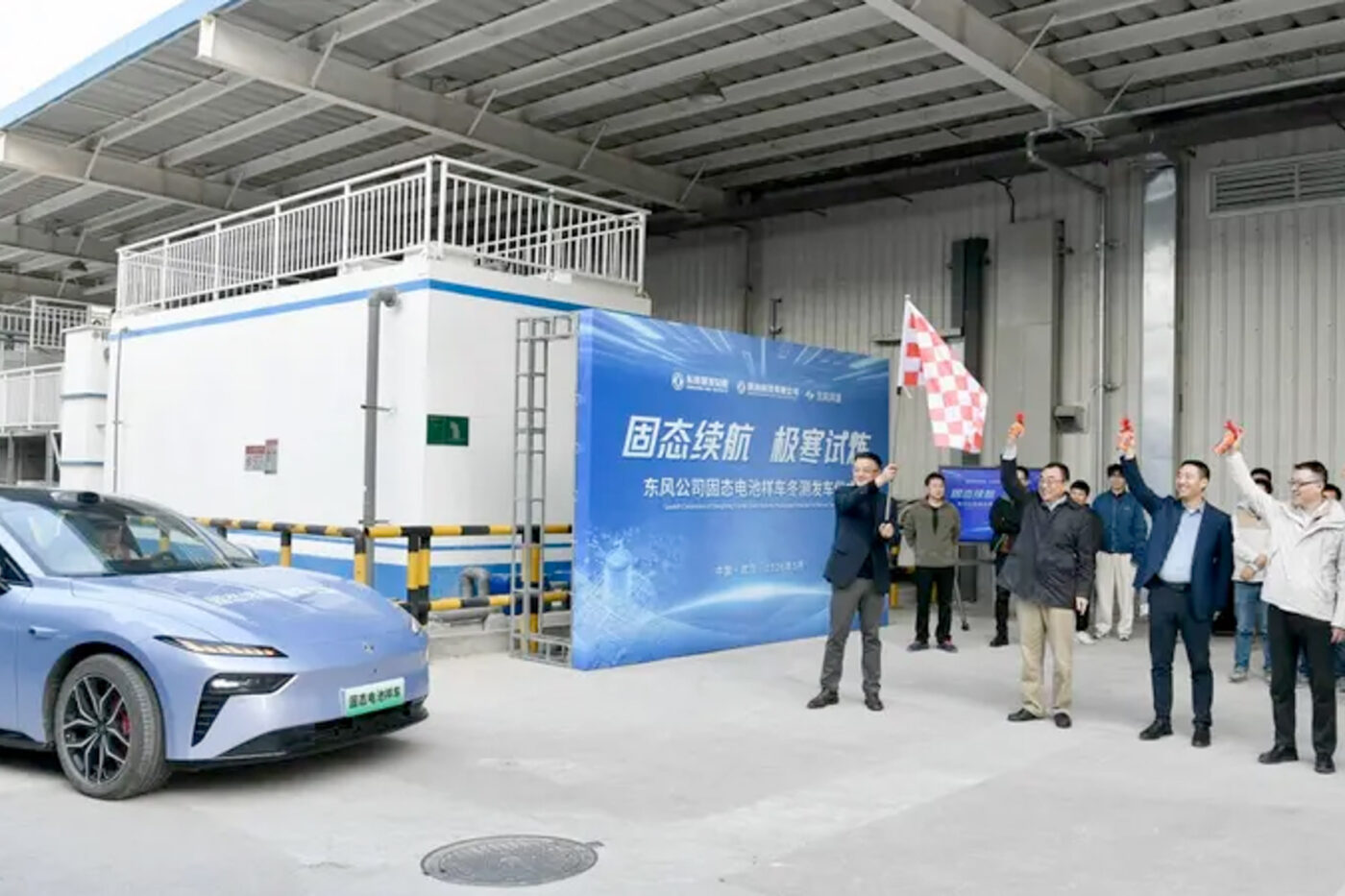
Dongfeng Motor has begun winter testing of electric vehicle prototypes equipped with solid-state batteries, marking a further step toward the planned industrialisation of the technology, according to Chinese media reports.
The prototypes, understood to be based on the Dongfeng 007 sedan, are fitted with solid-state cells offering an energy density of 350 watt-hours per kilogram. Dongfeng has said it aims to begin mass production of batteries at this energy density by September 2026. The first series application, however, is expected to be deployed under Dongfeng’s premium electric brand Voyah, rather than the core Dongfeng marque. As recently as February 2025, Dongfeng had publicly referred to a target energy density of around 300 Wh/kg.
See also: Dongfeng Targets 2026 for Mass Production of 350 Wh/kg Solid-State Batteries
The test vehicles departed Dongfeng’s headquarters in Wuhan earlier this week and are heading north to Mohe, one of China’s coldest regions. Dongfeng said the tests in Heilongjiang province represent a “decisive step towards the industrial application” of its solid-state battery technology.
According to the company, the 350 Wh/kg cells were produced on Dongfeng’s pilot production line and have already passed multiple validation stages covering materials and electrochemical system design. The winter programme is intended to verify laboratory results under real-world conditions, including snow, ice and rapidly changing temperatures.
See also: Dongfeng Motor Develops Fully Independent Solid-State Battery Supply Chain in China
Chinese reports indicate that more than 70 individual tests are planned at temperatures between minus 40 and minus 30 degrees Celsius. These will assess range stability, charge and discharge efficiency, structural safety and vehicle integration. Dongfeng has said the batteries retained up to 72% of their energy at minus 30 degrees Celsius during earlier testing and also passed high-temperature safety tests at 170 degrees Celsius.
Dongfeng has disclosed few additional technical details, stating only that the solid-state battery is designed for high safety, improved low-temperature performance and a driving range of more than 1,000 kilometres. The range figure is likely based on China’s CLTC test cycle and is primarily enabled by the higher energy density at cell level. For comparison, lithium iron phosphate batteries typically offer around 140 to 210 Wh/kg, while conventional nickel-manganese-cobalt cells range from roughly 200 to 260 Wh/kg.
See also: China Urges Auto Industry Consolidation to Boost EV Transition, Eyes Dongfeng-Changan Merger
Although the 350 Wh/kg battery is expected to debut in a Voyah production model, Dongfeng has said it is developing a broader modular portfolio, with planned solid-state battery products spanning energy densities from 240 Wh/kg up to 500 Wh/kg.
According to a report cited by Chinese outlet CarNewsChina from the newspaper Hubei Daily, Dongfeng’s solid-state batteries use high-capacity ternary cathodes, silicon-carbon anodes and oxide-polymer composite solid electrolytes. The company has said the design is intended to address safety concerns and low-temperature limitations associated with conventional lithium-ion batteries.


