



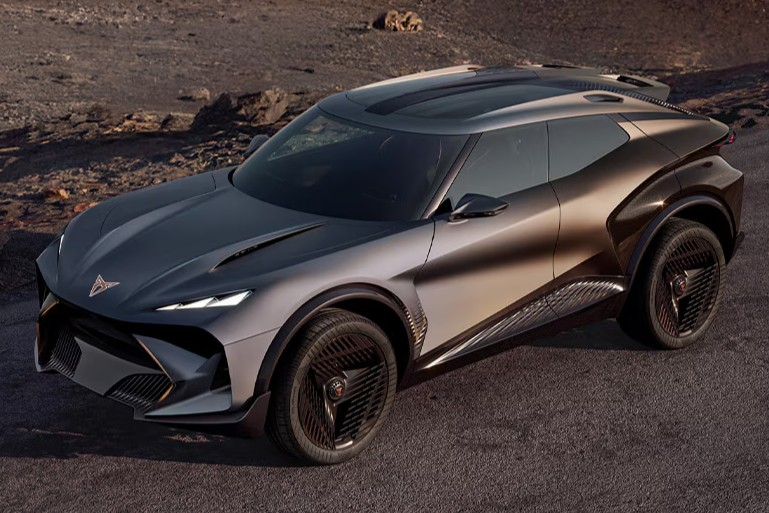
Cupra has confirmed that its Tindaya concept vehicle will enter series production, with the future flagship crossover expected to reach the market in the coming years.
The announcement was made by Seat and Cupra CEO Markus Haupt, who revealed that development work on the production version is already underway. However, the company has yet to decide whether the model will retain the range-extender electric powertrain showcased in the concept or launch as a fully electric vehicle.
The Tindaya was first unveiled at the IAA Mobility show in Munich in September 2025 and is expected to sit above the battery-electric Tavascan in Cupra’s lineup.
Production Plans Confirmed
Named after the volcanic mountain on the Spanish island of Fuerteventura, the Tindaya concept was introduced as a high-performance crossover measuring 4.72 metres in length.
Speaking to Autocar, Haupt confirmed that the model is part of Cupra’s future product plans.
“It looks fantastic – why should we not build the Tindaya?” Haupt said.
“We are indeed looking at our plans for when we could build the Tindaya, but it’s something I can promise: this car will see the streets in some years.”
The production model is expected to become one of the most important vehicles in Cupra’s future portfolio as the brand continues its expansion into higher market segments.
Originally Presented as a Range-Extended EV
When unveiled at IAA 2025, the Tindaya featured an electric drivetrain supported by a range-extending petrol engine.
The concept combined electric motors delivering a total system output of 365 kW with a 1.5-litre TSI engine that functioned solely as a generator to produce electricity for the battery and motors.
According to Cupra, the show car offered approximately 300 kilometres of electric driving range and a combined range of around 1,000 kilometres.
The company did not disclose battery specifications at the time.
Built on Volkswagen Group’s SSP Platform
The future production model will be based on Volkswagen Group’s upcoming Scalable Systems Platform (SSP), the next-generation vehicle architecture intended to underpin a wide range of future models across the group.
Volkswagen is expected to introduce the SSP platform first in an Audi model before expanding its use to Porsche, Volkswagen, Cupra and other brands.
The architecture will also support future vehicles such as the Volkswagen ID. Golf and is expected to serve as the foundation for approximately 30 million vehicles across the Volkswagen Group over its lifecycle.
The SSP platform incorporates a new zonal electronic architecture and software systems developed through Volkswagen’s partnership with US electric vehicle manufacturer Rivian.
Flexible Approach to Powertrains
Originally conceived as a dedicated battery-electric vehicle platform, SSP has since evolved to support range-extender technologies in response to changing market conditions and consumer demand.
Unlike traditional plug-in hybrid systems currently used on Volkswagen Group’s MQB platform, the SSP architecture is designed to accommodate fully electric vehicles and range-extender configurations.
Cupra has not yet decided which approach it will take for the production Tindaya.
“But which powertrains will we have in the end? It’s a decision we have not taken now, and we want to stay flexible as long as possible, because when the car hits the streets, we need to ensure that it has the right powertrains for our markets, for our customers,” Haupt told Autocar.
The executive added that discussions regarding future powertrain strategies are evolving rapidly, making it important for the company to maintain flexibility until closer to launch.
Expanding Cupra’s Premium Ambitions
The Tindaya reflects Cupra’s broader strategy of moving further into the premium performance segment while expanding its electrified vehicle lineup.
Whether it ultimately arrives as a fully electric SUV or a range-extended electric vehicle, the model is expected to play a key role in defining the brand’s next generation of products and showcasing the capabilities of Volkswagen Group’s SSP architecture.
With development ongoing and the SSP platform still awaiting its first production application, the Tindaya is unlikely to reach customers before the end of the decade.


