
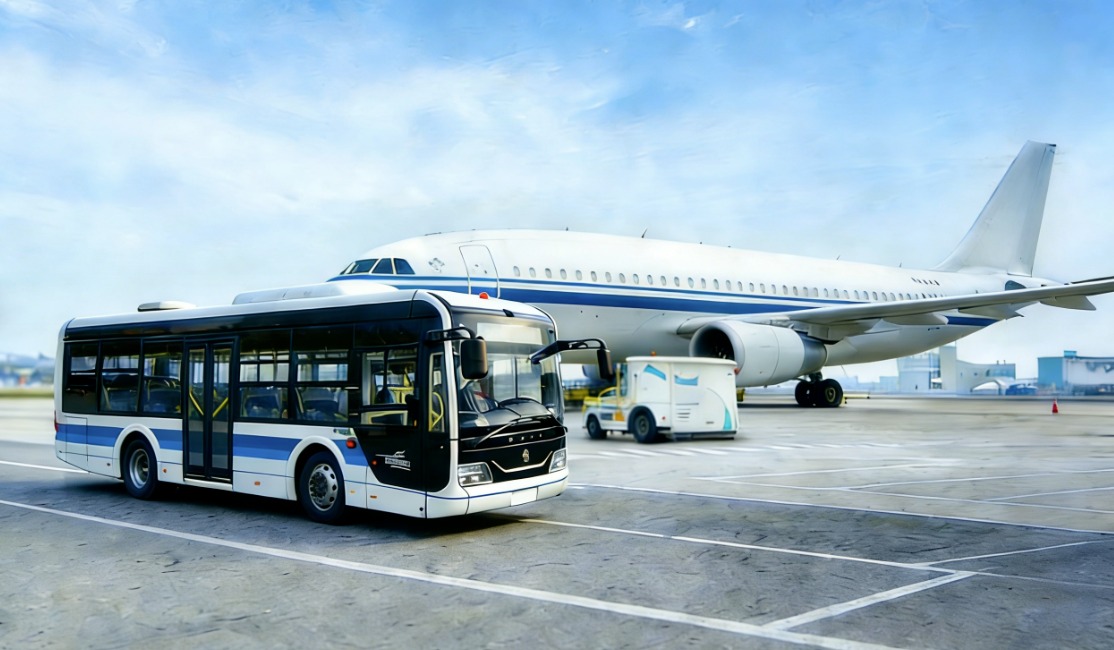
Automotive Intelligence and Control of China (AICC) said it has secured an airport shuttle bus order worth tens of millions of yuan, marking the start of large-scale deliveries for its Level 3 autonomous-driving platform designed for original equipment manufacturer (OEM) mass production.
The contract was signed on Jan. 12 and focuses on deploying autonomous shuttle services in airport environments, AICC said. The collaboration is aimed at enabling “smart mobility, efficient connections, and round-the-clock operations,” using controlled airport scenarios to support automakers in accelerating the development and volume delivery of Level 3 autonomous vehicles.
See also: Pony.ai and BAIC BJEV Deepen Partnership to Scale Level 4 Robotaxi Operations
At the core of the solution is AICC’s self-developed Computing Base and Development System (CBDES), which the company describes as the “vehicle brain” within its vehicle–road–cloud integrated architecture. The platform is designed to support OEMs throughout the full production cycle, from system design and integration to on-vehicle validation and deployment.
The airport shuttle program uses CBDES’s layered and decoupled technical stack, combining platform hardware, operating systems and application software. A localized main domain controller, together with multi-sensor fusion, is intended to enhance functional safety and operational reliability at both the hardware and software levels.
See also: Hesai Selected by Nvidia as LiDAR Partner for Drive Hyperion L4 Platform
AICC said its proprietary ICVOS operating system underpins an end-to-end in-house algorithm stack covering perception fusion, high-precision positioning and decision-making. The system has been optimized for closed, low-speed airport environments to deliver accurate perception and stable autonomous driving performance.
Integrated with an intelligent operations cloud, the solution enables remote monitoring, data management and automated charging, forming a closed operational loop. The platform supports functions including autonomous navigation, obstacle avoidance, smart lane changes, intersection handling, automated docking, U-turns, self-parking and automatic charging, allowing for fully driverless airport shuttle operations.
See also: Pony.ai Grows Robotaxi Fleet to 1,159 Units, Surpassing 2025 Target
The order comes as Chinese autonomous driving companies increasingly target enclosed and semi-closed environments such as airports and ports as near-term pathways to commercial deployment, positioning them as stepping stones toward broader adoption of Level 3 autonomous systems.