




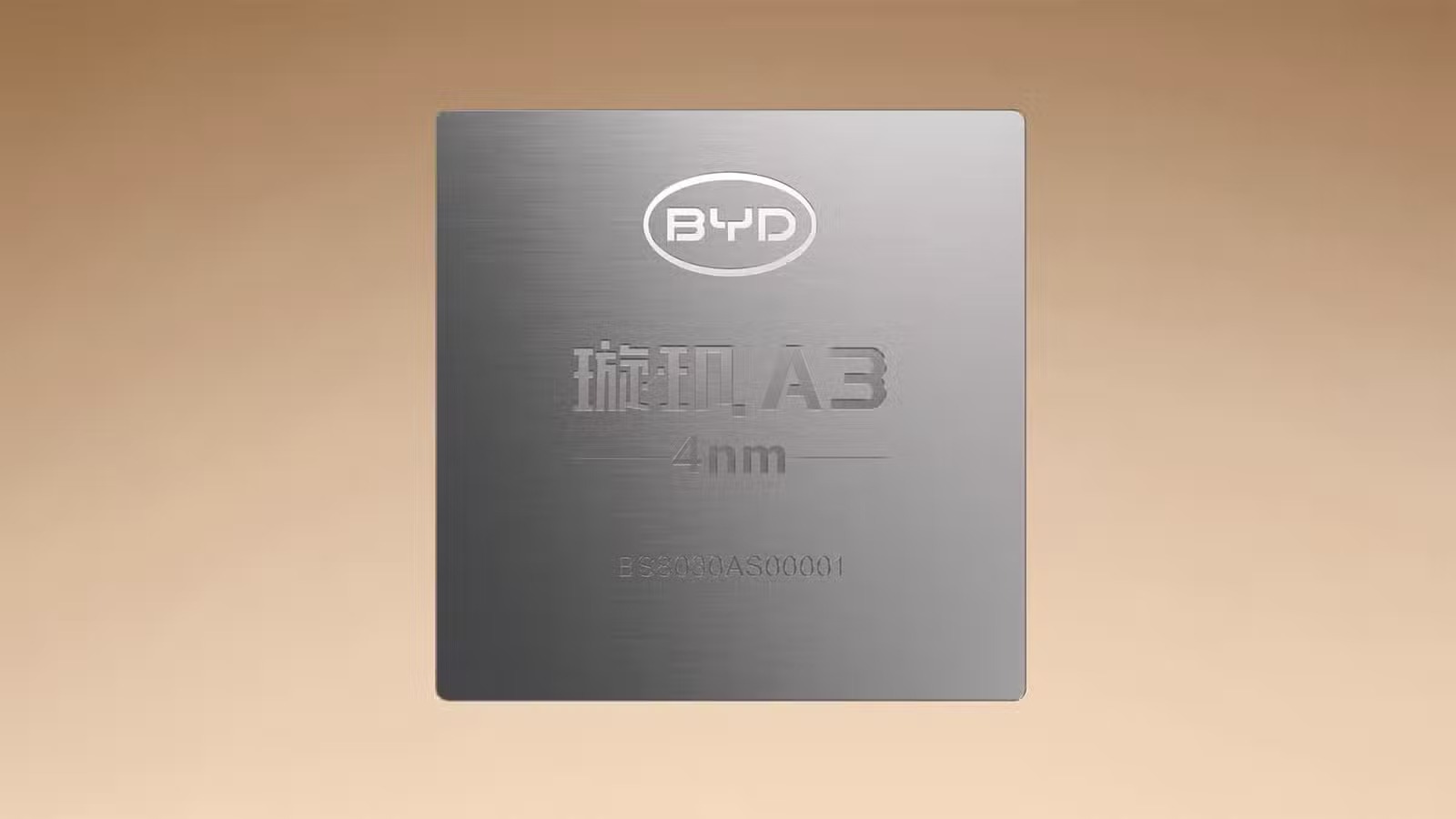
BYD has unveiled its first in-house developed smart driving chip, becoming the latest Chinese electric vehicle manufacturer to pursue proprietary semiconductor technology as competition intensifies in autonomous driving and artificial intelligence.
The Shenzhen-based automaker introduced the new processor, called the Xuanji A3, during its intelligence strategy launch event on Tuesday, describing it as China’s first smart driving chip built on a 4-nanometer process.
According to BYD, the chip is designed to support Level 3 and Level 4 autonomous driving functions and has already entered large-scale mass production.
The company said a configuration combining three Xuanji A3 chips can deliver more than 2,100 trillion operations per second (TOPS) of computing power.
BYD added that deep integration between the chip and its internally developed software algorithms has doubled computing power utilization compared with previous solutions.
The launch marks a significant milestone in BYD’s broader semiconductor strategy, which the company has been developing for more than two decades.
Wang Chuanfu, chairman and president of BYD, said the company established its integrated circuit design department in 2002, laying the foundation for its current semiconductor operations.
“The integrated circuit design department established in 2002 became the predecessor of BYD’s semiconductor business,” said Wang Chuanfu, Chairman and President of BYD.
According to the company, cumulative investment in chip-related research and development has exceeded 100 billion yuan ($14.75 billion).
BYD said it employs more than 7,000 engineers dedicated to chip development across four research and development centers.
The company has also built five wafer fabrication plants and claims to have introduced more than 2,000 semiconductor products covering applications in smart vehicles and consumer electronics.
BYD stated that it is currently the only automaker with capabilities spanning the entire semiconductor development and manufacturing process, from chip architecture design to wafer fabrication, packaging and testing.
The introduction of the Xuanji A3 gives BYD direct control over key components of its advanced driver-assistance and autonomous driving systems, enabling closer integration between hardware and software.
The move comes as several Chinese electric vehicle manufacturers accelerate efforts to develop proprietary chips to reduce dependence on external suppliers and strengthen their competitiveness in the AI-driven automotive market.
Nio was among the first Chinese automakers to commercialize its own autonomous driving processor. Its 5-nanometer Shenji NX9031 chip is now deployed across models sold under the Nio and Onvo brands.
Xpeng is also transitioning to its internally developed Turing AI chip, which is intended to support both intelligent cockpit systems and autonomous driving functions.
Meanwhile, Li Auto recently introduced its 5-nanometer Mach M100 processor, which debuted in the latest version of the Li Auto L9.
The growing focus on custom silicon reflects a broader shift within China’s electric vehicle industry, where automakers are increasingly seeking deeper integration between software and hardware to enhance performance, accelerate feature development and differentiate themselves in a highly competitive market.
As autonomous driving capabilities become a key battleground among manufacturers, proprietary chips are emerging as an important strategic asset alongside batteries, software platforms and vehicle architectures.