
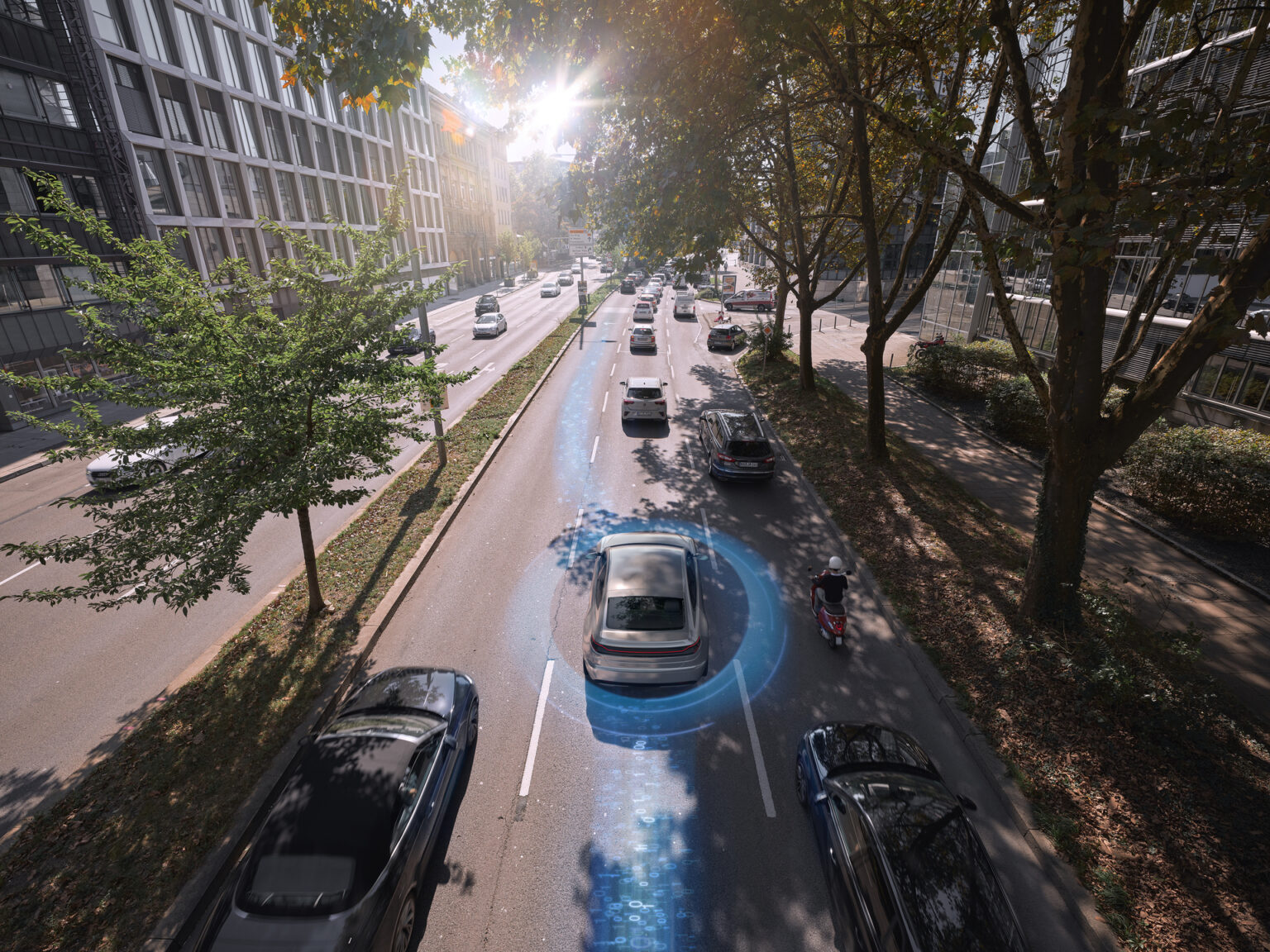
A three-year research project led by Bosch has developed new mechanisms designed to ensure connected automated driving systems remain safe even when data exchanged between vehicles and infrastructure is incomplete or uncertain.
The ConnRAD initiative—short for Connectivity & Resilience for Automated Driving Functions in Germany—brought together automotive suppliers, research institutes, universities and certification bodies to address vulnerabilities in Vehicle-to-Everything (V2X) communication networks.
Project partners include the Daimler Center for Automotive Information Technology Innovations, Fraunhofer FOKUS and IEM, Infineon Technologies, several German universities and TÜV SÜD. The effort was funded by the Federal Ministry of Research, Technology and Space.
A core outcome of the program is a trust-based communication filter that allows automated vehicles to evaluate the reliability of incoming V2X information before using it for safety-critical decisions.
The consortium said this approach prevents systems from acting on low-quality or unverified data. According to the findings, vehicles can quantify their own reliability as well as that of communication partners to determine whether the information supports a required safety function.
The project also validated its methods in urban left-turn scenarios, a complex maneuver for automated systems. Tests showed that generic intersection clearance messages were insufficient and that single radar sensors did not provide adequate confirmation.
Using both radar and lidar increased data confidence, enabling safer maneuver execution. Systems are programmed to abort turns automatically when the quality of supporting information drops below required thresholds.
Infineon Technologies contributed a hardware-based authentication method that uses inherent cellular component characteristics as immutable identifiers. The company described the signatures as unchangeable “fingerprints” that verify the origin of transmitted data. This approach shifts authentication from software layers to the physical hardware, reducing vulnerability to manipulation. Infineon said the method ensures “unique identification of transmitted information.”
In parallel, researchers at Technische Universität München developed protocols for teleoperated driving under reduced bandwidth conditions. Predictive network quality indicators allow vehicles to anticipate communication degradation and initiate countermeasures, such as adjusting driving behavior or switching to alternative information sources.
Simulations by the University of Ulm showed measurable resilience gains using probability-based trust assessments, while Fraunhofer IEM created development processes to embed resilience requirements into distributed driving function architectures. TÜV SÜD examined regulatory implications, contributing to a reference architecture designed to support regulatory approval of safety-related functions in connected automated systems.