





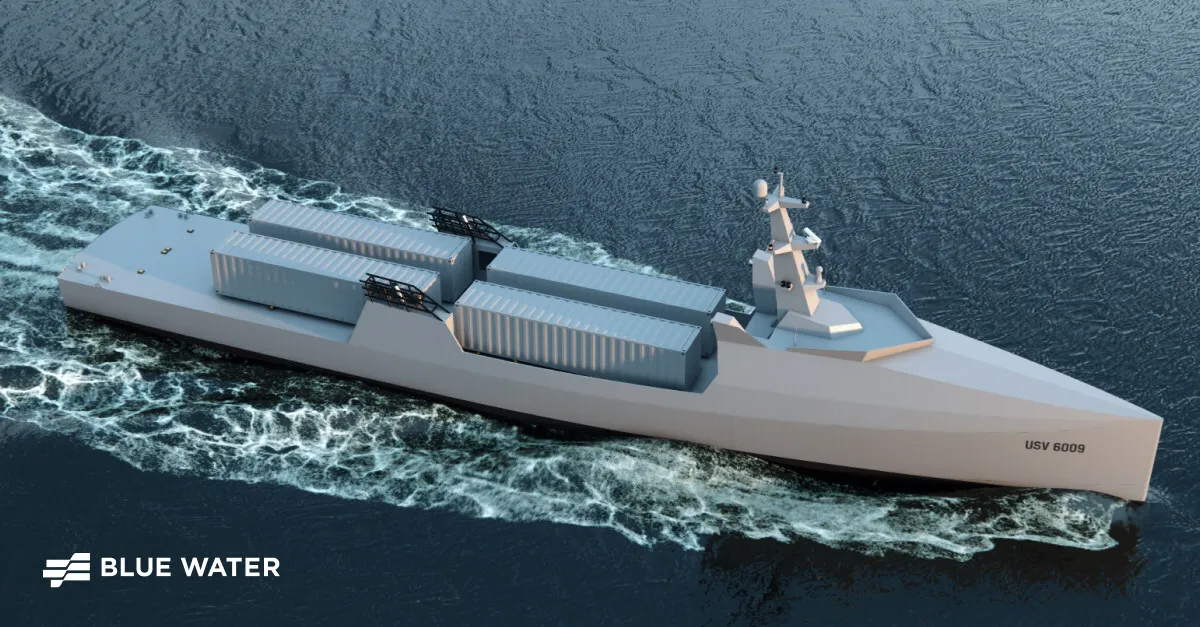
Blue Water Autonomy has introduced the Liberty Class, a 190-foot autonomous surface vessel designed for U.S. Navy deployment, as the Pentagon accelerates efforts to expand unmanned maritime capabilities.
The Boston-based technology and shipbuilding company said the steel vessel will have a range exceeding 10,000 nautical miles and payload capacity of more than 150 metric tons, enabling missions including missile launch, sensor deployment and logistics support. Construction is scheduled to begin in March 2026 at Conrad Shipyard in Louisiana, with the first ship expected to be completed later in the year under a formal acquisition program.
The Liberty Class is built on Damen’s Stan Patrol 6009 hull, featuring the company’s Axe Bow design — a vertical bow shape intended to reduce wave impact and improve seakeeping. More than 300 vessels using the Axe Bow configuration are currently in service worldwide, providing an established performance track record.
Blue Water said adopting a proven hull reduces technical risk and allows engineers to focus on redesigning internal systems for fully autonomous operation. The vessel has been reconfigured from the engine room outward, incorporating fault-tolerant propulsion and automated control systems intended to enable long-duration deployments with minimal human intervention.
Chief Executive Rylan Hamilton said the ship was designed from the outset for endurance and scalable production, noting that the company re-engineered a commercial platform to operate without a crew. Mark Honders, design and license manager at Damen, said the project demonstrates how existing commercial ship designs can be adapted for emerging unmanned missions.
The program is being developed entirely with private capital — an uncommon approach for a vessel intended for naval use — aligning with U.S. defense priorities encouraging industry to fund early-stage innovation. Blue Water worked with more than 100 suppliers, including Damen and Conrad Shipyard, which operates five facilities and employs about 1,100 workers.
Conrad said it has the capacity to support serial production, using automated panel lines, advanced welding and parallel construction techniques. Following delivery of the first vessel, Blue Water aims to produce between 10 and 20 ships annually.
Named after the mass-produced Liberty Ships of World War II, the new class is intended to support the Navy’s strategy of deploying large numbers of unmanned systems alongside traditional crewed vessels to increase fleet capacity and operational flexibility.


