



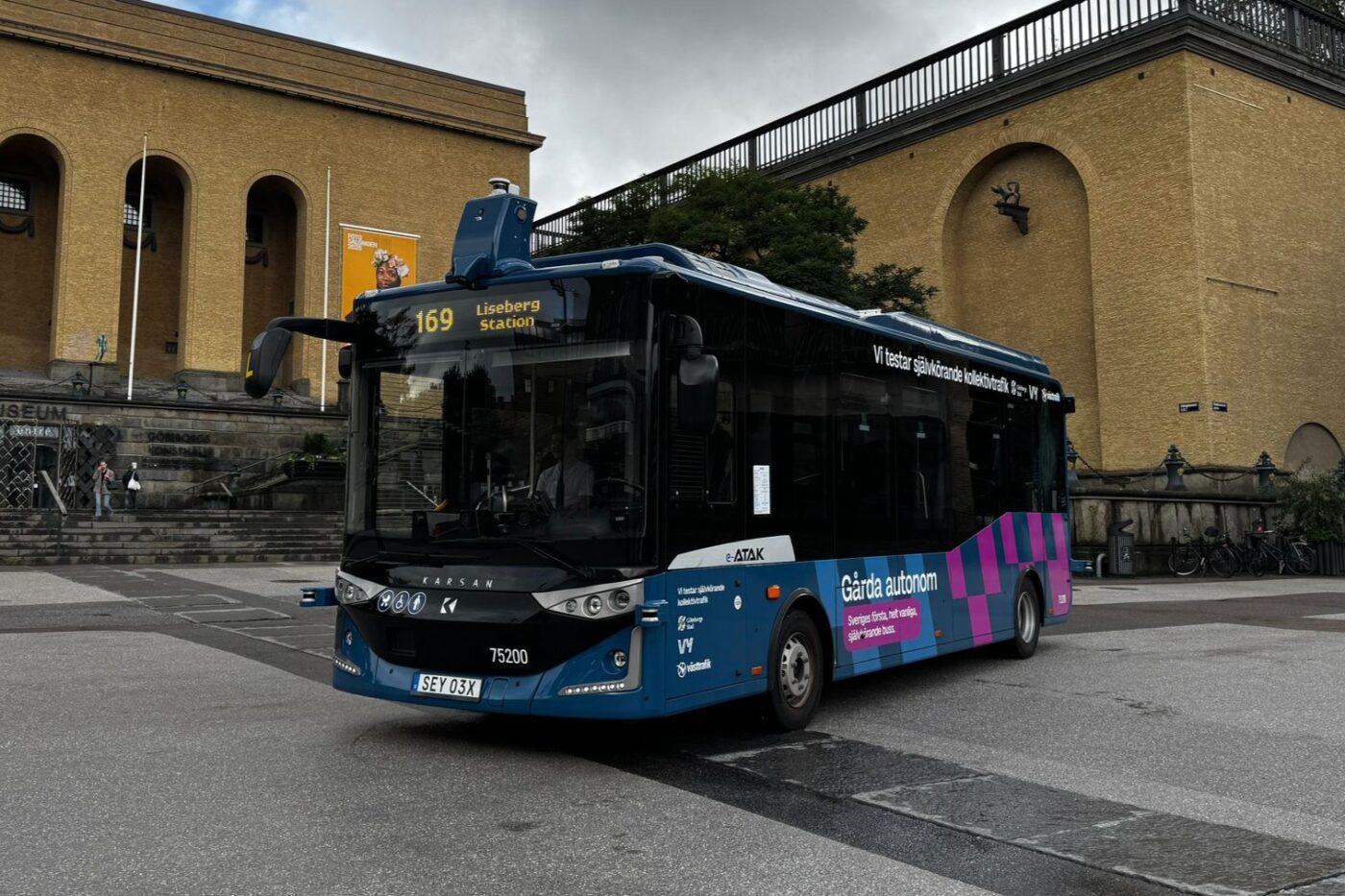
The launch of an autonomous bus service in Gothenburg was interrupted after just one hour on Monday when a self-driving electric bus operated by public transport authority Västtrafik was involved in a collision with a tram, prompting an investigation into the incident and raising questions about the future of the project.
The autonomous Karsan e-ATAK bus had been undergoing testing for several months before it was approved to carry passengers on Route 169 through Gothenburg’s Gårda district. The service began on Monday morning but was suspended shortly afterward following the collision at Kapellplatsen.
According to Västtrafik, the autonomous bus, which was operating with a safety driver on board, braked before being struck by a tram approaching from behind.
“There were no injuries, neither in the bus nor in the tram,” Patrik Chi, spokesperson for Västtrafik, said following the incident.
The collision led authorities to temporarily close the affected street in both directions. Traffic resumed approximately two hours later.
The cause of the accident has not yet been determined, and it remains unclear whether passenger operations for the autonomous bus will resume in the near term.
“It is naturally very unfortunate that this happened, and we are relieved that no one was injured. We will now conduct a thorough analysis of the incident,” Chi said.
Bus manufacturer Karsan later issued a statement disputing what it described as incomplete public interpretations of the event and said preliminary assessments indicated that the autonomous driving system operated as intended.

According to the company, the autonomous e-ATAK detected surrounding objects and followed its programmed safety protocols throughout the incident. Karsan said the tram approaching from behind did not maintain sufficient distance and subsequently collided with the bus.
“Based on initial findings, the incident appears to be a traffic-related event occurring within the flow of urban traffic, rather than an issue related to the autonomous driving system,” Karsan said in a statement.
The autonomous driving technology used in the Karsan e-ATAK was developed by technology partner Adastec. The system combines LiDAR, radar and camera sensors with localisation, perception and planning software designed to enable real-time driving decisions.
The incident could have implications beyond Sweden. An identical autonomous Karsan e-ATAK bus is currently being tested by public transport operator Üstra as part of the Albus project near Hanover, Germany. Scheduled test operations there have been cancelled for the remainder of the week, although officials have not confirmed whether the decision is directly linked to the Gothenburg collision.
The Karsan e-ATAK has also been operating in Stavanger, Norway, since 2022. Earlier this year, Norway’s road authority, Statens Vegvesen, approved the autonomous electric bus for regular passenger service within the region’s public transport network without requiring a safety driver on board.
The outcome of the Gothenburg investigation is likely to be closely watched by public transport operators and regulators evaluating the broader deployment of autonomous bus technologies across Europe.
Source: Reuters


