


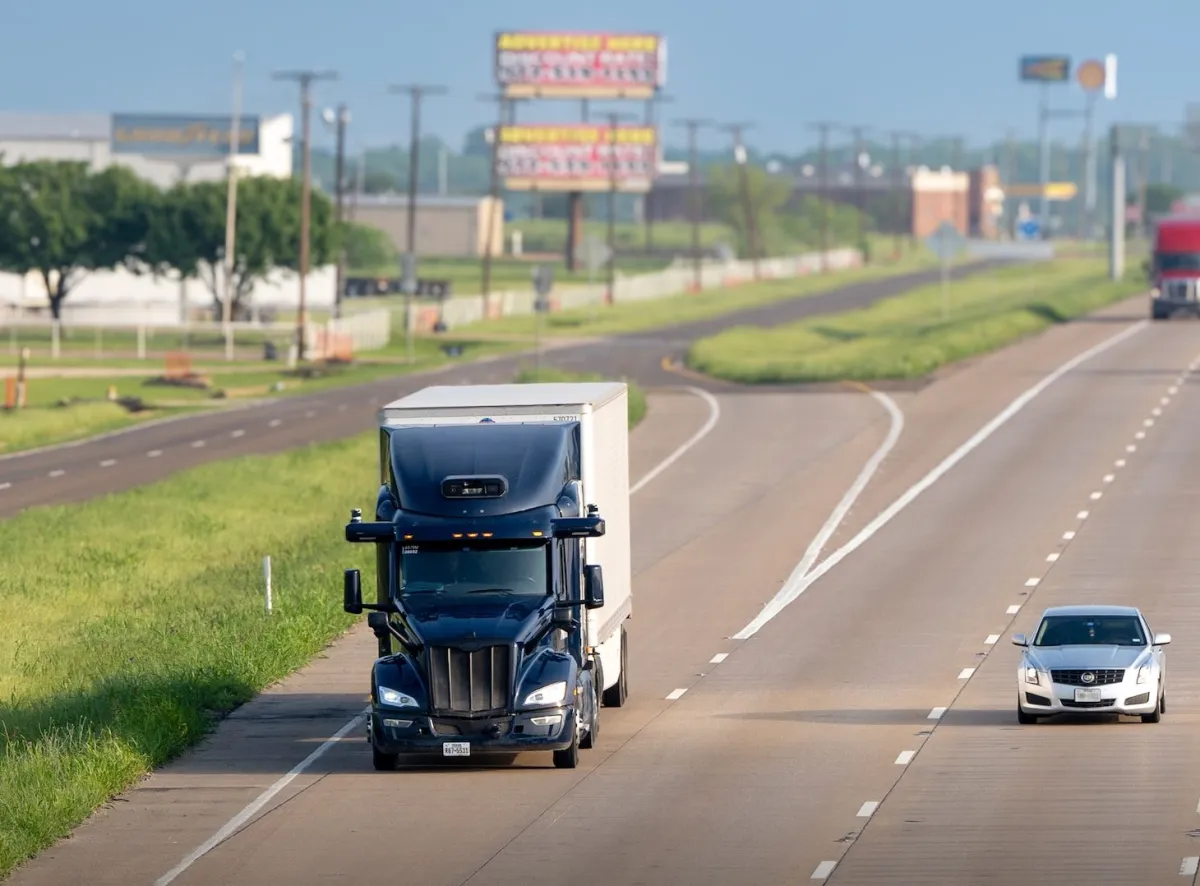
Aurora Innovation said its self-driving trucks can now haul freight nonstop over a 1,000-mile route between Fort Worth, Texas, and Phoenix, Arizona, a distance that exceeds what human drivers can legally cover without extended rest breaks.
The company said the journey takes about 15 hours using driverless trucks, compared with significantly longer travel times for human operators constrained by U.S. federal hours-of-service rules. Regulations require truck drivers to take a 30-minute break after eight hours of driving, limit driving time to 11 hours per shift and mandate a 10-hour rest period before resuming work.
Chief Executive Chris Urmson said the milestone could transform freight economics. “This represents more than a technological achievement,” Urmson said during an earnings call. “It is the dawn of a superhuman future for freight.” He added that the technology could eventually cut transit times nearly in half for customers.
Aurora’s clients include Uber Freight, Werner, FedEx and Schneider, with carriers such as Hirschbach already using the Fort Worth–Phoenix route. The company said it plans to expand operations across the southern United States, where it already runs driverless services — some with a human observer in the cab — on routes connecting major logistics hubs including Dallas, Houston, El Paso and Laredo.
The expansion marks Aurora’s transition from a research-focused developer to a commercial operator generating revenue from autonomous trucking. The company reported about $3 million in revenue for 2025, including $1 million in the fourth quarter, according to filings with the U.S. Securities and Exchange Commission. Chief Financial Officer David Maday said adjusted annual revenue, including pilot programs, reached about $4 million.
Despite the early revenue, Aurora posted a net loss of $816 million for 2025 as it scales operations, reflecting the high costs of developing and deploying autonomous systems. The company had reported no revenue in 2024.
Aurora currently operates a fleet of about 30 trucks, including 10 running without drivers, and expects to expand to more than 200 vehicles by year-end. Urmson said the fleet had accumulated roughly 250,000 driverless miles as of January 2026 with no safety incidents reported.
Later this year, Aurora plans to deploy a new batch of driverless International Motors LT trucks without a human observer on board. Existing operations using Paccar trucks continue to include a safety monitor in the cab at the manufacturer’s request.
Urmson said advances in software and hardware are enabling expansion into diverse terrain and weather conditions across the Sun Belt. “Just as the last two years brought robotaxis into the mainstream, we expect 2026 to mark the inflection point where the market recognizes that self-driving trucks have arrived and are quickly becoming a permanent fixture in our transportation landscape,” he said. “If you’re in the Sun Belt in 2026, you won’t just read about the Aurora driver. You’ll see it every day.”
Aurora said it currently operates autonomous routes in Texas, New Mexico and Arizona and plans to expand into additional states including Nevada, Oklahoma, Arkansas, Louisiana and several southeastern states.