
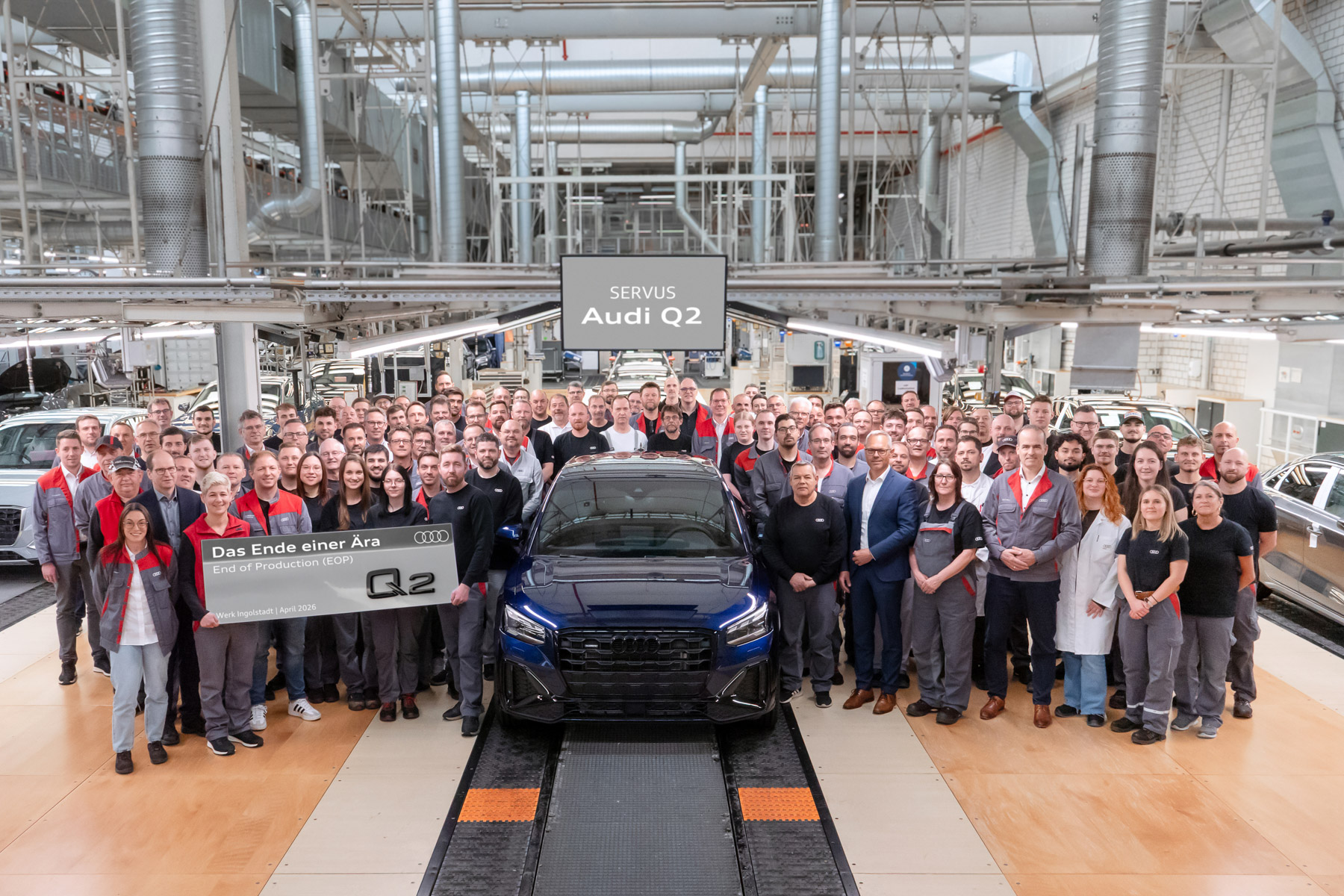
Audi has discontinued production of its smallest internal combustion engine models, the A1 and Q2, as the company accelerates its transition toward battery-electric vehicles, the automaker said.
Production of the A1, previously built at the Martorell plant operated by Seat, has come to an end after nearly 1.4 million units were produced since its launch in 2010. The model was initially manufactured in Brussels before being relocated to Spain following the conversion of the Belgian facility for electric vehicle production and its subsequent closure.
Meanwhile, the Q2 compact SUV, assembled at Audi’s headquarters in Ingolstadt, has also ceased production after reaching a total of 887,231 units. Audi described the model as a “cornerstone of the production programme” at the site since its introduction in 2016.
The discontinuation of both models reflects a broader shift within the Volkswagen Group toward electrification. The Martorell plant is preparing to produce a new generation of compact electric vehicles, including the Cupra Raval and the Volkswagen ID. Polo.
At Ingolstadt, Audi will not immediately replace the Q2 with an electric equivalent. Instead, the site will begin joint production of the Audi Q3 with Audi Hungaria in Győr starting mid-2026. Vehicle bodies produced in Győr will be transported to Ingolstadt for painting and final assembly to expand capacity for the high-demand SUV.
“The teams at the Ingolstadt plant have passionately driven the success of the Audi Q2. Working closely with Győr, we are turning a new page and will begin the integrated production of the Audi Q3 in mid-2026,” said Siegfried Schmidtner, plant manager at Ingolstadt, in a statement.
Schmidtner added that the collaboration ensures balanced capacity utilization across sites while responding to strong SUV demand. “The integrated production of the Q3 is a core element of the agreement for the future signed in March 2025 and exemplifies the flexibility of the international production network,” he said.
Audi said logistics teams in Ingolstadt and Győr established the required supply chains within a year, enabling rail transport of vehicle bodies between the two locations.
The automaker continues to produce the A3 and Q3 combustion-engine models in Ingolstadt, while advancing electrification at the site. Following the launch of the Audi Q6 e-tron in 2023 and the Audi A6 e-tron in 2024, the company plans to begin production of another all-electric model, the A2 e-tron, later this year.
“For Ingolstadt, the Audi A2 e-tron marks the next milestone on the path to electrification. I am proud that this car is being produced at our home plant,” Schmidtner said.
At Audi’s second German site in Neckarsulm, the company is nearing completion of what it describes as the largest production ramp-up in the plant’s history. The facility has updated the A5 and A6 model families and will gradually expand variants and trim levels.
Preparations are also underway at the nearby Böllinger Höfe site for a new fully electric sports model, previewed by the Concept C show car, with production scheduled to begin in 2027.