




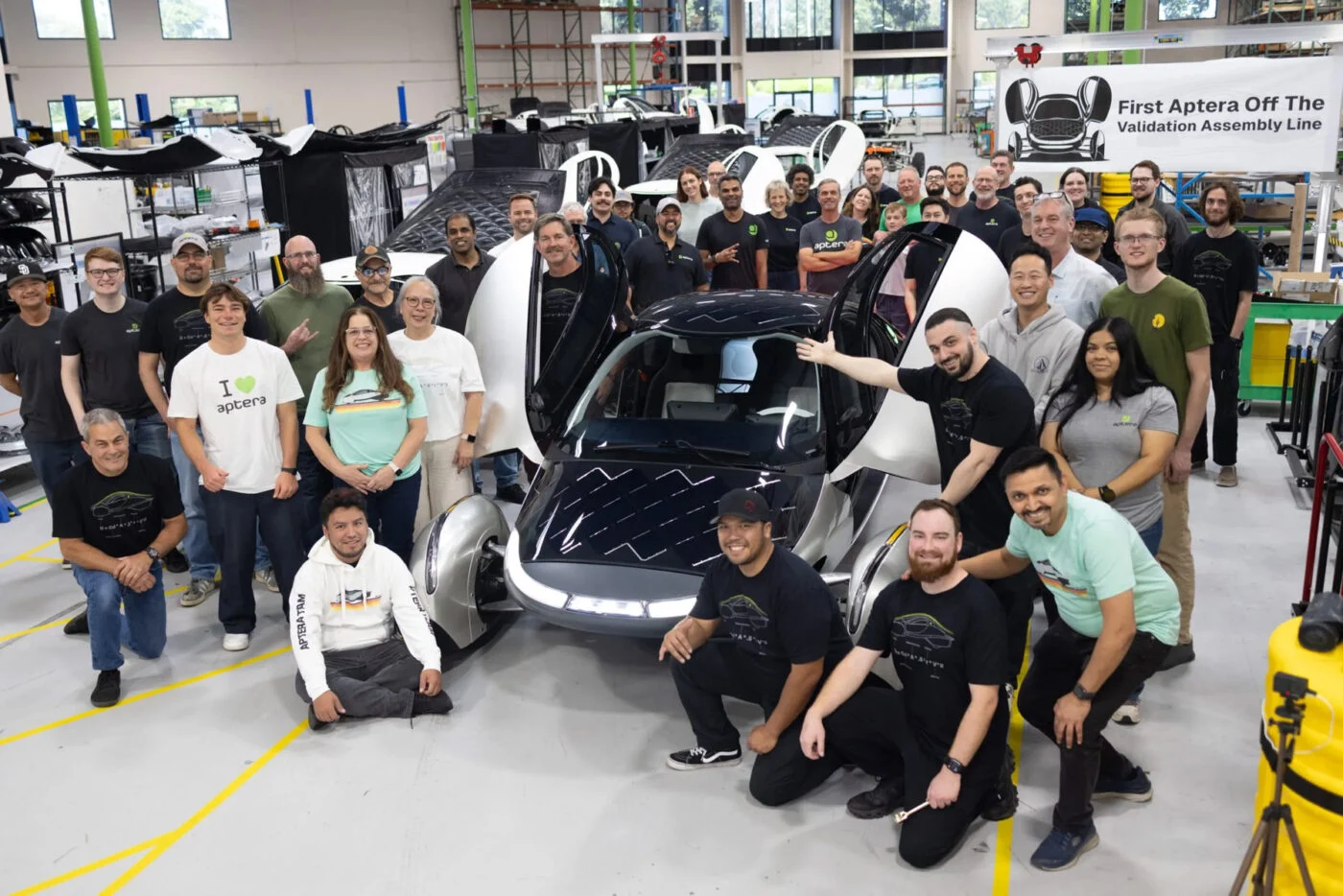
California-based solar electric vehicle developer Aptera Motors has produced the first vehicle from its validation assembly line, marking a key step toward regulatory certification and the planned start of initial customer deliveries.
The company said the milestone follows the installation and commissioning of its validation vehicle assembly line at its factory in mid-November 2025. The line is intended to allow engineers and technicians to refine manufacturing systems, tools and processes before the transition to full-scale production.
Unlike conventional vehicles built with steel bodies, Aptera’s solar EV uses a large carbon-fibre monocoque structure known as the Body-in-Carbon (BinC). The design requires specialised assembly methods, supported by a large-format precision assembly system developed specifically for the carbon-fibre structure.
According to Aptera, the new validation line marks a shift away from the more manual processes used during earlier prototype development.
“The company’s low-volume validation assembly line represents Aptera’s transition from hand-built validation vehicles to a structured assembly line process,” the company said in a statement.
The line consists of 14 specialised assembly stations where teams of technicians build the vehicles. During the validation phase, the station layout and procedures can still be adjusted to support repeatable builds and optimise processes before future production lines are established.
Vehicles produced on the line will not be delivered to customers but will instead be used for testing and certification. Planned testing includes thermal validation, brake performance evaluation and crash testing, as well as regulatory assessments such as range and energy consumption certification by the U.S. Environmental Protection Agency.
Aptera said the company’s assembly and integration department has expanded significantly, becoming its largest functional team as hiring continues across key roles.
“The completion of the first vehicle off our low-volume assembly line is a significant achievement for the entire company,” said Steve Fambro. “These first vehicles will be used to complete the key tests and optimisation required to sell our first vehicles to customers.”
The company said it has received nearly 50,000 reservations for the vehicle, representing potential revenue of more than $2 billion. However, the reservations are not binding orders and can still be cancelled.
Aptera said it will continue focusing on manufacturing readiness and testing as it works toward delivering the first vehicles to customers later this year.
The solar-electric vehicle is designed to offer a range of up to 400 miles (643 km) on battery power. Integrated solar cells are expected to provide up to 40 miles (64 km) of additional driving range per day from sunlight, with the company estimating up to 16,000 km of annual driving powered by solar energy alone in favourable climates.
To keep weight low and maximise efficiency, the vehicle is constructed primarily from carbon-fibre sheet moulding compound materials.


