


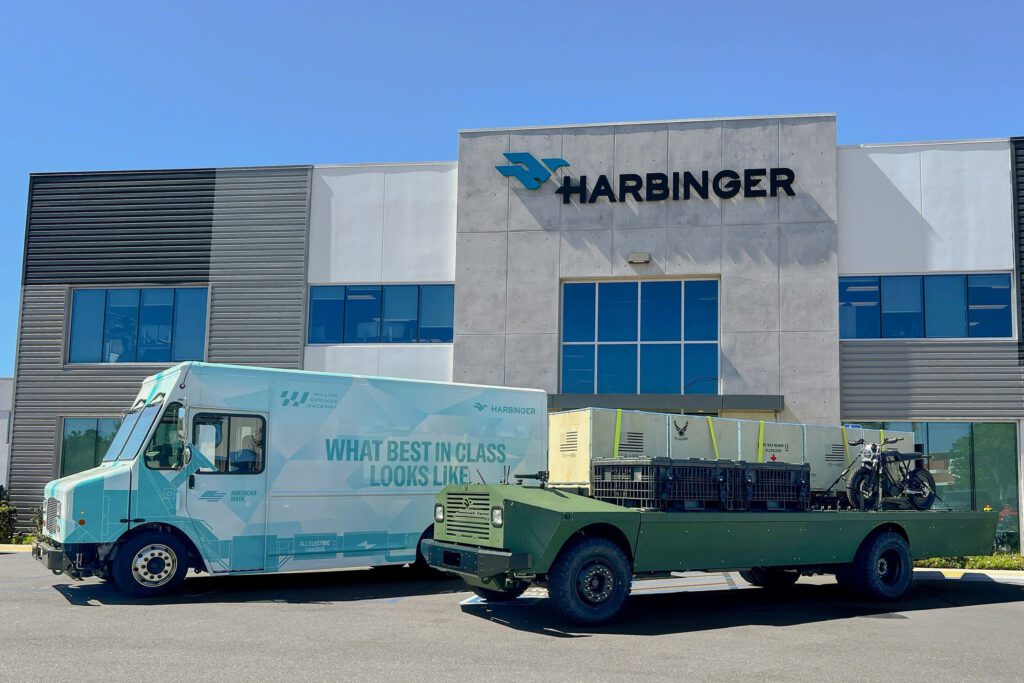
American Rheinmetall and Harbinger have formed a partnership to develop a family of uncrewed ground vehicles (UGVs) for the U.S. Department of Defense, combining Rheinmetall’s military vehicle integration expertise with Harbinger’s hybrid-electric commercial vehicle platform.
The companies said the collaboration will focus on current and future U.S. Army requirements, including autonomous tactical wheeled vehicles, contested logistics missions and manned-unmanned teaming operations.
Under the partnership, Harbinger will provide its drive-by-wire hybrid-electric chassis platform, while American Rheinmetall will contribute systems integration and defense vehicle development capabilities.
The platform features a hybrid-electric powertrain that combines an electric drivetrain with a gasoline-powered range extender. According to the companies, the configuration is designed to provide extended operating range while enabling reduced thermal and acoustic signatures during military operations.
The drive-by-wire architecture also supports autonomous vehicle applications and remote operation capabilities.
The companies said the platform is intended to support missions where lower detectability, extended endurance and autonomous operation are increasingly important operational requirements.
Matthew Warnick, Chief Executive Officer of American Rheinmetall, said affordability and scalability remain critical factors for future military robotics programs.
“Soldiers need robotics they can trust, at a cost that lets them field them in the numbers required to win,” said Matthew Warnick, Chief Executive Officer of American Rheinmetall.
Harbinger said its commercial vehicle architecture can help reduce costs while accelerating deployment of autonomous military systems.
“Partnering with American Rheinmetall, one of the most capable ground systems integrators serving the DoD, allows us to bring our autonomy-ready platform at a price point that makes true attritable mass possible,” said John Harris, Co-Founder and Chief Executive Officer of Harbinger.
The companies expect to conduct joint demonstrations of the technology later this summer.
Development efforts are expected to proceed through a combination of Commercial Solutions Openings (CSOs), Other Transaction Authority (OTA) agreements and traditional U.S. defense procurement programs.
Both companies said the vehicles will be designed, engineered and manufactured in the United States.
The partnership reflects growing interest within the defense sector in leveraging commercial electric and hybrid-electric vehicle technologies for military applications, particularly in autonomous logistics, reconnaissance and support missions.
Military organizations increasingly view hybrid-electric propulsion systems as a means of reducing fuel consumption while improving operational flexibility through lower noise levels, reduced heat signatures and onboard power generation capabilities.
The collaboration also highlights the broader trend of adapting commercial vehicle platforms for defense applications as armed forces seek to accelerate the deployment of autonomous and uncrewed systems while managing development costs.