
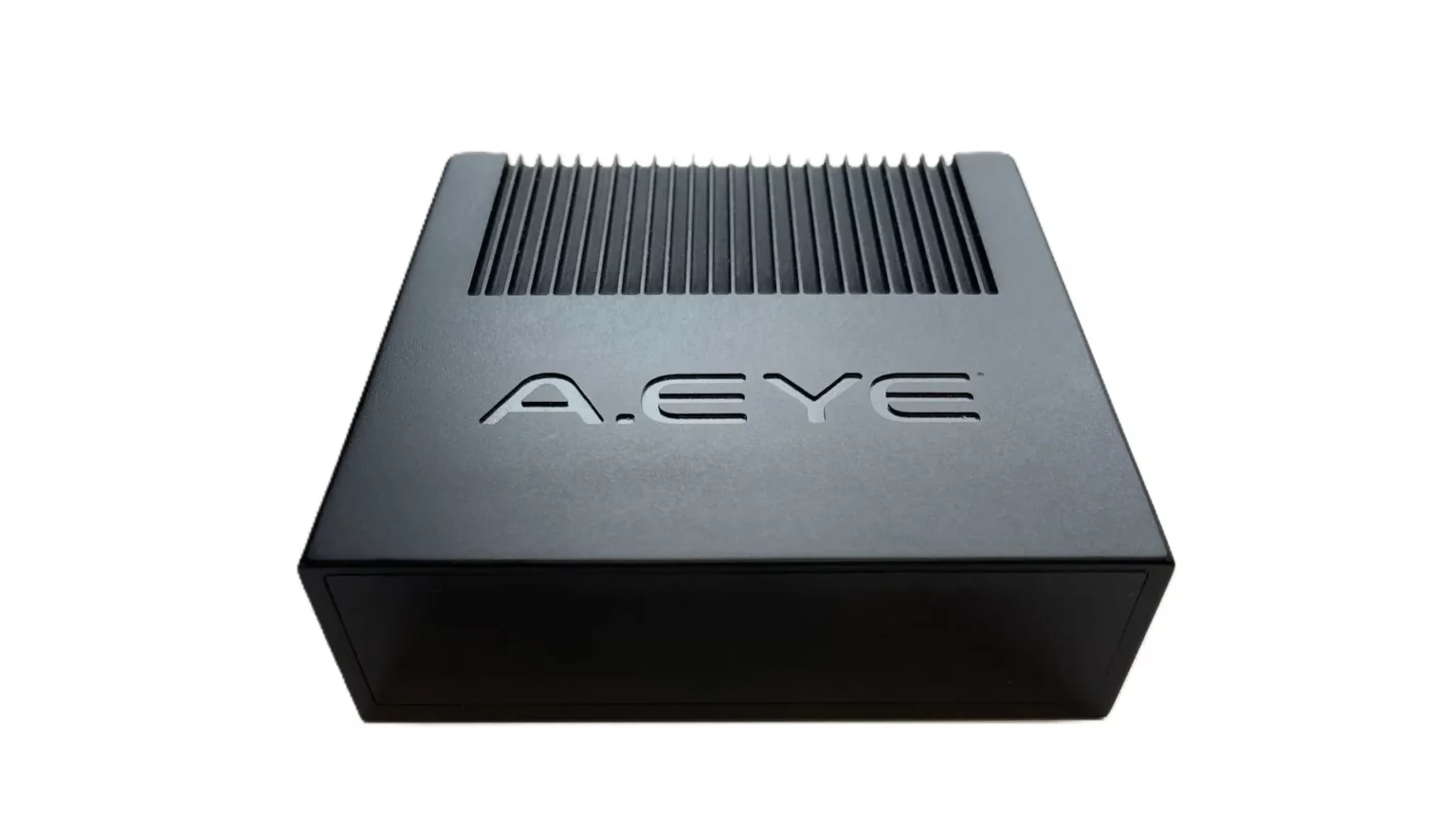
U.S.-based lidar maker AEye has unveiled Stratos, a third-generation lidar sensor capable of detecting objects at distances of up to 1.5 kilometers, as competition intensifies to deliver longer-range and higher-resolution perception systems for autonomous vehicles and other safety-critical applications.
The new sensor significantly extends AEye’s range and resolution compared with its previous Apollo model, while retaining a compact form factor roughly the size of a smartphone. The company said the design allows Stratos to be mounted behind a vehicle windshield for automotive use, while still achieving detection ranges of around 500 meters in that configuration and up to 1.5 kilometers in open-air installations.
See also: Seyond Introduces Mass-Production Solid-State LiDAR With Confirmed OEM Design Win
AEye said Stratos delivers more than twice the resolution of the Apollo sensor, enabling earlier and more accurate object recognition at long distances. Such performance is aimed at high-speed environments, where additional reaction time can improve safety margins for automated and assisted driving systems.
“Stratos represents a significant leap forward in long-range lidar capability,” said Matt Fisch, chief executive of AEye. “By extending detection out to 1.5 kilometers while maintaining precision and system efficiency in a small form factor, we’re enabling customers to detect smaller objects earlier, react sooner, and operate more safely in real-world conditions.”
See also: MediaTek and DENSO Team Up on Custom ADAS Chip for Global Automakers
The company said Stratos is built on its software-defined lidar architecture, which combines adaptive scanning with advanced optics to allocate resolution dynamically where it is most needed. AEye positions this approach as a way to balance performance, cost and scalability as lidar adoption expands.
Beyond passenger vehicles, AEye said Stratos is designed for use across multiple industries, including trucking, aviation, rail and defense, where long-range sensing and early hazard detection are critical. The extended range and compact size are intended to support applications ranging from autonomous driving to infrastructure monitoring and security.
See also: Nvidia Unveils ‘Thinking’ Autonomous Driving AI Alpamayo, to Debut on U.S. Roads With Mercedes CLA
AEye’s earlier Apollo sensor gained traction for its compact design and detection capability of up to one kilometer. The company also offers its OPTIS platform, which integrates lidar hardware with perception software to deliver real-time 3D environmental data and guidance.