
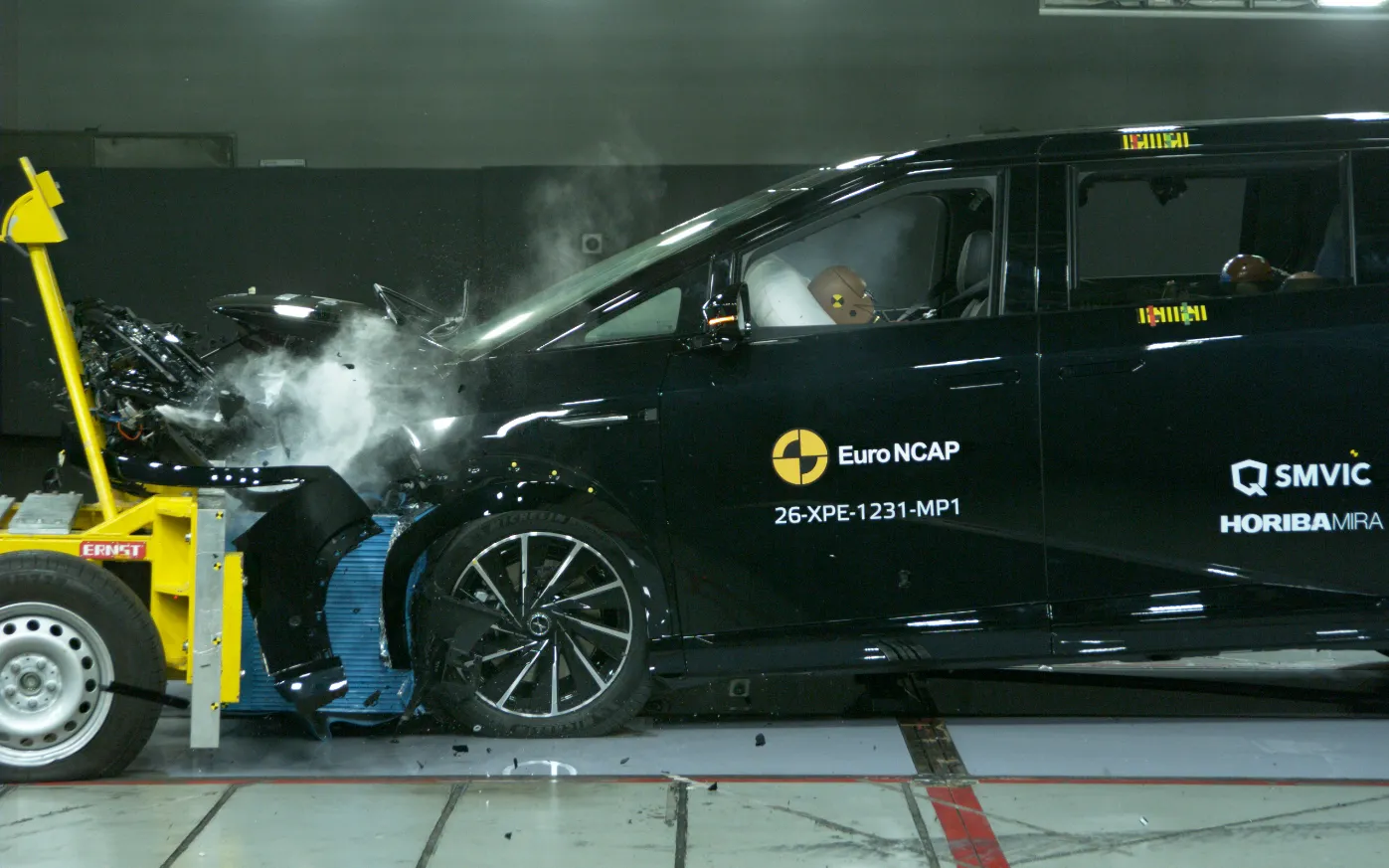
The Xpeng X9 has received a five-star safety rating from the European New Car Assessment Programme (Euro NCAP), according to an assessment published on October 12, 2026.
The electric multi-purpose vehicle (MPV) was evaluated across four categories: safe driving, crash avoidance, crash protection and post-crash safety. It scored 57% for safe driving, 82% for crash avoidance, 91% for crash protection and 91% for post-crash safety.
The assessment covers several variants of the Xpeng X9, including front-wheel-drive and all-wheel-drive versions with different battery and range configurations.
Crash Protection
The Xpeng X9 scored 91% in crash protection, with a frontal impact assessment score of 95%, a side impact score of 99% and a rear-impact score of 98%.
Euro NCAP reported that protection for adult occupants was generally good in frontal offset and full-width impact tests. The vehicle also performed well in side barrier and side pole tests, with good protection recorded across most assessed body regions.
However, the report identified areas for improvement in certain impact scenarios, including chest protection for the driver during the side pole test. It also noted limitations in the availability of some child restraint systems across seating positions.
The vehicle’s overall child occupant protection performance was assessed as part of the crash protection category, which received a score of 91%.
Crash Avoidance Systems
The Xpeng X9 achieved 82% in crash avoidance, covering its ability to detect and respond to potential collisions involving vehicles, pedestrians, cyclists and motorcyclists.
Its autonomous emergency braking systems were evaluated in multiple scenarios, including junction manoeuvres, rear-end collisions and interactions with vulnerable road users. Euro NCAP recorded varying performance across individual test scenarios, with results depending on the type of collision and road user involved.
The assessment also covered lane departure collisions, low-speed manoeuvres and cyclist dooring prevention.
The vehicle’s driver assistance equipment includes advanced emergency braking, lane-keeping assistance and blind spot monitoring.
Safe Driving Assessment
The Xpeng X9 scored 57% in the safe driving category, which examines occupant monitoring, driver engagement and vehicle assistance systems.
The report assessed seatbelt usage, rear-seat occupancy, passenger airbag status and child presence detection. The vehicle’s occupant monitoring results included 100% scores for correct belt routing and rear-seat occupancy.
Driver engagement was assessed at 55%, covering driver monitoring, distraction, impairment and driving controls. The report also examined vehicle assistance functions, including speed assistance, adaptive cruise control and steering assistance.
While the X9 recorded full scores in certain steering assistance assessments, its speed assistance performance was limited in the tested system configuration.
Post-Crash Safety
The Xpeng X9 scored 91% in post-crash safety, covering rescue information, post-crash intervention and vehicle extrication.
Euro NCAP assessed the availability of rescue sheets and rescue guides, as well as the vehicle’s advanced eCall system and hazard light activation following a collision.
The report also examined vehicle extrication measures, including energy management and occupant extrication. The X9 recorded strong results in this category, although its advanced eCall performance did not receive the maximum available score.
Rating and Model Variants
The five-star rating was published on October 12, 2026, and applies to the tested Xpeng X9 model range. The assessment lists front-wheel-drive and all-wheel-drive configurations, including Long Range Pro and Standard Range Pro versions.
The Euro NCAP results provide an independent assessment of the X9’s crash protection, collision avoidance, driver monitoring and post-crash safety systems. The scores also identify differences in performance between categories, with crash protection and post-crash safety receiving higher scores than safe driving and crash avoidance.