
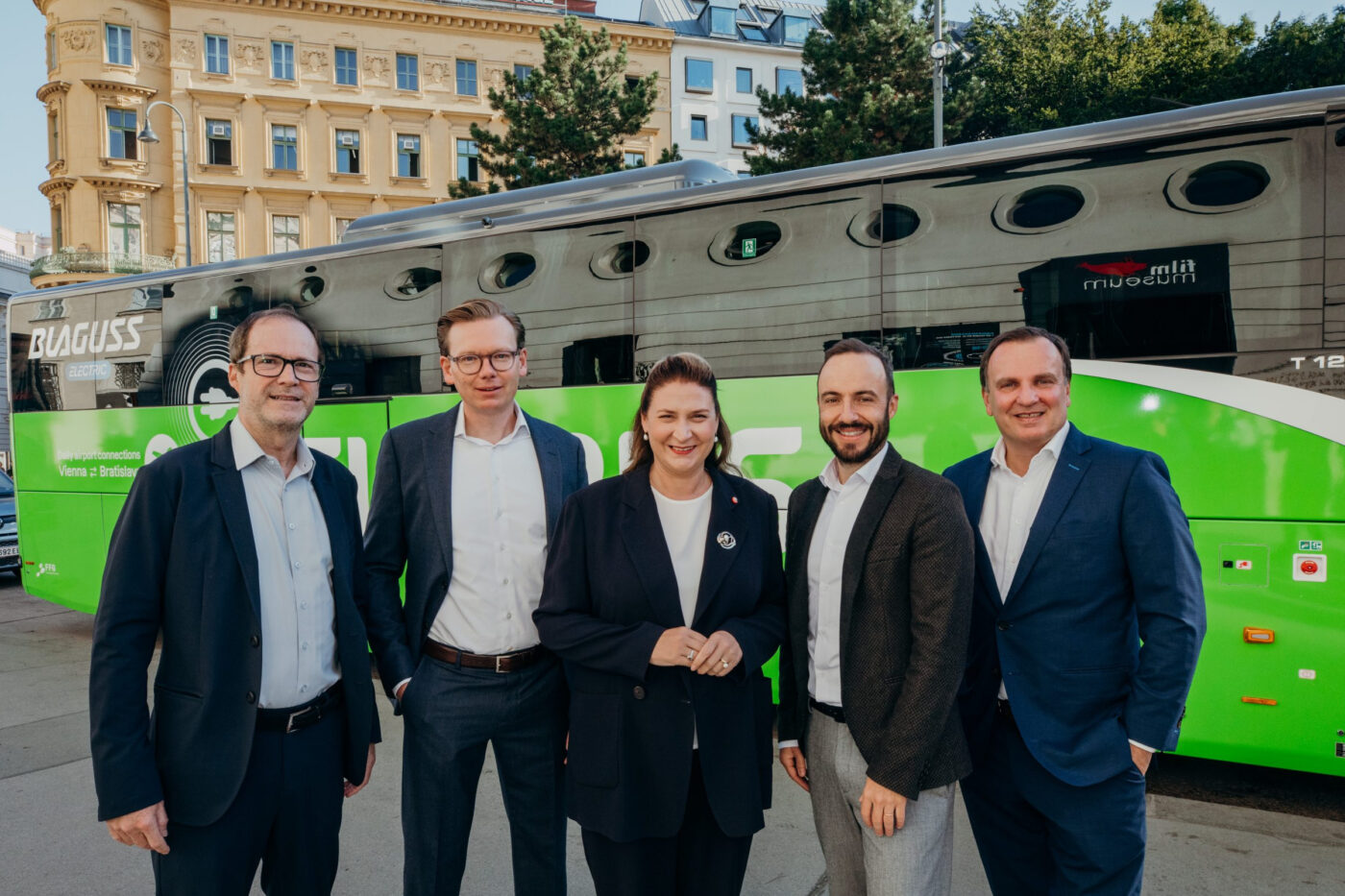
FlixBus will deploy eight battery-electric coaches on regular scheduled services between Vienna and Bratislava from October 1, marking a move from pilot projects to daily electric long-distance bus operations.
The approximately 80-kilometer route will offer 66 daily connections between the Austrian and Slovak capitals, including services connecting the two city centers with their respective airports.
Eight Yutong Electric Coaches to Serve the Route
The electric fleet will consist of eight Yutong T12E battery-electric coaches. Austrian FlixBus partner Blaguss has procured 12 vehicles of the same model, with eight assigned to the Vienna-Bratislava route.
The coaches are equipped with 466 kWh batteries and have a stated range of around 500 kilometers. The relatively short distance between Vienna and Bratislava, together with the route’s predominantly flat profile, provides conditions suitable for battery-electric operation.
The vehicles will be charged at facilities in both cities, allowing them to operate the scheduled services between the two endpoints.
Charging Infrastructure Includes Solar and Battery Storage
Charging facilities in Vienna and Bratislava will use photovoltaic systems combined with battery storage, according to FlixBus.
The company estimates that the electric operation can reduce CO₂ emissions by approximately 66 kilograms per 100 kilometers compared with equivalent diesel-powered services.
The route’s high frequency is also intended to demonstrate how electric coaches can be integrated into regular intercity operations where charging infrastructure is available at both endpoints.
FlixBus Expands Electric Coach Experience
FlixBus has previously tested battery-electric coaches in several markets.
In 2024, the company tested a Yutong GTe14 on services between London and Cambridge. Earlier pilot projects were also conducted in Portugal, Germany and the United States.
The Vienna-Bratislava operation differs from those trials because the eight electric coaches will enter regular scheduled service from the beginning rather than being deployed solely as part of a limited demonstration.
Private and Public Funding Supports Deployment
The project has been financed through private investment from Blaguss together with public funding from Austria and the European NextGenerationEU program.
FlixBus said the deployment is supported by the combination of a suitable route, strong passenger demand and the availability of charging infrastructure.
The Vienna-Bratislava corridor also illustrates the conditions required for battery-electric coaches to move into higher-frequency long-distance operations. Route distance, charging windows and the availability of sufficiently powerful charging infrastructure at endpoints remain important factors when determining where electric coaches can operate reliably.
By putting eight battery-electric coaches into daily service on a busy international route, the project provides an example of how electric coach technology can move beyond testing and into regular intercity passenger transport.