
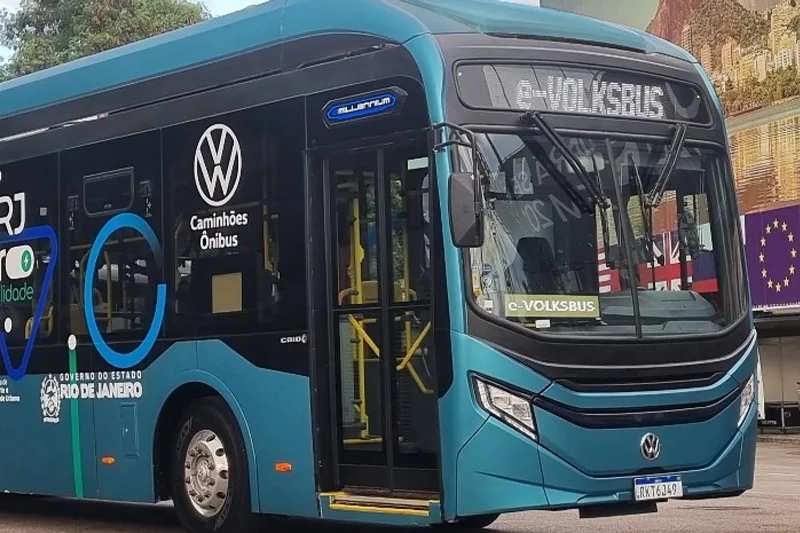
Rio de Janeiro is investing the equivalent of approximately US$98 million in 175 electric buses and a new charging depot. The vehicles are scheduled to enter the city’s public transport system in the second half of 2027 and will fully electrify bus operations at Terminal Gentileza.
According to media reports, the Brazilian metropolis has announced a project worth 509 million Brazilian reais. The funding will cover 175 battery-electric buses and associated charging infrastructure, equivalent to approximately €86 million.
BNDES Provides Majority of Project Financing
A significant portion of the financing comes from Brazilian development bank BNDES. Through its climate fund, Fundo Clima, it is providing 329 million reais, or around $63.5 million. The concessionaire will invest a further 141.2 million reais, while the city will contribute 38.8 million reais. The BNDES funds are explicitly earmarked for the procurement of the electric buses.
According to the municipality, the project represents Brazil’s first public-private partnership specifically focused on electric buses. The contract spans 16 years, comprising one year for implementation and 15 years for operation.
The private partner will be responsible for procuring some of the vehicles, installing the charging infrastructure and constructing the new depot. It will also handle the operation and maintenance of the facilities.
Rio Builds New Charging Depot in Maré
All 175 electric buses will be stationed at a new public depot in the Maré district. The site covers approximately 41,000 square metres, with around 23,000 square metres dedicated to e-bus operations.
Plans include parking and maintenance areas, administrative and storage spaces, as well as the necessary charging infrastructure. The vehicles will primarily be charged overnight at the depot.
The first electric buses are expected to enter service in the city’s transport network, Sistema RIO, from the second half of 2027. With the 175 vehicles, Rio aims to fully electrify the bus fleet operating from Terminal Gentileza.
Project Supports Broader Electrification Target
The project is being carried out under the name “Elétrico Carioca.” In parallel with electrification, Rio plans to increasingly use lower-emission biofuels for its remaining buses.
The city is also pursuing a broader electrification goal. By 2030, zero-emission vehicles are expected to account for 20% of the municipal bus fleet, equivalent to around 1,000 buses.
Brazil’s Electric Bus Market Expands
The expansion coincides with a growing electric bus market in Brazil. According to E-Bus Radar data, the country currently has 2,216 electric buses in operation, accounting for around 21% of the 10,628 e-buses in Latin America.
Domestic production is also increasing. Volkswagen Truck & Bus began delivering its Brazil-developed e-Volksbus at the end of 2025. The first batch comprises 100 vehicles, with the initial 50 units going to operator Transppass in São Paulo.
The model is produced in Resende, in the state of Rio de Janeiro. BYD also plans to expand its bus production in Brazil.
Project Expected to Cut Emissions
According to the city, the 175 electric buses could avoid around 199,400 tonnes of CO2 equivalents over the 16-year contract period. The municipali