
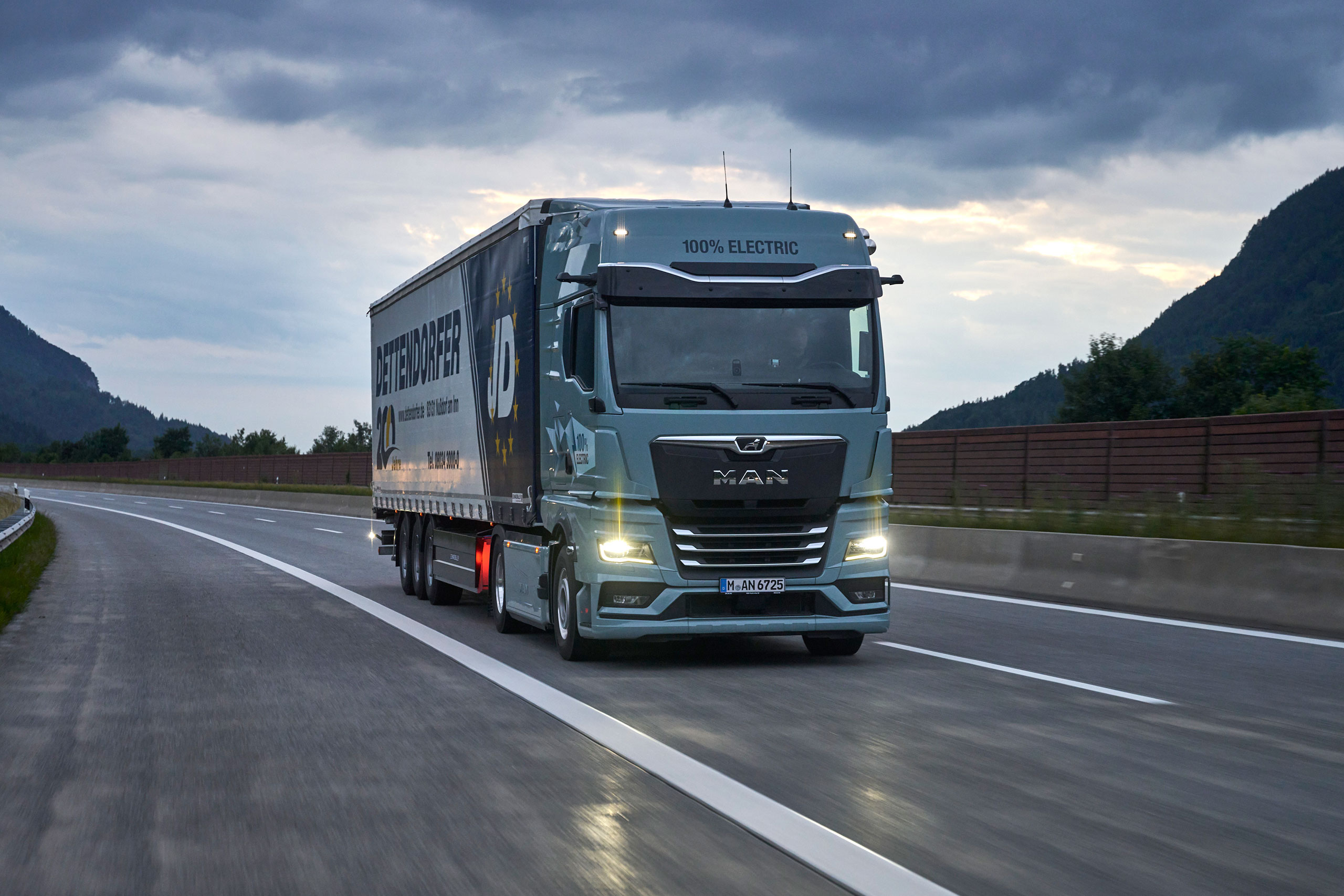
MAN Truck & Bus and Dettendorfer Energy GmbH have launched the Initiative Green Brenner, bringing together companies from the logistics, energy and infrastructure sectors to accelerate the deployment of battery-electric trucks along the Brenner freight corridor connecting Germany, Austria and Italy.
The initiative aims to support the transition to zero-emission freight transport on one of Europe’s busiest cross-border logistics routes by promoting charging infrastructure, demonstrating commercial viability and encouraging broader adoption of electric heavy-duty vehicles.
Dettendorfer Energy is a joint venture between regional utility Energie Südbayern and Dettendorfer Spedition, an Upper Bavarian logistics company operating a fleet of approximately 240 tractor units.
According to the initiative, battery-electric trucks can deliver a lower total cost of ownership than comparable diesel vehicles on the Brenner route. Based on annual mileage of 110,000 kilometres, the coalition estimates that an electric truck can achieve a 20% cost advantage over a three-year operating period.
The calculation is supported by lower energy and toll expenses. The initiative estimates that electricity costs are currently around 40% lower than diesel fuel costs, while electric trucks benefit from significantly reduced toll charges on the Austrian section of the corridor.
According to the coalition, toll costs for battery-electric trucks are approximately 80% lower than those for comparable diesel vehicles on the Austrian Brenner route.
The group also highlighted the operational advantages of electric trucks in mountainous terrain.
According to the Initiative Green Brenner, battery-electric trucks can recover up to 40% of the energy consumed during uphill driving through regenerative braking on downhill sections of the Alpine route.
The coalition argues that this recuperation capability further improves vehicle efficiency and reduces operating costs compared with conventional diesel-powered trucks.
The environmental benefits also form a key part of the initiative’s case for electrification.
The group estimates that each battery-electric truck operating on the corridor can reduce carbon dioxide emissions by up to 95 tonnes annually compared with a diesel equivalent.
Based on a scenario involving 300 electric trucks per day, annual emissions reductions could reach as much as 28,000 tonnes of CO₂.
Noise reduction was identified as another advantage, particularly in the narrow valleys surrounding the Brenner Pass.
According to the initiative, electric trucks generate 12.6 decibels less noise than diesel vehicles during acceleration from a standstill, which could help improve public acceptance of freight transport in environmentally sensitive Alpine regions.
The coalition emphasized that the project is intended to complement rail freight transport rather than compete with it.
The initiative said battery-electric trucks can provide a low-emission transport solution while construction of the Brenner Base Tunnel continues and could continue serving freight flows that are not suitable for rail transport after the tunnel becomes operational.
The Brenner corridor has become an increasingly important focus of European transport policy due to environmental concerns, growing freight volumes and restrictions on heavy-duty vehicle traffic.
Austria has introduced various measures aimed at reducing emissions and congestion on the route, making the corridor a key testing ground for alternative freight transport technologies.
For fleet operators, the economics of electric trucking on the Brenner route are influenced by a combination of policy incentives and geographic conditions. The substantial toll savings currently available to zero-emission vehicles on the Austrian section of the corridor provide a significant commercial advantage, although these benefits are linked to existing regulatory frameworks and could evolve over time.
Similarly, the energy recovery potential offered by the Alpine terrain distinguishes the Brenner corridor from flatter long-haul routes, where regenerative braking opportunities are generally more limited.
The initiative’s progress is expected to be closely monitored by transport authorities, policymakers and logistics companies as Europe seeks practical pathways to decarbonize heavy-duty freight transport while maintaining efficient cross-border trade.