
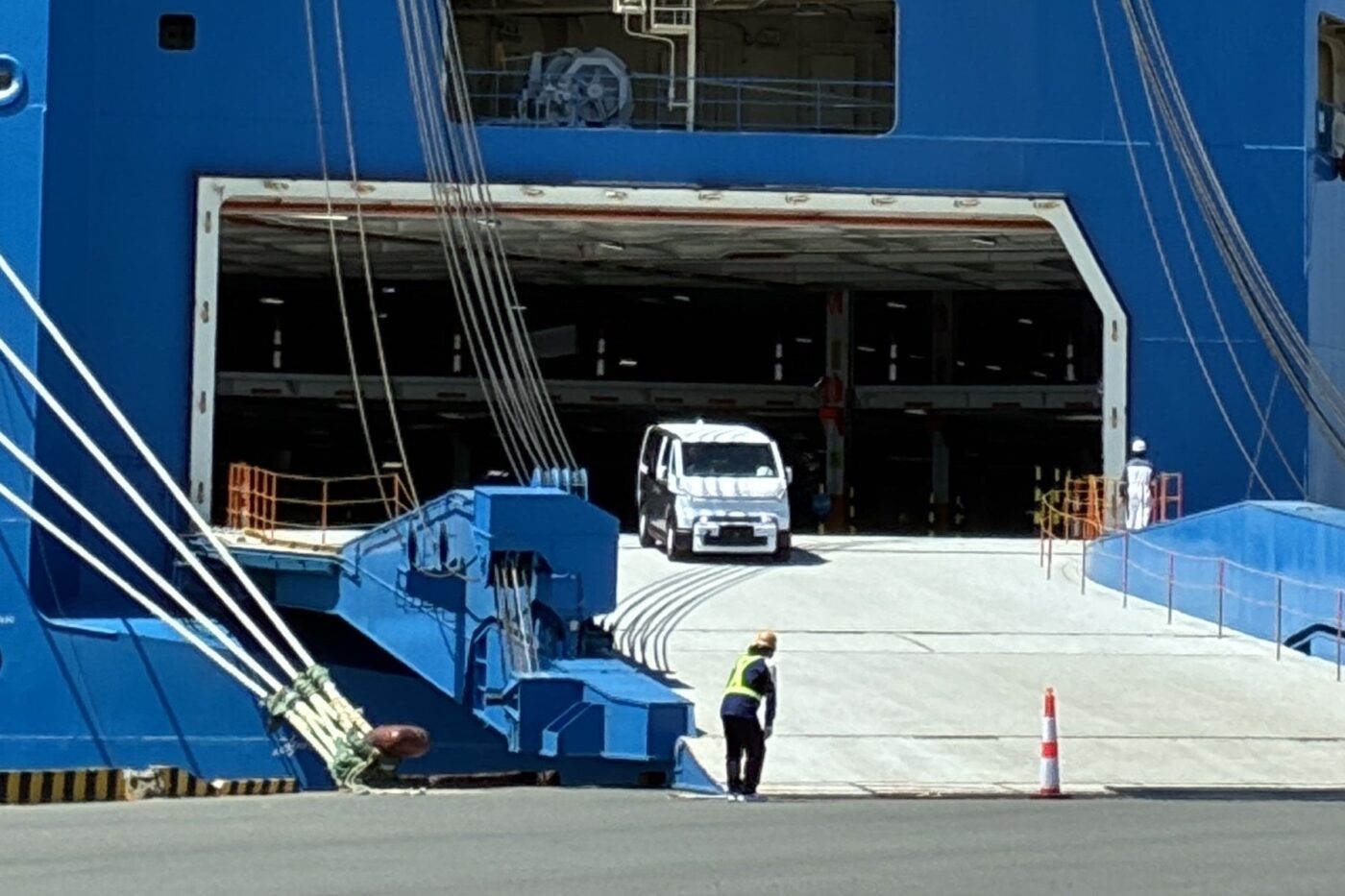
Kia has started exporting its PV5 electric van to Japan, completing another step toward the commercial launch of the company’s first purpose-built vehicle (PBV) in the country later this spring.
The first shipment of the PV5 arrived at Mikawa Port in Toyohashi, Aichi Prefecture, in April and consisted of 34 vehicles.
Kia manufactures the mid-sized electric van at its dedicated PBV production facility in Hwaseong, Gyeonggi Province, South Korea, where the company has allocated annual production capacity of 100,000 units for the model.
The automaker has appointed Sojitz Corporation as local importer and distributor through a wholly owned subsidiary named Kia PBV Japan.
The Japanese operation plans to launch both Passenger and Cargo versions of the PV5.
Kia previously displayed the two variants at the Japan Mobility Show together with a wheelchair-accessible WAV version and the Spielraum Glow cabin concept developed in cooperation with LG Electronics.
In Japan, the PV5 Passenger will initially be offered only in a standard-body configuration measuring 4.695 metres in length, 1.895 metres in width and 1.9 metres in height, with a wheelbase of 2.995 metres and seating for five occupants.
Customers will be able to choose between two electric drivetrain configurations.
The first combines an 89-kW motor producing 250 Nm of torque with a 51.5-kWh nickel-manganese-cobalt battery pack, delivering a WLTC driving range of 377 kilometres.
The higher-output version pairs a 120-kW motor with a 71.2-kWh NCM battery pack, increasing the WLTC range to 521 kilometres.
The PV5 Cargo will also initially be available only in the standard-body version.
The cargo compartment measures 2.255 metres in length, 1.565 metres in width above the wheel arches and 1.52 metres in height, while total cargo volume reaches 4,420 litres.
According to Kia, the van can accommodate two Euro pallets.
The Cargo version will be offered with three electric powertrain options.
The entry-level variant uses a 110.8-kW motor and a 43.3-kWh lithium iron phosphate battery pack.
Two additional versions use the same 51.5-kWh and 71.2-kWh NCM battery packs available in the Passenger model, paired with 89-kW and 120-kW motors respectively.
The larger battery versions provide WLTC ranges of 379 kilometres and 528 kilometres.
Maximum payload capacity is rated at 700 kg for the 51.5-kWh version and 600 kg for the 71.2-kWh configuration.
Kia’s PBV business has also shown early momentum in Europe.
Paul Philpott, managing director of Kia’s UK division, recently said demand for the PV5 had exceeded company expectations, according to Auto Express.
Since launching in late 2025, Kia has reportedly delivered around 3,750 PV5 units in the UK, including more than 1,000 passenger versions and approximately 2,750 cargo variants.
The Japanese launch marks another step in Kia’s broader strategy to expand its dedicated electric commercial vehicle business globally.