
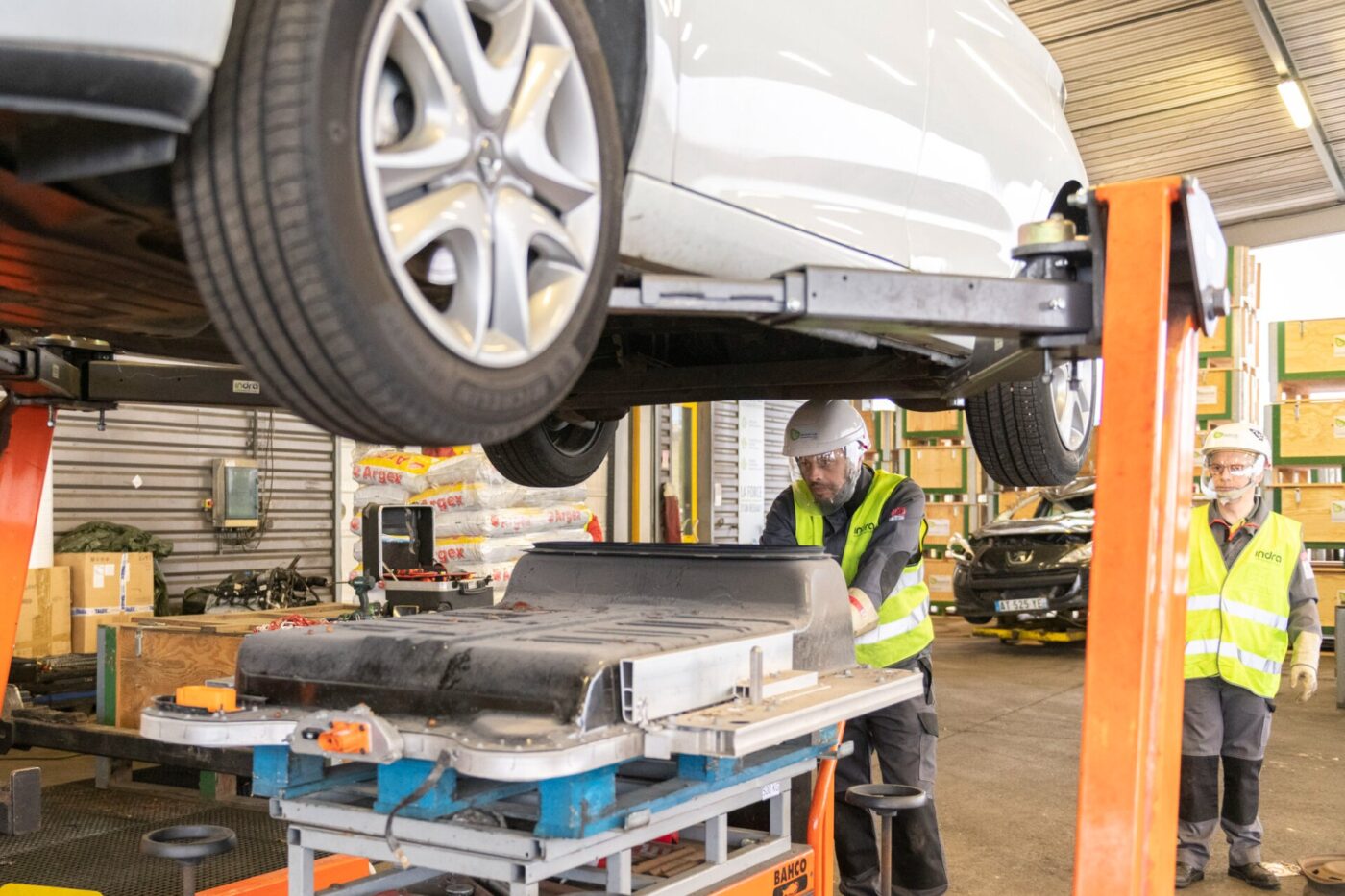
The European Union and India have launched a joint initiative worth 15.2 million euros ($16.5 million) aimed at advancing electric vehicle battery recycling technologies and establishing a pilot recycling facility in India.
The programme was announced under the EU-India Trade and Technology Council (TTC) as part of a broader collaboration on green and clean energy technologies.
See also: Global EV Battery Cell Production Rises 9.1% in First Quarter, SNE Research Says
Funding for the initiative will come from the EU’s Horizon Europe programme and India’s Ministry of Heavy Industries.
The initiative invites companies, startups, small and medium-sized enterprises, universities and research organisations from both regions to apply for project funding through a competitive tender process. Applications will remain open until Sept. 15.
According to the TTC, the programme will support the development of advanced battery recycling systems, including high-efficiency recovery of materials, digitalised collection and sorting technologies and new industrial recycling processes.
See also: Altilium Receives £18.5 Million UK Grant for Planned Battery Recycling Facility
A central component of the initiative is the creation of a pilot recycling plant in India intended to validate technologies under real operating conditions and support future industrial deployment.
The programme also aims to foster collaboration between researchers, companies and startups in Europe and India to develop scalable recycling systems for electric vehicle batteries.
Technical priorities include improving lithium and cathode-active material recovery rates, developing flexible recycling methods capable of handling multiple battery chemistries and introducing digital collection systems that can integrate informal recycling sectors safely into the supply chain.
See also: Cylib Joins German Consortium to Develop Sodium-Ion Batteries and Recycling Processes
The initiative will additionally focus on battery diagnostics for second-life applications and safety monitoring systems.
The EU and India said the programme reflects growing concerns over securing supplies of strategic raw materials such as lithium, graphite and cobalt amid rising electric vehicle demand.
The partners aim to reduce dependence on imported raw materials, particularly from China, by recovering valuable materials from used batteries and reintroducing them into battery manufacturing supply chains.
See also: Fraunhofer-Led Difference Project Targets Improved Recycling of Cell-To-Pack Batteries
“Batteries sit at the core of the green transition, with their components far too strategic to be discarded after a single use,” Hervé Delphin, EU ambassador to India, said in a statement.
“By launching this joint call, we are uniting European and Indian expertise into a single team to solve one of the most pressing challenges of our time,” Delphin added. “Our goal is to take these innovations all the way from the development phase to real-world deployment — a move that represents a direct investment in our mineral security and our shared climate goals.”
“This joint initiative marks a critical leap in India’s circular economy, establishing a beyond state-of-the-art pilot line designed to transform battery waste into a strategic resource,” Parvinder Maini, scientific secretary at the Office of the Principal Scientific Adviser to the Government of India, said in a statement.
See also: Fraunhofer Develops Electrochemical Method To Recover Battery Materials
“Through these efforts, we are poised to securing a domestic supply of critical minerals and also catalysing momentum for pioneering a digitalised, inclusive logistics model that integrates the informal sector while ensuring the highest safety standards for second-life applications,” Maini added.